Scarves are like Jesus

– Wisdom* from the life of Emily Hylden.


Scarves are the accessory that pull together/keep together/makes/completes any outfit.  Jesus is the only one who can pull us together (singly or corporately), Jesus is the only one through whom we have any hope of maintaining friendships, relationships, or marriages.  Jesus makes us–we’re unable to comfortably, honestly, confidently be who each of us is meant to be without Jesus.  In a way that no one else ever could, Jesus completes us.

*Revelation after 2 days in the woods at choir camp.  Though initially horrified when a choir camp mom mentioned my offhand comment to me on Sunday (her daughter had not only remembered it, but shared it…), its wisdom worked its way into my good graces.

Architectural Assumptions

What does the architecture of a worship space tell us about the builder’s beliefs about baptism?  –in the case of these two lovely places, it tells us a lot (I’d argue that any religious space will tell you a lot theologically, but that’s for another day).

St. Francis Chapel – Kanuga, North Carolina

20130808-181039.jpg

This humble little outdoor chapel almost made me cry when I came upon it early one morning.  Do you see the bridges leading over the creek from the congregational area to the altar?  One literally goes through water to arrive at the Eucharistic table.  We first experience baptism, the washing of our bodies that signifies the washing to which we submit our souls through Jesus’ sacrifice.  We then may approach the altar where we are fed, spiritually and in other ways, by Jesus’ sacrifice.  It’s really all about Jesus’ work–hence the cross you see over the altar.

…and another bit of architectural theology, from Minnesota (and the Roman Catholic Church).

Church of the Holy Spirit in St. Cloud, the parish from which my great-grandma was buried this May, has had a significant impact on my understanding of liturgical theology (half is this, explained here, and the other half will wait for another time).

20130808-181340.jpg

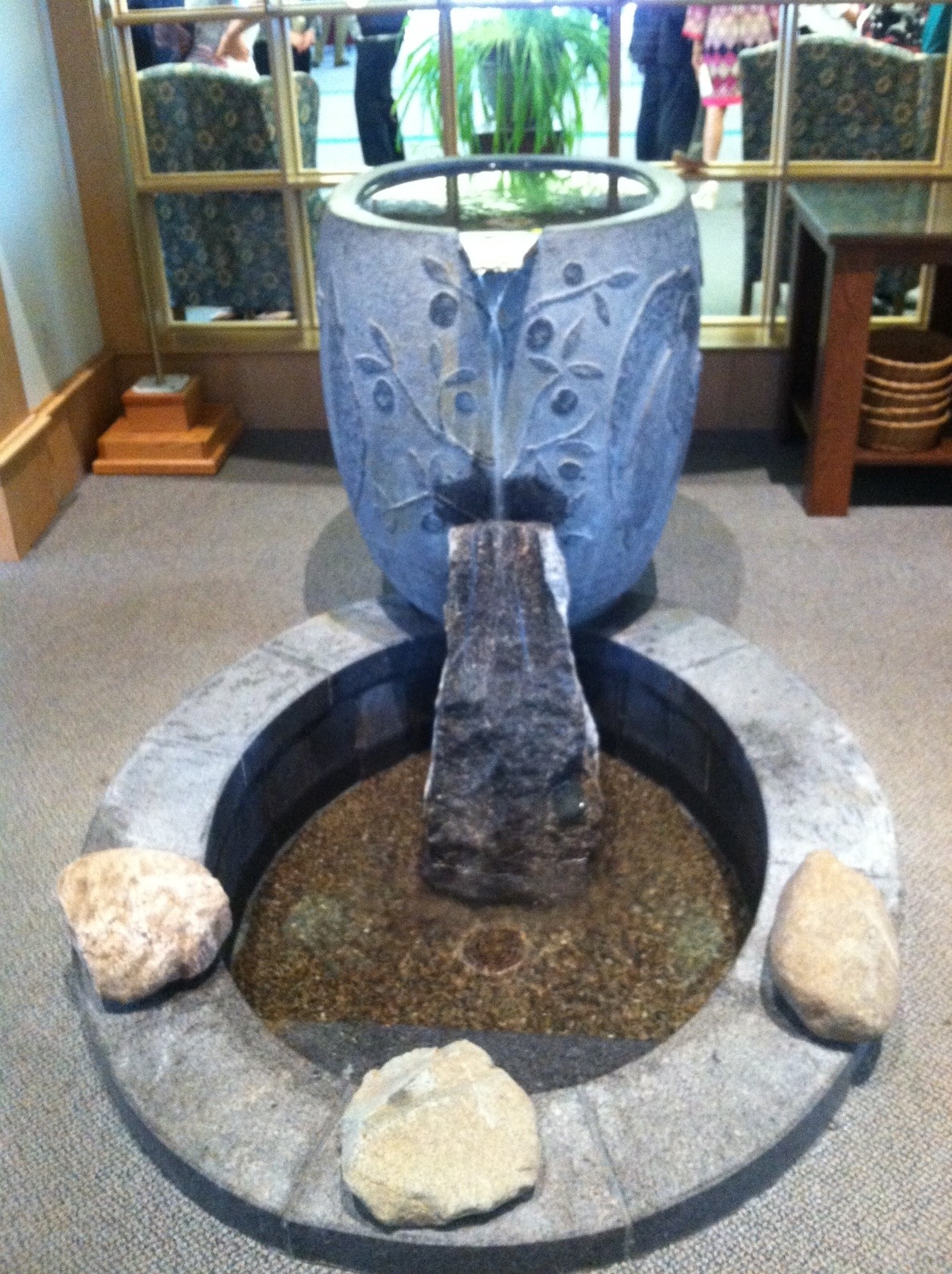
This is their baptismal font.  Do you see how it’s clearly meant to be used by adults as well as babies?  This piece of furniture will make the baptizan wet.  They will be drenched, if they kneel on the rock underneath the water flow.  It’s at least better than a sprinkle, and more significant still that this parish built its object used for the entrance rite into Christian life to be used by both infants and grown ups.  What kind of assumptions have Christians made in the past when baptismal fonts became little marble bowls?

Road Rage

On Monday, I was driving toward downtown midday.  Traffic was slow as the four-lane road came to a major intersection; knowing I could turn right (and maybe avoid a bit of the bottleneck?) at the next intersection, I swiftly flicked on my signal, checked for cars in the next lane, and moved to the outside lane (it should be said, it was sunny, the sunroof was open, and i was listening to country music–Monday is my day off, so imagine it says “on Saturday…” not “Monday”).

Suddenly: HHOOONNNKKKK!!!!!  A very loud, very very long car horn was clearly very angry that I’d changed lanes in almost-stopped traffic.

Much more disappointed (that I’d finally “met” a mean person in South Carolina–I’d begun to think they didn’t let unkind people in at the border) than mad, I cast a glance to my left when I turned right at the intersection (as much to make sure there wasn’t any traffic as to see who’d honked so angrily), and a mom (or, a woman with a full child’s seat in the back of the car), holding a half-eaten apple gestured at me with her free finger, glaring.

My eyes went wide, but my shock was less over her reaction, which was bewildering enough!, and more over what her apparent anger had done to her face.  Her contorted visage was just plain ugly (not to say by any means that I imagine she was ugly when smiling, or generally!).  (Unrighteous) Anger makes a person ugly.

Over the last week, when I feel reaction and frustration and anger bubbling up inside me, I remember this woman’s face; knowing that if I allow the reactive, unrighteous anger to control me, my insides (and my outsides!) will be just as ugly has her face at that moment–and may have even longer-lasting effects.

Psalm 102

“a prayer of one afflicted, when faint and pleading before the Lord.” (prescript NRSV)

Psalms offer words for us to pray when we have none. They offer language for us to use when we’re not quite sure what to say, and are perhaps feeling empty or exhausted (or jubilant! or overflowing!). Psalm 102 offers a narrative: the first half describes in painful, vivid detail the condition of the supplicant, “my bones burn” (v. 3), “I lie awake. I am like a lonely bird on the housetop” (v.7), “I… mingle tears with my drink” (v.9). The last few verses move toward hope–recognizing that God remains no matter what circumstances may prevail in the life of the author (or pray-er) and their environment. Not only does God remain no matter what, but he promises rescue, redemption, resurrection, and blessing.

Jerusalem and Zion loom large in this psalm (“You will rise up and have compassion on Zion” v. 13; “For the LORD will build up Zion” v.16; v. 21); how do they reveal what God promises and what he’s doing? Jerusalem and Zion are the Promised Land–even when God’s people are in exile and diaspora, these places are held up as the site to which we will one day return. They are sort of like Heaven–they’re the place at the end of time where all things will be put in order again. So this psalm has a very long view–waiting for God to bring restoration to His people; they wait for peace and for the rebuilding of their true home.

There are sometimes geographical places, and chronological moments in time in our lives that give us a little taste or feeling of what this kind of togetherness and homeyness might be like. For me, that place is Durham, North Carolina.

20130703-120901.jpg

I went there this past week to witness a friend’s ordination (see yesterday’s post), and while I was there, I drove around in circles to visit all my dear old familiar places. I drove around to see and be in the midst of everyday places–not even “dear old” ones, but that one stoplight that takes 2 minutes to turn (I’ve timed it with eager soccer & ballet class attendees in my backseat), and that stretch of road I’ve driven thousands of times to get downtown or to get to the mall. I remember thinking to myself, “man, these lucky trees! they LIVE here their whole lives!” (how silly I get, driving down the highway…)

One of the verses of Psalm 102 spoke deeply to me on my visit. In the NRSV, it goes, “for your servants hold (Zion’)s stones dear, and have pity on its dust.” (v.14) The 1979 Book of Common Prayer renders it, “for your servants love her very rubble.” The BCP version alludes to the destructed state of the Promised Land, but both get at the feeling that even the dirt and the bricks and the trees of a place might bring one to awe and silence at their precious place in your life.

What places or experiences have felt to you like a “thin spot” or a glimpse or fleeting feeling of Heaven and Home?

pouring yourself out

This morning, we threw away a carton full of raspberries.  They were big and juicy and red and just the right amount of tart (a week ago).  I was saving them for something special.  I never did discover what the special thing was, and while I was working hard to save them–seeing them taunting me on the refrigerator shelf every morning–they grew moldy.  All my difficult work, saving them up for something special instead of enjoying them NOW, ended up to be for naught.  My effort to enjoy them later ended up meaning that I never got to enjoy them–though I’m sure the mold spores enjoyed the berries very much.

Reflecting on moments and phases of life when I’ve been more generous with my time and energy, I know that those are the times I’ve been most happy.  Then, more often than my generous moments, I get grabby with my time.  I want to protect my moments and hours, to save them up for something.  But why am I saving this precious time?  Where is it all going?  It goes into watching netflix and lolling around the house, into using up the energy on my wandering, worrying mind–which is not fun at all.

It’s like on high school track team, when our coach, Mr. Barney, told us to leave it all on the track at the end of a race.  Why else had we trained our muscles for weeks and eaten carefully for days and stored up our energy that morning?  I remember always being afraid that I would leave too much on the track–that my strength would give out before the end and I would just fall over, or that I’d just stop, or… whatever it is that happens when you really get to the end of your physical rope (can you tell I never really quite got there?).  Because of course a 16-year-old who’s in decent shape should be worried about falling over after running half a mile (see “worrying mind” above).

Let’s worry less and leave more of ourselves in the moments of our lives.