
Revelation 7:9-17 + Matthew 5:1-12
Sitting down to write this sermon was the first time I’d spent any time at my desk since the first week of October. My monthly desk-blotter calendar was still showing “October” as I spread out my Bible and print outs. And I just couldn’t start writing. I texted Jordan, I texted Jillian, another friend who is also preaching this week called me and we talked. I even started a load of towels to strip in the bathtub.
When I came back to my desk, I looked again at the calendar. As y’all may know, I spent a week of October, fully 7 days, in the hospital at Women’s and Children’s with Jacob who was battling RSV. He was baptized last year on All Saints Sunday, and as I’ve grown, I’ve found that our lives and experiences and feelings are cyclical. Is there a time of year that always feels heavier to you? Is there a season that brings up twinges or tickling in your chest, a joy or sentimental nostalgia? Sometimes I’ll even find on specific days that my body feels more achy or I have a headache that I can’t shake, and then I’ll realize that on that day 10 years ago my grandpa died or I graduated from college, or some other big event, happy or sad, took place and I hadn’t really recalled it, but some part of my body, my being, knew it was happening, and was even remembering the impact of that event on my life while my brain forgot it.
I love that God made our selves so complex and so memorable that pieces of us will be sensitive to God’s movement even when our minds are oblivious.
And so as I sat down to write this sermon, I realized, staring at that calendar, that my body and spirit needed a little acknowledgement of what had transpired in our family in the last month. So I got a pen, and I drew an arrow through the seven days that Jacob and I spent in a tiny room, hooked up to oxygen. I wrote, “Hospital” “Jacob in the Hospital” under the arrow, and then I just looked at the paper. I took a few deep breaths, I told myself “that was a big chunk of the month.” “That really broke up October.” “You didn’t think that would happen again this year.”
And after a few more breaths – I love to think of breathing as a way to acknowledge the Holy Spirit, in both Hebrew and Greek the original languages of the Bible, the words used to name the Holy Spirit “ru’ah” and “pneuma” are words for breath, for breathing. After a few breaths, I rolled my shoulders, tore off the “October” page, and set down to read and write again. I felt better. It’s a way I was able to feel the bigness of what October had meant for our family, a way to give space for and honor the grief and fear and powerlessness and restlessness of that month. And then, a way to let it go.
Y’all will know from your own experiences and your own lives, it’s not over, the feelings and grief of our hospital stay and of our child’s illness will come up again in some other way, spurred by something else, and it’ll be my work then to listen again, slow down and welcome the stirrings that pull at me.
I tell you all this because we find echoes in today’s Scriptures, too, and we will each hear ripples that might slosh at us sideways in the liturgy today, maybe in the names prayed for and listed in our bulletins, maybe in the memories of baptisms-past, maybe in the way the light angles through the windows at this time of year. And I pray, my precious brothers and sisters, that when these stirrings pop up, whether they bring waves of joy or grief or headache or achiness or ease, that just as you welcome visitors into your home, you will welcome these movements of the Holy Spirit, that you will ask them to sit down and stay awhile, that you’ll have the courage to sit and listen and learn from these visitors that the Holy Spirit has sent to you. With that in mind, let’s turn to the readings for today.
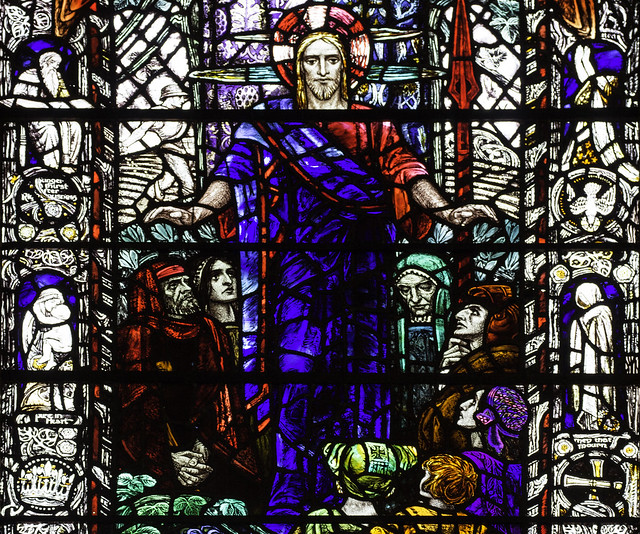
“After this I, John, looked, and there was a great multitude that no one could count, from every nation, from all tribes and peoples and languages, standing before the throne and before the Lamb, robed in white, with palm branches in their hands. They cried out in a loud voice, saying,
“Salvation belongs to our God who is seated on the throne, and to the Lamb!” And all the angels stood around the throne and around the elders and the four living creatures, and they fell on their faces before the throne and worshiped God.”
I hear an echo from Babel here. Do you remember that story? Way back in Genesis, before Abraham, before Moses and all the prophets, God saw that people were putting themselves up as idols, as the center of the universe, and he made different languages and scattered the people to protect them from themselves. Of course a consequence of that has been our division and strife against each other tribe since. But here in Revelation, at the end of time, we read that it won’t be that way anymore. That people from every nation all tribes and peoples and languages will be gathered and oriented toward the real king, the true center of the universe, of all creation, which is God, and the Lamb, Jesus. This echo of grief, of division that’s written in our bones as humans, that longs for connection instead of misunderstanding and isolation, will be put right, will be overcome, only by God and through his grace.
Later in that same passage, somebody tells John, the writer who is relaying this vision:
“For this reason they are before the throne of God,
and worship him day and night within his temple,
and the one who is seated on the throne will shelter them.
They will hunger no more, and thirst no more;
the sun will not strike them,
nor any scorching heat;
for the Lamb at the center of the throne will be their shepherd,
and he will guide them to springs of the water of life,
and God will wipe away every tear from their eyes.”
Do you recognize that? Did those words stir in you? We hear here prophecies from Isaiah and from the Psalms. You may remember from Isaiah 4 the lines about being sheltered by the one on the throne; you may recall from Psalms 49 and 121 the promises that no one will hunger or thirst anymore; you may hear the echo from Isaiah 25 the vow that God will wipe away every tear from every eye. I wonder if you’ve had moments, or glimmers of these truths in your own life, a sort of little promise or little fulfillment of God’s goodness and grace as we still await God’s big overhaul of evil’s eradication from existence.
Leaving the hospital surely felt like a little fulfillment, lying in my bed that night with all my boys under the same roof surely felt like a small grace and a moment to cherish and note and welcome into my house and listen to. *take a breath* Do you have those, too?
Then as we move to the Gospel lesson for today, those ladies in the Luke Bible study will have heard big echoes everywhere in these 12 verses. These passages are shared almost verbatim in Luke as here in Matthew, with a few notable adjustments. Y’all don’t have to be part of the Bible study for them to be familiar words, and maybe you remember another sermon you’ve heard on these words. Maybe you recall your momma quoting them as she instructed your behavior as a child. Maybe you feel unsettled, wondering what persecution for righteousness’ sake might require of you.
God, in inspiring the composition of Scripture, intends for these echoes to poke at us, to reveal himself to us ever more deeply, to resonate on both deep intellectual levels and on levels in us that are too deep and hidden for words at all. Do you know that verse from Romans, about prayer and the Holy Spirit? “Likewise, the Spirit, helps us in our weakness. For we do not know what to pray for as we ought, but the Spirit himself intercedes for us with sighs too deep for words.”
When our sighings are too deep for words, when our grief or echoes of love are too strong for us to stay standing, when our joy is too mighty to keep from splitting into a smile, may God the Holy Spirit help us in our weakness, in our fear or freeze in the face of such power so near us. May God the Holy Spirit intercede for us, drawing us along with him in prayer as we offer these echoes of holy stirrings back to God himself. May God give us courage to sit still with the memories that he offers us, may God be present with us – just as he promises he always will be through the cross – as we seek to learn what it is that God reveals to us about himself in our hearts, in our families, in our communities, and in our world. Amen.

 hope of things not seen