The holiest half-hour of my week, when the profundities of God rain down into my head, is when I’m hoping to administer communion to God’s people at the altar rail. This week, a middle-aged woman faltered up to the rail; I could tell, though she didn’t look injured, that it was a feat for her to get herself to the rail – she gladly expended significant effort to come and receive life-giving bread.
I began to pray as I pronounced to each person, “the body of Christ, the bread of Heaven.” I prayed for what these dear, faithful people faced in order to get themselves and their loved ones to Jesus’ altar, to his living Body and Blood.
A sister congregation lost two whole families in a plane crash last weekend; well-publicized – and many more not-well-publicized – court case verdicts came in; someone left a marriage or a home; someone got very bad medical news.
Years ago, friend of mine posted quotation that (in my better moments) I try to keep in mind, “Be gentle with everyone, for you do not know what load they are carrying.”
Our sufferings in this life are many, but our medicine is the same – God’s love through Christ’s broken body.
Category Archives: healing
God Keeps His Promises (full stop).
A homily on Genesis 16:1-16
Sarai’s getting old. She’s getting worried. God has just made a promise to Abram, but there’s got to be some kind of work-around. In chapter 15 of Genesis, God makes a covenant, promising that Abram’s descendants will be as numerous as the stars in the sky. As chapter 16 opens, Sarai seems to realize that there’s no way that she herself is going to be able to produce an heir, and she’s trying to help God save face. She wants to save God the embarrassment if it turns out he can’t make good on his promise due to obvious biological restrictions.
I often try to hedge my bets with God. I pray safe, small, could-just-be-coincidence prayers. I dutifully go about my day at “medium”–not stepping out too far in faith, lest I get embarrassed because I wasn’t listening to God, or lest God get embarrassed because I’m trusting him too much.
The Bible is full of examples of people–the history of the church is full of examples!–who want to help God along, to provide needed assistance in his great plan, or to let him out of his promises altogether.
Indeed, God does call us to action, to trust, and faith, and personal relationship. But we aren’t to make God out to be a child–he isn’t in need of our help to figure out how to make his plans real or help clean up messes. We are the children. We are the ones who can never quite understand the whole picture. God does not need us to excuse him from his promises, he desires our trust that his promises are the only thing upon which we can depend.
God desires our obedience. We don’t have to worry about how to get somewhere or how to make God’s dream come true. God is big enough to keep the promises he makes, and we only need to learn how to listen quietly, and to believe that God keeps his promises to us. There is no easy way to learn to listen and to be quiet–no short cut of prayers to engage or practices to enact. As God offers his promises to us, we are invited to respond with the hard, disciplined work of faithfulness.
Let us seek after God–not interested in sinning boldly, but in living faithfully–knowing, as we’re shown in Scripture, that when we fail, the almighty God will weave our missteps and doubts back toward his purposes.
Grey’s Anatomy & Jesus
I’ve found my true calling: recognizing (“rationalizing”?) the echoes and underpinnings of the Christian message in popular television. It’s a difficult job–watching lots of television and searching as for a needle in a haystack to find something true to affirm–but it’s the calling I’ve been given. (tongue-in-cheek, my friends)
But seriously: in this year’s season finale of Grey’s Anatomy, a main character realizes that she and her ex-husband/companion/lover (that is, they got divorced in order to keep their love alive…) have mutually exclusive life goals, and that she must end the relationship. The nugget of wisdom I heard in all this mess was this woman telling her not-husband, as he tried to convince her that their relationship didn’t have to end over the difference they suffered, “It’s already happened.” He’d had a desire to adopt a child, and while it was only a desire, it was one that he dwelt on and dreamt of, all the while, not telling her. It didn’t work out, and he didn’t try to adopt the boy, but the not-wife knew that the damage had already been done. The irreversible change in their relationship had already happened, though he hadn’t made any physical, procedural, or preparatory moves toward this life change.
“You have heard that it was said, ‘You shall not commit adultery.’ But I say to you that everyone who looks at a woman lustfully has already committed adultery with her in his heart.'” (Matthew 5:27-28)
In our relationships, how much damage is done by both the fleeting thoughts and the thought-patterns that we allow to seep into our heads? I’m aware that just by saying out loud to everyone who asks, “this move has been bewilderingly easy and wonderful!” I’m teaching myself to believe it’s true (of course, it helps when, as in my case, it happens to be true!). Hearing yourself, or someone else, say the same positive thing again and again makes it seep into your head and heart, and you begin to believe it–because it’s true (a lot of life is which details we choose to underline).
However, if we aren’t active about the sorts of things we habitually say and think, we easily slip into negative habits and thought patterns, looking at others with contempt, focusing on our exhaustion (as we complain to everyone how tired and achy and over-worked we are). Or, in the case of our favorite Grey’s Anatomy characters, our minds run away with us and our plans, knowing that at some point the new life we’ve created in our heads will come crashing down when reality–that is, trying to life out this dream-life–sets in.
There are times and places for honest discussion about those things in life which are challenging, and perhaps even suffocating for us, but being aware of our mental tape loops can allow us to create new, powerful, more truthful thought-and-speaking patterns about our lives.
With (spoiler alert!) Yang & Hunt on GA, Christina Yang knows that Owen Hunt’s foray into fatherhood through adoption in his mind has already planted the growing seed of desire which will turn to resentment; “it’s already happened”–our thoughts count.

Who is my family?
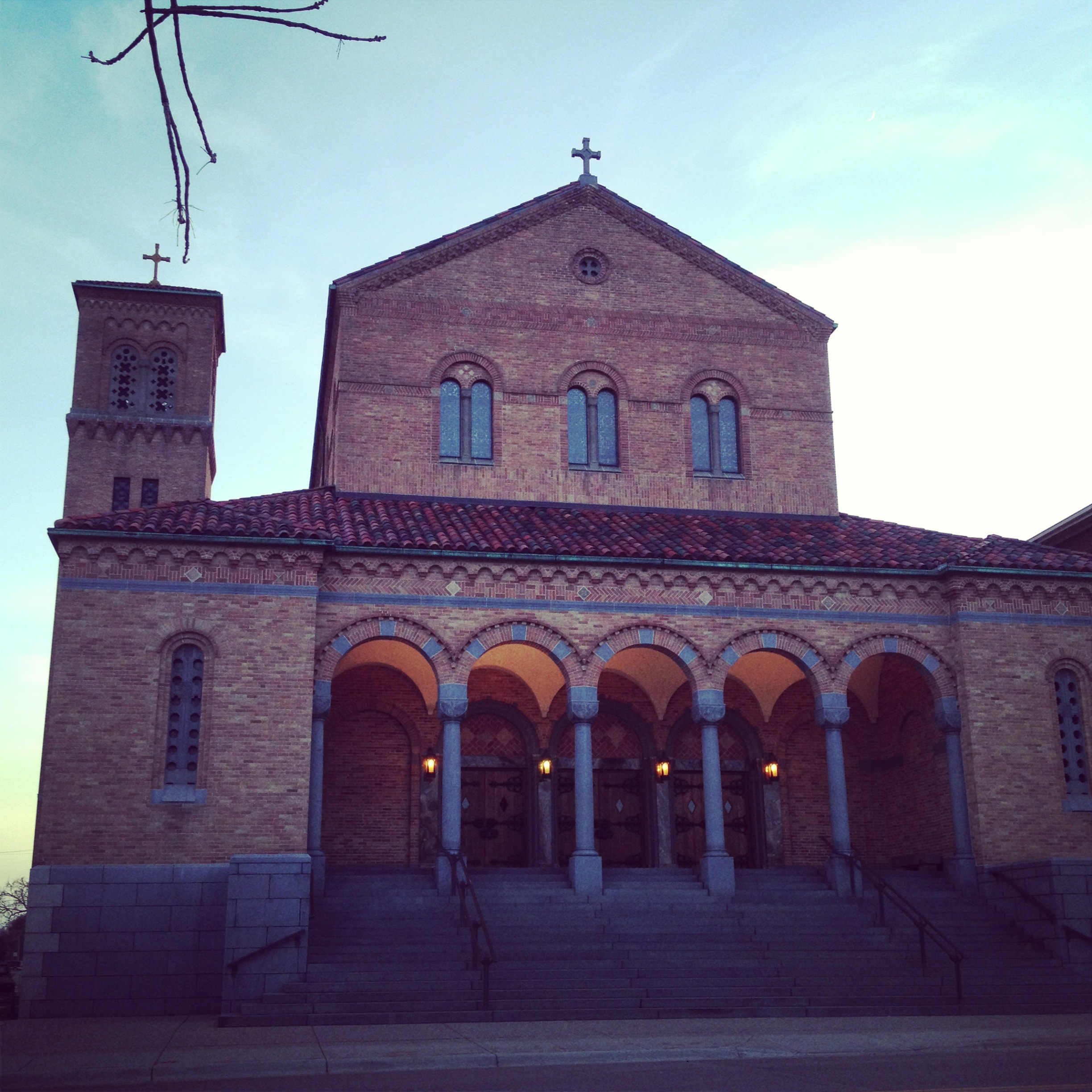
(Cathedral of St. Mary, St. Cloud, Minnesota)
All of my genes come from one county in central Minnesota. Spending time there as a girl with my father’s family, seeing my paternal family name on gravestones in churchyards, hearing my grandmother’s stories about where the first pioneer of our family settled on “that very hill!” My mother’s family, from the same area, was the quiet, present, forbidden topic. I don’t remember a time that my biological parents were together, and rarely visited the area with my mother, so my experience of this county is fragmented, though my relatives may very well have sat next to each other in church.
Last week, I went back there, to St. Cloud, for my great-grandmother’s funeral. I saw the county and its people through my mother’s eyes again–the dozens of people who came to the wake lived on the same roads I’d traversed numerous times with my father’s family, but hadn’t stopped to introduce myself or say hello.
I remember always being so curious about my mother’s family and her own time in St. Cloud where exactly she practiced throwing pots, where her grandparents had lived and worked, the places that meant something to her and to that ancestral half of me.
Running the St. Cloud State campus the morning of the funeral, I realized that my mother’s family was something like God’s family should be for each of us: my father’s family (while visiting the county) was present, obvious–they sat next to me at the dinner table and drove me around; my mother’s family was there too–in the grocery store, perhaps, or walking along the same street toward a movie–I just didn’t know they were next to me, too. God’s family is not always easy to identify–we don’t know who is part of our family in God–but we know as surely as they are part of our blood that they surround us and we belong to each other.