On Idol Worship

Images of golden calves, or the thought kneeling before stone altars with animals killed on them have never struck a chord with me.  I easily gloss over the temptations of the Israelites to make up their own gods and the devotion to little wooden or stone carved beings.  Who can commiserate with such strange, ignorant people?  How are we to understand ourselves as parallel to these people who would take a tree trunk and make it into a “god”?

This morning I realized that idols are a way to try to control our lives–it seems that idols, or for example the ancient Greek or Roman gods and goddesses, would scratch your back if you scratched theirs.  We rule-loving people could do the right things (give this amount of money, or offer that sort of animal) and we could expect to be safe from this disaster or to receive that blessing.  Idols are predictable; they help people feel like they have some power, a few cards to play.

Understood this way, idols have a lot more resonance for me.  Imagine the Israelites at the foot of Mount Sinai after they’ve left their homes in Egypt.  Sure, the conditions were bad in Egypt, but at least it was familiar, at least there was a status quo, a stable lifestyle.  Abandoned in the shadowed valley of the Mountain of God, the Israelites clung to anything they could get their hands on.  Perhaps they thought, “This God that Moses says is ours is all well and good, and we’ve even seen his great work in the Red Sea and in the twelve plagues, but he hasn’t given us the game rules–we don’t know what he wants of us.  We know that we can gain some semblance of order if we just solve this problem ourselves, now, by setting up our own life schedule and making our own rules of life.  It can’t be too hard!”  And they do–they set up their own way of understanding the world and of understanding power, and they even begin to form their lives around this new philosophy they’ve created.  Then, of course, Moses comes down from the mountain, literally shining from the time he’s spent with God, full of the Spirit, burning to share with the people the love that God has for them and the plan that God has for them to be able to live well together.  And then, of course, more trouble begins–the people aren’t so interested in this demanding, totally transforming, difficult, somewhat obtuse way of living, a way of living that is purposely not status quo and purposely not just a set of rules or boxes to check off.

into the cloud. on transfiguration

2013-01-29 08.18.42

“…a cloud came and overshadowed them; and they were terrified as they entered the cloud.  Then from the cloud came a voice that said, “This is my Son, my Chosen; listen to him!” (Matthew 9:34b-35)

20130210-183737.jpg

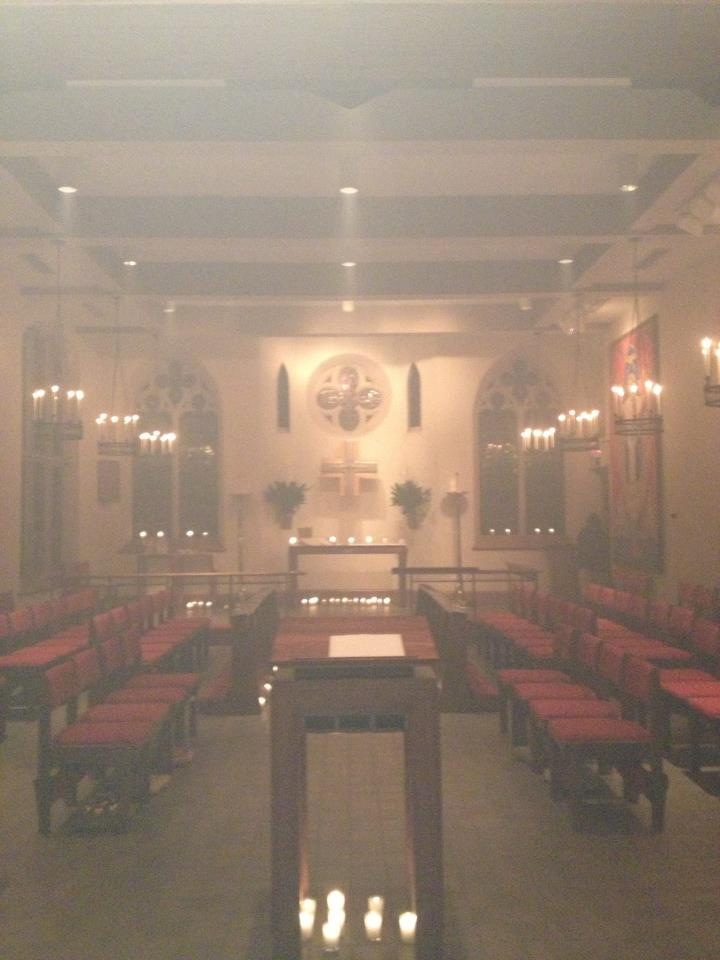
When the Gospel passage of the Transfiguration was read last Saturday evening during our Vigil service, another one of the imports of incense dawned on me.  I happened to be thurifer last week, making me the cloud-maker for the evening; throughout the service, as the incense swirled around us, we quite literally entered a cloud.  The smelly (in a good way, to my nose) incense enveloped us and we dwelt in the closest thing to a blanket of mist that people can easily create themselves.  That’s why we use incense (among many other reasons).  It moves us into the cloud.

It’s not just any cloud.  As we read in our Isaiah Bible study this week (ch. 19), God’s communication with humanity is often through a cloud (this was a big-deal connection to the Church Fathers–see Cyril of Alexandria, Gregory of Nyssa, John Chrysostom)–like the pillar of cloud that led the Israelites through the wilderness, God speaking out of a cloud at Jesus’ baptism, and God and Moses communicating through a cloud on Mount Sinai.  Clouds are often used in Scripture to remind us that God is near and so we use cloud, in incense, to remind us that God is in our midst when we worship together.

Join us at the corner of Wydown & Ellenwood on Saturday nights at 5 p.m. to worship in the cloud…

Ash Wednesday – Don’t Get Too Comfortable – the Church of St. Michael & St. George

When I was in seventh grade, I started to learn what it meant for growth to be painful; I met my orthodontist, Dr. Bunkers, and he fitted my mouth with an expander.

This spider-like metal device affixed to the roof of my mouth had a keyhole into which my mom fitted a tool morning and night, and turned the crank in order to create enough space in my mouth for my adult teeth.  One of my most vivid memories from adolescence was the day I forgot to have my mom turn the key before I left for school, and I had to ask her to do it on my lunch break—we stood in the hallway outside my science classroom and I tried to think of anything else than the metal bars pushing the left side of my jaw further from my right.  It more of a powerful, dull ache than a sharp or searing pain, and I still remember the tingling feeling I’d get as my malleable bones started to adjust to their new position.

Thankfully, just two years later, I had Dr. Bunkers to thank for the glowing smile you all enjoy today.

IMG_0048

I’m not by any means an orthodontic expert, but having experienced the dreaded expander, I learned that progress in growing things—like making my mouth bigger—must be done gradually, and that discomfort is usually part of that growing.

Moving here to St. Louis last June was a much more dramatic sort of uncomfortable experience in my life.  It wasn’t a gradual change at all—one morning I woke up in North Carolina, and after a harrowing twenty-one-hour day, I fell asleep in Missouri.  The move toward feeling at home here was slow and uncomfortable.

The Church of St. Michael and St. George immediately felt right—I still smile when I walk through the Ellenwood entrance every day.  The transition to loving the rest of St. Louis was not so quick and so easy.  Of course, there were the weeks of 100+ degree heat that did not help matters, but I found the arrangement of foodstuffs at Schnucks bewildering , I had many false starts trying to find a new “perfect” latte here, and the roadmap of Durham that occupied the geographical portion of my mind was suddenly useless.  I was bereft of all the little comforts that made my life just a little easier and a little cozier in North Carolina.

It felt a little bit like a long summer day when you’re out in the sun for too long—you’re a little achy and dehydrated, and the bright rays are no longer energizing and refreshing, they’ve become tiring to you.  You wish you could hide from the sun, but here in St. Louis, everything was bright and new, there was nowhere familiar that I could hide and rest.

Since last June, though, I’ve grown.  I still don’t like the set-up at Schnucks very much, but I’ve found that no one else does, either.  I’ve found a new favorite place to enjoy a latte, and there are even a few restaurants that I love now, too.

One of the things I thought about over last summer while I was adjusting to a new place was how Jesus told his followers that this world was not their home.  We are Jesus’ brothers and sisters, we’re as princes and princesses in God’s kingdom, so we belong with God in Heaven.  The discomfort of living in a new and strange place reminded me that the whole world should feel a little bit uncomfortable to each of us.  All the time, church should feel like the most comfortable, most homey place in the world, and our malls, and our grocery stores, and our movie theaters should all feel a little bit off-kilter, a little bit uncomfortable.   Of course, we have to do some work to keep ourselves uncomfortable—to help us remember all the time that the point of all this is to grow closer to God, and growing tends to hurts a little bit.

How can we grow a little bit this Lent?  How can we purposely make ourselves a little bit uncomfortable in this world in order to make ourselves a little bit more prepared, a little bit more comfortable, for Heaven?

Jesus tells us in the Gospel reading[1] for today to give our money away, to spend time praying and getting to know God himself, and to fast, to give up things that keep us tied up in the immediate, practical things in this life.  So I wonder what it would look like to choose to move ourselves a little closer to Heaven and a little further from the way our lives look today.

A woman I know gave up her morning cup of coffee one year for Lent, and she said it was the most transformative Lent she’d ever experienced.  She didn’t give up coffee altogether, just that cup that she used to sit and stare over in the early morning in her kitchen.  She used that time to pray and read Scripture instead.

A young man I knew in high school gave up fighting with his sister for Lent, and it changed their whole relationship.  Once his sister knew that he wasn’t going to react with anger to her, she told me it wasn’t fun anymore, and she stopped egging him on.  Their truce didn’t last forever, but it changed their relationship.

These stories are snapshots into what God’s kingdom looks like—the world that God wants for us to live in is peaceful and loving and full of his presence.  We know this sort of world doesn’t just pop up around us, we have to take steps to make room for God’s presence and to shift the focus of our lives.

I wonder what might disorient you just enough to shift the compass of your life toward God.


[1] Matt 6:1 (NRSV) “Beware of practicing your piety before others in order to be seen by them; for then you have no reward from your Father in heaven.

2 “So whenever you give alms, do not sound a trumpet before you, as the hypocrites do in the synagogues and in the streets, so that they may be praised by others. Truly I tell you, they have received their reward. 3 But when you give alms, do not let your left hand know what your right hand is doing, 4 so that your alms may be done in secret; and your Father who sees in secret will reward you.

5 “And whenever you pray, do not be like the hypocrites; for they love to stand and pray in the synagogues and at the street corners, so that they may be seen by others. Truly I tell you, they have received their reward. 6 But whenever you pray, go into your room and shut the door and pray to your Father who is in secret; and your Father who sees in secret will reward you.

16 “And whenever you fast, do not look dismal, like the hypocrites, for they disfigure their faces so as to show others that they are fasting. Truly I tell you, they have received their reward. 17 But when you fast, put oil on your head and wash your face, 18 so that your fasting may be seen not by others but by your Father who is in secret; and your Father who sees in secret will reward you.

19 “Do not store up for yourselves treasures on earth, where moth and rust consume and where thieves break in and steal; 20 but store up for yourselves treasures in heaven, where neither moth nor rust consumes and where thieves do not break in and steal. 21 For where your treasure is, there your heart will be also.

On Lent & Fasting

2012-10-14 13.20.10

This Wednesday marks the beginning of Lent for the Western church.  Lots of people in the arms and legs and nose and fingers of the church will give up sweets, or swear off facebook, or take on some kind of spiritual discipline (instead of “giving up” something) for the next 40-odd days (because, you know, Sundays are freebies–or at least they don’t count in the tally).

The year I gave up sweets was hard, but I wasn’t very interested in turning to God in my moments of craving–I turned to hot chocolate and popcorn, which didn’t count, I decided on that first Thursday or Friday of Lent.  Forty days later, I gorged on Cadbury creme eggs, and did not grow so much.

2012-12-13 10.25.37

The year I gave up eating from sun-up to sun-down on Fridays was not as hard as giving up sweets, and though I got a little hungry those days, I didn’t notice too much of a difference in my demeanor, or my neediness (of God or food), or my spiritual well-being.

Then I gave up on giving up food-stuff for a few years.  I just put it on a shelf.  Last week, I presented to my Sunday School class about fasting; I made the argument that fasting means stopping-eating-food and that Jesus includes it in a list with giving of our money and with prayer.  Now, I’m preaching Ash Wednesday, and that (Matthew 6) is the Gospel passage (“and when you give alms… and when you pray… and when you fast…”).  I’m sensitive to the ole’ “it’s written in black-and-white, so THAT’S what you do” argument (which is to say not-convinced by it as a rule), but, we do literally, seriously, think that Jesus is talking about and calling us to actual prayer, including the regular recitation of the Lord’s Prayer (part of the same Matthew 6 passage) when Christians come together, and we do literally, seriously think that Jesus is talking about tithing and giving money and clothing and food to the poor and the needy and the oppressed.  So, why not think that Jesus is literally, seriously talking about stopping eating for a time?  Why would he suddenly mean stop-doing-whatever-it-is-that-strikes-your-fancy-and-makes-you-stumble-according-to-your-personal-preferences-in-2013?

I’ve also been noodling the huge way our food and eating has changed in the last hundred years–that few of us produce our own food anymore, many kids, especially in cities, cannot identify raw produce, personally, I’ve never known a piece of meat I’ve eaten (in the last thousands of years, I imagine that didn’t happen), and though I haven’t done much research–and I’m glad to be proven wrong!–I suspect that the number of people suffering from eating disorders has exploded in the last century (let alone the last few decades).  What do the drastic changes to our food system and our cultural attitude toward food mean for the spiritual discipline of fasting?  (nothing?  everything?)


Thin Spots

2012-06-05 11.17.05

A number of months ago, a seminarian here at CSMSG preached about “thin spots,” moments and events when the distance or space between us and God or us and heaven seems to be inconsequential–the space seems “thin.”

I think of the way that light peeks through well-worn fabric; the way that the “fabric” of our lives can get to be gauze-like in places, and that wearing away reveals the light–the glory, the God-ness–behind/underneath it.  The more I focus on these spots, the more I see them.  I don’t think they’re increasing in frequency by any means–I’m not becoming holier by the minute, let’s be real!–but I do think that in training myself to see them, I’m getting better at seeing more of them.

2012-06-01 10.39.29Another contributing factor: really, truly working to see trials as opportunities to grow.  I’m borrowing another blogger’s great, great wisdom here.  When we help to create thin spots*, we’re more attuned to God’s work in our own lives, and we’re more willing to receive/notice the gift of those moments that remind us of God’s presence and of the joy of life itself.

*choosing to think of trials as opportunities to grow–loving others well with no attention or regard for their behavior toward us.  This is helping others, especially in physical ways–bringing dinner to a person’s home, inviting someone to coffee, visiting with someone in the check out/coffeeshop/DMV line; this is going ahead and being honest (lovingly!) with others, especially in positive ways–sending that note to the acquaintance who just gave birth and you want to congratulate, telling your spouse out loud that you’re so grateful for him/her, calling that dear old friend you haven’t spoken with in a year (not letting the shame of how long it’s been/how strange you think it might sound/how stalkerish it might seem get in the way of expressing gratitude!); this is washing your mind out when storm clouds gather and when the person in line/in the car in front of you/in the upstairs apartment happens to be very, very rude.  I have to constantly remind myself that there’s surely something that is bothering her/him, and it’s not really about me, but about trying to work through the anger and hurt, and I happen to be caught in the crossfire (this is one of my biggest challenges).

In my own life, paying more attention to thin spots recently, I’ve found they most often happen when I’m with other people–not alone–and when I’m praying.  Now, I must have the courage to be with people and to pray all the more!