Isaiah 37 – Bible Study

Last night at the Women’s Bible Study, we read Isaiah 36 & 37–a welcome prose-break in the midst of months of (glorious but sometimes obtuse) poetry!  We noticed the parallels in the narrative between King Ahaz in early Isaiah, and here, King Hezekiah (his son).  Assyria has captured most of Judah, leaving Jerusalem alone, an Assyrian messenger comes to taunt and cajole the Israelites on Jerusalem’s wall.  The messenger jeers at them for trusting their God–whom he does not differentiate from the Baals and Astorehs whose high places Hezekiah has torn down–he narrates a scene that leaves the Israelites no reasonable recourse but to throw themselves on the mercy of the Assyrians.  After his arrogant proclamation, the Israelites stand on the wall, stony-faced–they refuse to abandon their trust in Hezekiah and the Lord.

For Hezekiah’s part, he places the message they’ve been sent from the Assyrians before the Lord, and he prays, “So now, O LORD our God, save us from his hand, that all the kingdoms of the earth may know that thou alone art the LORD.” (Is. 37:20 RSV) We were struck that Hezekiah boldly asks God for exactly what he wants–we remembered how psalmists also often employ this method, sharing their strong desires with God, seeking to convince or cajole God to see their own point of view.  One member recalled Abraham’s talk with God about Sodom & Gomorrah–how Abraham dares to engage in conversation with God about the fate of the people of these cities; he behaves as if God is actually listening (not just hearing the words that Abraham is saying, but actually considering them, as their conversation’s course reveals).  God interacts with Abraham as Abe progressively contracts the number of faithful people for which God would spare the cities from destruction.  We learn many things about God from that scene with Abraham, not least of which is that God seems to desire for us to talk back, to offer our opinion, to persuade, to present our case–like Hezekiah did in the temple.

The woman who reminded us of Abraham’s Sodom and Gomorrah story also offered her modern version–watching her grandson negotiate and plead with his mother over new electronics and video games.  Every few days, she said, he’d approach her with his new plan, all set out, all reasoned through, and she’d cringe as she saw him present his case anew to his mother, knowing the game all too well from her own experiences of parenting.  She observed that after months–about the time of Christmas–he might have just worn his mother down enough that she might determine it was easier to buy the new electronics than hear any more cajoling.  Just like the widow and the unjust judge–how much more, as the parable tells us, does God desire to give you the best things?

Another woman chimed in, sharing a bit of wisdom she’d read about prayer, “just choose something good and start praying for it.  Choose anything.”  The point, she said, is that our personal relationships with God are made by interaction, presenting our case for the good thing that we desire deeply, and then waiting to hear what God says about this desire–maybe he’d even give it to us!–maybe he’s got something else in mind, too.

I’ve been given to trying to not have any desire at all, but I’m starting to think that’s a mistake, too–being resigned to anything at all that happens means I don’t question God, but it also means that I don’t have much interaction with God other than “what next, Sir?”  So this week I’m working to take Hezekiah’s and this wise woman’s advice and just choose something good for which I can pray.


Thin Spots

2012-06-05 11.17.05

A number of months ago, a seminarian here at CSMSG preached about “thin spots,” moments and events when the distance or space between us and God or us and heaven seems to be inconsequential–the space seems “thin.”

I think of the way that light peeks through well-worn fabric; the way that the “fabric” of our lives can get to be gauze-like in places, and that wearing away reveals the light–the glory, the God-ness–behind/underneath it.  The more I focus on these spots, the more I see them.  I don’t think they’re increasing in frequency by any means–I’m not becoming holier by the minute, let’s be real!–but I do think that in training myself to see them, I’m getting better at seeing more of them.

2012-06-01 10.39.29Another contributing factor: really, truly working to see trials as opportunities to grow.  I’m borrowing another blogger’s great, great wisdom here.  When we help to create thin spots*, we’re more attuned to God’s work in our own lives, and we’re more willing to receive/notice the gift of those moments that remind us of God’s presence and of the joy of life itself.

*choosing to think of trials as opportunities to grow–loving others well with no attention or regard for their behavior toward us.  This is helping others, especially in physical ways–bringing dinner to a person’s home, inviting someone to coffee, visiting with someone in the check out/coffeeshop/DMV line; this is going ahead and being honest (lovingly!) with others, especially in positive ways–sending that note to the acquaintance who just gave birth and you want to congratulate, telling your spouse out loud that you’re so grateful for him/her, calling that dear old friend you haven’t spoken with in a year (not letting the shame of how long it’s been/how strange you think it might sound/how stalkerish it might seem get in the way of expressing gratitude!); this is washing your mind out when storm clouds gather and when the person in line/in the car in front of you/in the upstairs apartment happens to be very, very rude.  I have to constantly remind myself that there’s surely something that is bothering her/him, and it’s not really about me, but about trying to work through the anger and hurt, and I happen to be caught in the crossfire (this is one of my biggest challenges).

In my own life, paying more attention to thin spots recently, I’ve found they most often happen when I’m with other people–not alone–and when I’m praying.  Now, I must have the courage to be with people and to pray all the more!


Children & the Kingdom of Heaven

“But Jesus said, ‘Suffer little children, and forbid them not, to come unto me: for of such is the kingdom of heaven.'” (Matthew 19:14, KJV)

2013-01-16 08.40.00

Last Wednesday in Chapel, I read this story out of the Jesus Storybook Bible (JSB) to the 1st-4th graders who gathered (the 5th and 6th graders were out that day, providing an opportunity for time with the little ones who, being suddenly foisted into leadership in the chapel, were blessedly deer-in-headlights quiet).  In the JSB, this story ties together the disciples arguing about who was greatest/most-beloved-of-Jesus among them, and the little children approaching Jesus (this is one of the many reasons i love the JSB–they’ve always thought of connections that I haven’t made).  The disciples are acting the way that one expects children to behave, “I’m best!” “No, I’m more clever!”  “Clearly, it’s ME who’s most important!”  While this niggling is going on in the background, Jesus is left un-guarded, and children start wandering up to him–drawn by his approachability, his gentleness, and his love.  They run into his arms, and he laughs with them (according to the JSB–a colorful, though fair!, description), they talk about what’s going on in their little lives, and sit on Jesus’ lap.  Finally, the disciples realize what’s been going on, and they rush over to shoo away the children who are disturbing the Important Work of Jesus.

Of course, Jesus then sets the disciples straight, showing them–and us!–how much we have to learn from children, from the way that little ones know that there’s more to the world than what we see–the world is magical–that Jesus is the Most Worthy of our love and trust.

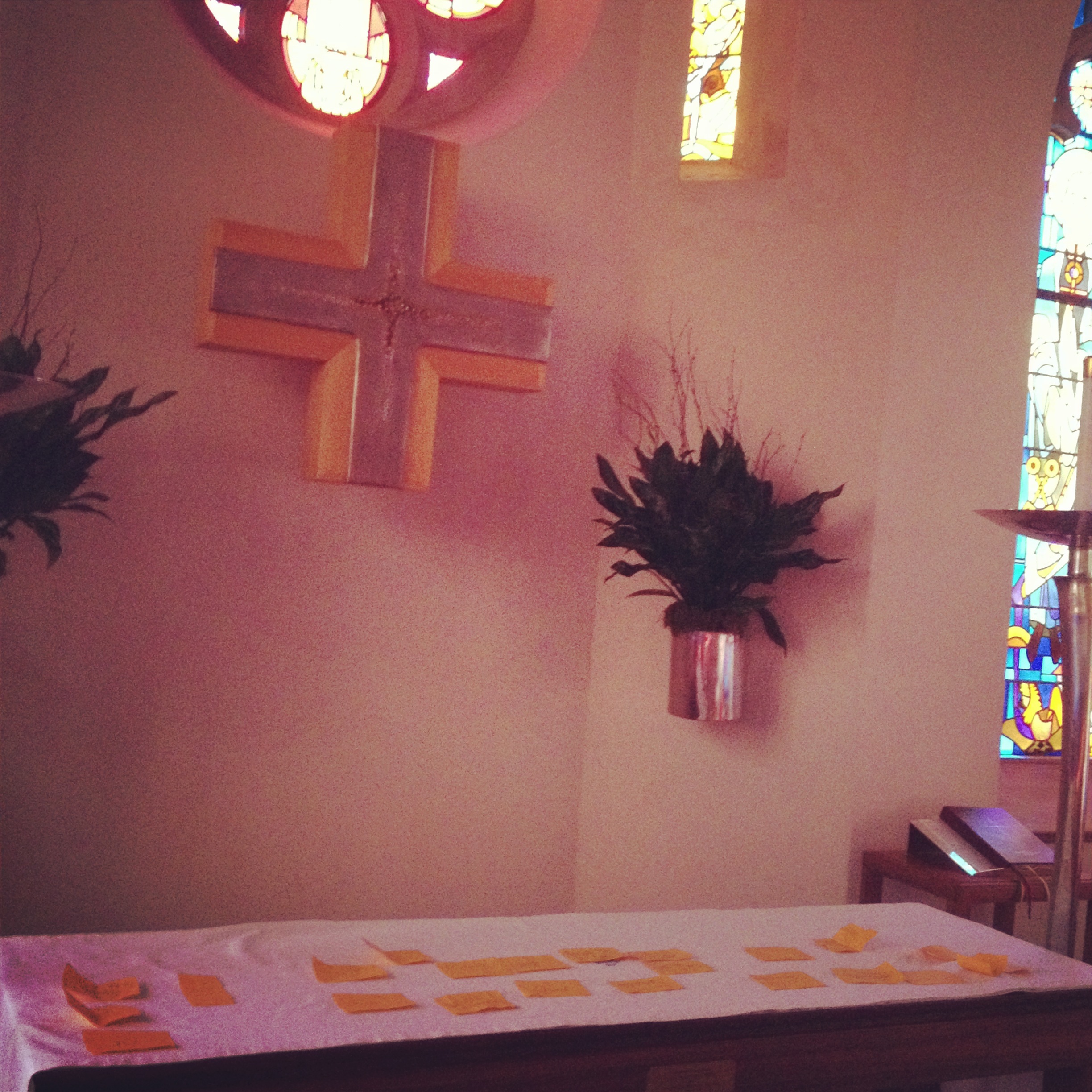
At the close of the story, I told the children about the leadership they’d be expected to take in showing the 5th and 6th graders the new habit we were going to start in chapel on Wednesdays (the day I lead).  All year, we’ve been taking prayer requests by voice, imagining that we’re placing those people in our two up-turned hands and then lifting them up to God.  Last Wednesday, we took it a step further.  I encouraged the children to take a slip of paper, to write on it any request they had–people they wanted to remember, or situations that they might want to bring to Jesus–and by rows, I released them to leave the paper on the altar at the front of the chapel.  They brought their hearts up to Jesus and laid their worries down on the altar in front of Him.

brave people make intimidating congregations

Often, while sermon-writing, words come slowly, and when they come, they seem like little clods of dirt that break apart into dust the moment you try to grasp them. This exercise sends me running through my cycle of google reader-facebook-twitter.  Having just completed the circuit a few minutes before, there was nothing new on my reader, but when i typed in “fac” in my browser bar (the fewest letters necessary to bring up my worn “facebook.com” link) and arrived at the top of my newsfeed, a new photo had been posted by one of my oldest friends:

She wore a white sundress, her blonde hair was down, and the big white posterboard she held up read, “Shh… just go back to sleep.”  It was a photo taken for Project Unbreakable, a website dedicated to survivors of sexual assault.  I’d known about the event she referred to for a few months, but seeing her brave face meeting the camera’s eye humbled me–what good were my fancy sermonizing words to her?

I’d asked that question of myself before, thinking of a friend of mine who is a veteran of Afghanistan.  With all that he’s seen and survived, what can a sheltered, charmed, suburban Midwesterner say that has any weight?

Of course, the answer is that the Gospel is the most powerful thing we can describe to anyone, but the rub is describing it faithfully and articulately, both with our words and with our lives.  These friends of mine make me a better preacher, because I know that sitting in the pews each Sunday are others who have been abused, assaulted, witnessed and survived war, and continue to fight for their lives; keeping them in mind as I search for language keeps me honest and humble (and makes me pray more often).