
Despair & Dashing Babies Against the Rocks

Two of the most infamous psalms in Scripture are 88 and 137, so it seemed like an especially brilliant idea to tackle them both in one go during the 35 minutes alloted for Sunday School (usually it’s more like 45 minutes, but the preacher went long…).  Here are a few notes from our class’ wonderings and wanderings:

Though these two prayers have no particular relation to each other, put together, they have something specific to teach; Psalms 88 & 137 take God seriously in a way that we are often unwilling to consider.  When a child is clearly upset but says, “No, nothing’s wrong!!” she’s distancing herself from you.  She won’t allow herself to be made well or to be changed.  Prayer, real talking to God in despair and in anger requires that you be ready for God to act, to transform you and the situation.  To share your sadness and anger with God, you must admit that you are sad and angry, and to admit that you aren’t in control and aren’t able to help yourself means you are humbling yourself.  It’s significant that in this depression and anger, these composers turn to God; they’re hurt and broken by the world, but they cling to God by continuing to offer prayers.

One woman said, “Whenever I want to pray about something that makes me angry or hurt or sad, I say to myself, ‘well, I should trust more.  I should not let this get me down–then I can pray about it.’  But the truth is that these psalms show us that we should approach God just where we are.”

Psalm 137

1 By the rivers of Babylon—
there we sat down and there we wept
when we remembered Zion.
2 On the willows there
we hung up our harps.
3 For there our captors
asked us for songs,
and our tormentors asked for mirth, saying,
‘Sing us one of the songs of Zion!’

4 How could we sing the Lord’s song
in a foreign land?
5 If I forget you, O Jerusalem,
let my right hand wither!
6 Let my tongue cling to the roof of my mouth,
if I do not remember you,
if I do not set Jerusalem
above my highest joy.

7 Remember, O Lord, against the Edomites
the day of Jerusalem’s fall,
how they said, ‘Tear it down! Tear it down!
Down to its foundations!’
8 O daughter Babylon, you devastator!
Happy shall they be who pay you back
what you have done to us!
9 Happy shall they be who take your little ones
and dash them against the rock!

 This shocking ending is both negative (rare in the psalms) and gruesome.  It’s been composed after the fall of Jerusalem, during the Babylonian exile (v.1); the composer is ridiculed by his captors for his hope of restoration.  The first section (vs.1-3) narrates the scene, the second bit (vs. 4-6) pledges loyalty to Jerusalem, and in the last section (vs. 7-9) the psalmist details to God exactly what he thinks is an appropriate payback.  In the ancient world, it was a practical military policy (albeit an especially cruel and not-always-enforced one) to kill the babies and children of a people group in order to wipe out that nation’s existence and legacy.  Pharoah did it to the Hebrew people in Egypt, which is why Moses was hidden as a baby and sent to sail down the Nile.  The writer desires for all of the Babylonian culture, all its legacy and mark on the earth, to be wiped out.

Well, there’s no country called Babylon anymore, so maybe the psalmist got his wish.  I think there’s more to be mined here than that: looking at the psalm again and thinking about it from a perspective of “good guys” and “bad guys” or perhaps even “God’s people” and “the Evil one,” what is the Scripture saying to us?  We live now in the midst of evil, strangers in a strange land; this place is not our home.  We endure violence and struggle against our sin.  But someday, we will struggle no more, and we will endure no more evil; happy shall be the one who roots out the progeny of evil, killing off all hints of evil, burning away all darkness–rooting out its very babies, that it has no future.

Psalm 88

 A Song. A Psalm of the Korahites. To the leader: according to Mahalath Leannoth. A Maskil of Heman the Ezrahite.

1 O Lord, God of my salvation,
when, at night, I cry out in your presence,
2 let my prayer come before you;
incline your ear to my cry.

3 For my soul is full of troubles,
and my life draws near to Sheol.
4 I am counted among those who go down to the Pit;
I am like those who have no help,
5 like those forsaken among the dead,
like the slain that lie in the grave,
like those whom you remember no more,
for they are cut off from your hand.
6 You have put me in the depths of the Pit,
in the regions dark and deep.
7 Your wrath lies heavy upon me,
and you overwhelm me with all your waves.
Selah

8 You have caused my companions to shun me;
you have made me a thing of horror to them.
I am shut in so that I cannot escape;
9   my eye grows dim through sorrow.
Every day I call on you, O Lord;
I spread out my hands to you.
10 Do you work wonders for the dead?
Do the shades rise up to praise you?
Selah
11 Is your steadfast love declared in the grave,
or your faithfulness in Abaddon?
12 Are your wonders known in the darkness,
or your saving help in the land of forgetfulness?

13 But I, O Lord, cry out to you;
in the morning my prayer comes before you.
14 O Lord, why do you cast me off?
Why do you hide your face from me?
15 Wretched and close to death from my youth up,
I suffer your terrors; I am desperate.
16 Your wrath has swept over me;
your dread assaults destroy me.
17 They surround me like a flood all day long;
from all sides they close in on me.
18 You have caused friend and neighbour to shun me;
my companions are in darkness.

A pscyhologist was in the class and she observed, “This sounds like clinical depression.  The words that are used, the way it’s described–it’s practically textbook.”  She is exactly right; the psalmist wants to have hope, but can’t muster it.  There is nothing but darkness.  We have friends and loved ones who suffer depression, some of us have lost people to the illness.  Here in Scripture is preserved one experience of depression, perhaps to let us know that this may be a part of life on earth.  This sort of brokenness may not be solved on this side of Heaven.  We must admit that not all will be made well in advance of the end.  The psalmist reminds us of something very important in verses 10-12: “Do you work wonders for the dead?” he asks; “Is your steadfast love declared in the grave?” he challenges.  In Jesus Christ, and in the salvation God offers us through him, yes–God does work wonders for the dead; indeed, his steadfast love is declared exactly in the grave.  This does not provide a cure for depression, but we are given hope of healing, whether in this life, or the life to come.
Morning Prayer & I-85 Exits

Back in June, when I made my first voyage back to my hometown* (Durham), about ten minutes out from my best friend’s home, I realized that we NEEDED cheese for our Sunday night repast. Flipping my brain quickly into cheese-emergency mode, I thought, “Must get to Whole Foods (only cheesey place open on Sunday nights). Where am I now? How to get there fast?” And my brain then did a very funny thing. It shut off. I exited the interstate, and my arms felt like they were moving themselves, turning the wheel; my foot had a mind of its own, pressing the brake and the gas. And then, I turned up in the Whole Foods parking lot–presto! What a strange thing to happen, I thought, that my brain wouldn’t do the think-through-the-map-you-keep-stashed-in-your-mind, calculating distances and times and the length of stoplights…

It dawned on me: my brain had done that exact thing so many times on those exact streets that it didn’t need to think anymore. Living in St. Louis, and now in Columbia, I can get around very well, but my mind is constantly calculating and reorienting itself to remember where things are located and how the streets line up. My mind didn’t have to think through routes from here to there because it’d been making that route in my brain so long, through so many seasons of road construction and rain, that my body–in a way–just knew how to get where I wanted to go.

It wasn’t like that in the beginning, back in 2004. I knew one way to get from point A to point B, and though it may have been super-inefficient, I wasn’t going to abandon that route for anything. Gradually, I added more mental map and I colored in the way traffic affected roads at various times of day–eventually, I knew the roads so well, they were just part of me, my arms and legs could take over.

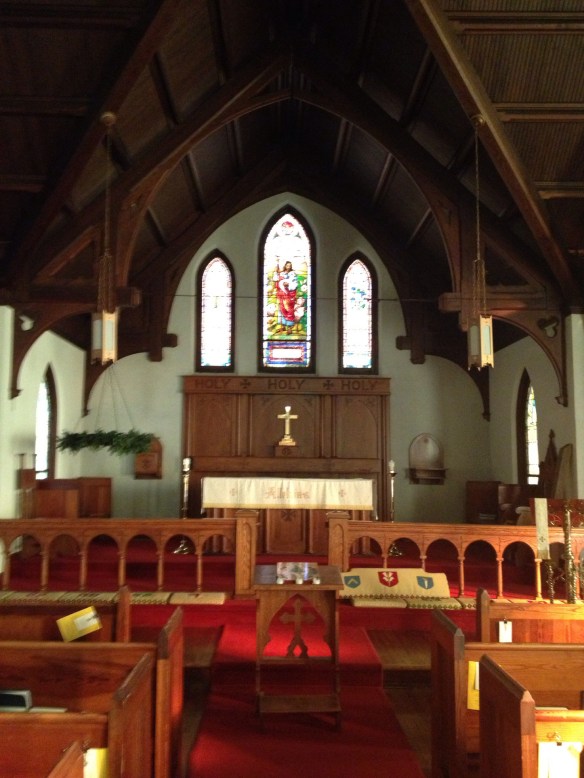
Back in 2008, I prayed Morning Prayer for the first time. I was in one of the hard, straight-backed wooden pews at St. Joseph’s Episcopal Church in Durham. I didn’t know which page we started on, I didn’t know how to choose readings or canticles or collects (or exactly what “collects” were) or when to stand or kneel. It was uncomfortable and foreign and not very enjoyable, but it was required for Confirmation, which I’d decided to undergo for some reason, and so I mouthed the words and listened.

20130925-173749.jpgI was committed to leading one of the Daily Offices (Morning, Noonday, Evening Prayer, and Compline) every week of the academic year, which roughly lined up to our time as catechumens, preparing for Confirmation in the Episcopal Church. Further, we were to pray this set of Offices every day by ourselves, if we didn’t show up at church for it. I was overwhelmed and a little bit rebellious. I didn’t stick with it well at all over winter break that year. By the next summer, a newly minted Episcopalian for just over a year, my field education supervisor expected me to pray Morning Prayer with him every day in our parish’s chapel, and though I felt a bit rebellious here too (when I led, I used contemporary language), I think that is when I fell in love with the Daily Office. Those weeks cemented something in me; some mornings I almost cried through the prayers, I was so tired, so humiliated, so lonely. But every morning, those words were there again, and in a way, that time and place–8 a.m. in St. Agnes’ Chapel–became sacred and became home.

I returned to Durham and to St. Joe’s that autumn, to the people and place that had already been with me through plenty of change and confusion. Morning Prayer was no longer a burden, a commitment that I’d made and felt imprisoned to keep, but a joy and delight–a place and time where I kept meeting God in the words I said and heard.

A little more than a year ago, I arrived late to a service of Morning Prayer in the parish I was serving in Missouri; I jumped right into the canticle being recited, and then I just forgot to pick up a prayer book. The rest of the service had hidden itself in my memory and in my heart. My brain turned off and the words easily came out of my mouth. Just like my body knew exactly how to drive my car to the grocery store, my heart practiced and found its way to God in Morning Prayer.

Years ago, when I started eating breakfast at St. Joe’s with who ever showed up for eggs and grits, they gave me a key, for the mornings that I’d be the first one there to start the coffee.  I still keep that key on my key chain to remember the place and people who re-introduced me to Jesus.

Last week, a dear friend of mine said, “Sometimes big things are the easy things to be courageous about; the little things are hard.” Why can we commit to things like marriage and jobs, but find it so difficult to commit to something like daily prayer, Scripture memorization, or keeping up with pen pals?

(postscript: this is the community now)

Psalm 131 Mash Up

20130925-095507.jpgHebrews 12:1-2 “Therefore, since we are surrounded by so great a cloud of witnesses, let us also lay aside every weight and the sin that clings so closely, and let us run with perseverance the race that is set before us, looking to Jesus the pioneer and perfecter of our faith, who for the sake of the joy that was set before him endured the cross, disregarding its shame, and has taken his seat at the right hand of the throne of God.” (NRSV)

Psalm 131 is a prayer, describing the thing we’re urged to do in this passage from Hebrews, “lay aside every weight.”  This psalm ought to be read, I think, as a plea to God for the truth of the words being uttered–it’s more prophecy than observation of present circumstances.

(1) O Lord, I am not proud, I have no haughty looks.

(2) I do not occupy myself with great matters, or with things that are too hard for me.

(3) But I still my soul and make it quiet, like a child upon its mother’s breast; my soul is quieted within me.

(4) O Israel, wait upon the Lord, from this time forth for evermore.

(via the Book of Common Prayer)

Jesus came because our sin is too heavy for us, because He can and does carry it himself.  Our propensity to turn away from God is too great to overcome ourselves, we must, in humility, lay aside the weight of making our own salvation happen again and again.  All to Jesus I surrender.

Through that laying down, through truly letting go of trying to control or to work ourselves into righteousness, our souls become quiet, our souls and our selves thereby inhabit the place we’re made for–we’re rightly out of the driver’s seat, listening, and being quiet.  We’re being, or practicing being, the humans that we are.

We Gentile Christians are grafted into Israel because of Jesus’ sacrifice, and just as people have waited on God for centuries–thousands of years, even–our occupation is to wait upon the Lord.

A Psalm 131 Rewrite:

Lord, keep us from being proud, and from looking down our noses.

Help us to remember that You are God, You are almighty, and we only need to be servants.

Quiet our hearts before You, drown out voices of worry and despair; relax our frazzled minds into trust in You, let us feel your hands holding us up.

Throughout all time, O Master, your servants have listened to your directions.  We now join with your witnesses from all time, waiting for Your coming again.

In the name of Your Son, our Savior Jesus Christ we pray, Amen.

Today’s Prayer

20130918-113046.jpgLord, give us the audacity to live as though we believe our hands and feet are instruments of prayer. Amen.

(from Common Prayer: A Liturgy for Ordinary Radicals, Shane Claiborne, Jonathan Wilson-Hartgrove, Enuma Okoro)

perhaps more to come today–last night, Dessert & Discussion met at Trinity Cathedral, we watched a video by Shane & Jonathan about how Christians are to live as a community in an ever-more-individualistic world…