writing in the walls

While in France, more than just my cell phone taught me to look up and look out.

IMG_2174

Sainte-Chappelle’s windows pointed my eyes heavenward, illustrating stories from Scripture (the very stones which line the windows are arranged in such a way as to make arrows–do you see?)

IMG_2319

Mont Saint Michel–a monastery which itself points upward, perched on a rock at the Atlantic shore–boasts a Gothic church, encouraging the pilgrim to continually remember the source of life and strength.

IMG_2420

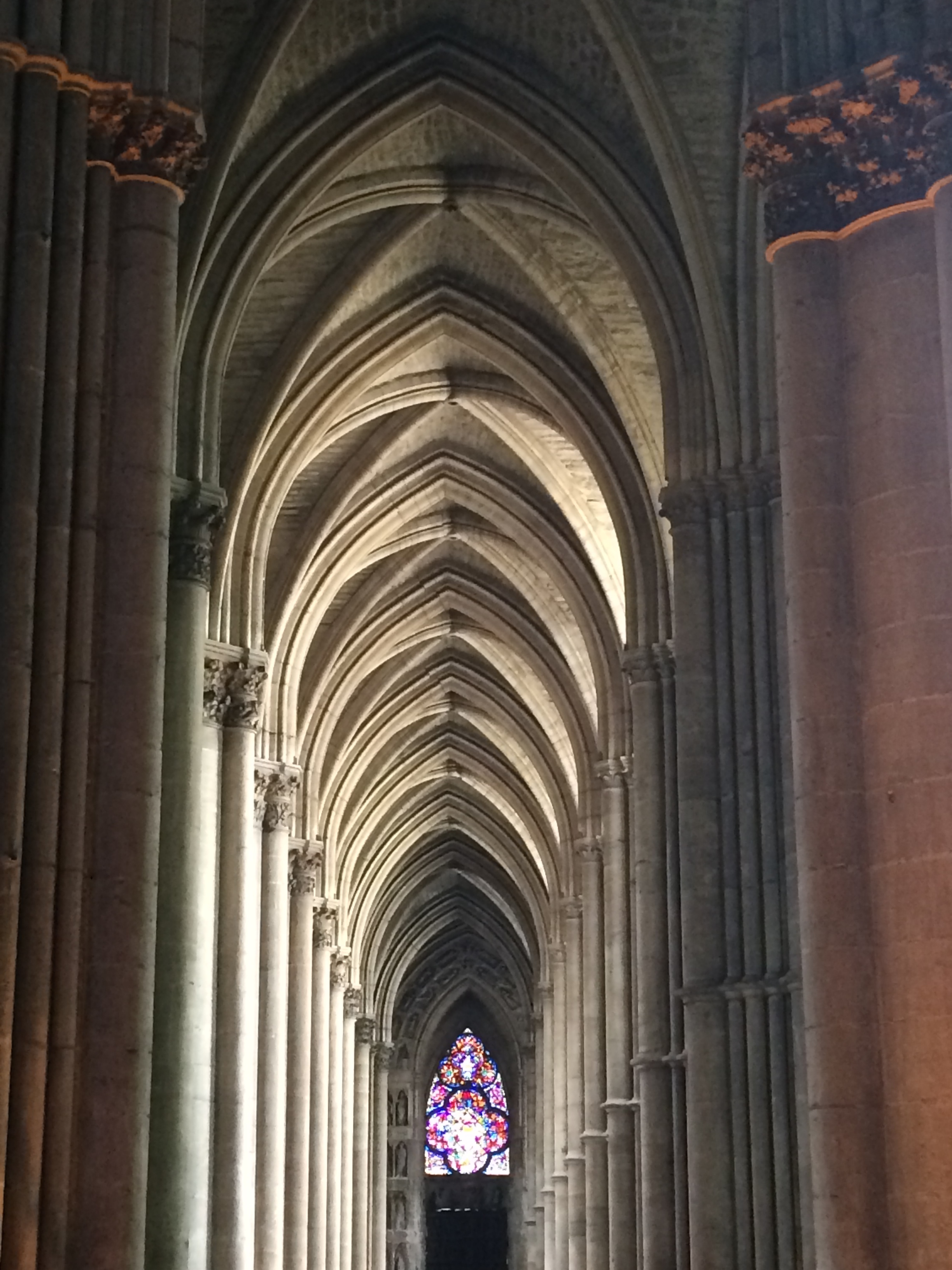
Arrows abound in the aisle at Reims.

IMG_2466

All is oriented upward on the West facade in Strasbourg.

Our necks hurt the first few days that we spent in cathedrals, but soon we got used to paying more attention to what was above and around us than what was below us or what was associated with our own individual experiences (I cannot recall which cathedrals were most-busy, or most-noisy, or too cold, or too warm, or too expensive).

I wonder if our lives should be a bit more about paying attention to who God reveals himself to be (those things, “above”), to God’s work in others’ lives and in the world (what’s around us).

This message is finding its way into all kinds of outlets recently–here are a few I’ve noticed:

Relevant Magazine

Huffington Post

What do you think?  How have sacred spaces challenged you to look differently at life?

Courage and Pilgrimage

Over the last few weeks, I did a lot of stair-climbing.  It wasn’t just at our walk-up rental in Paris, but in museums, castles, cathedrals, old hilly towns, terraced gardens (aren’t you sympathetic for my knees?  …not so much?).  By far, the most terrifying climbing, as one might imagine, was in the cathedrals–two of which enticed us up into their spires to enjoy the great heights which Medieval builders scaled.

20140704-083248-30768970.jpg

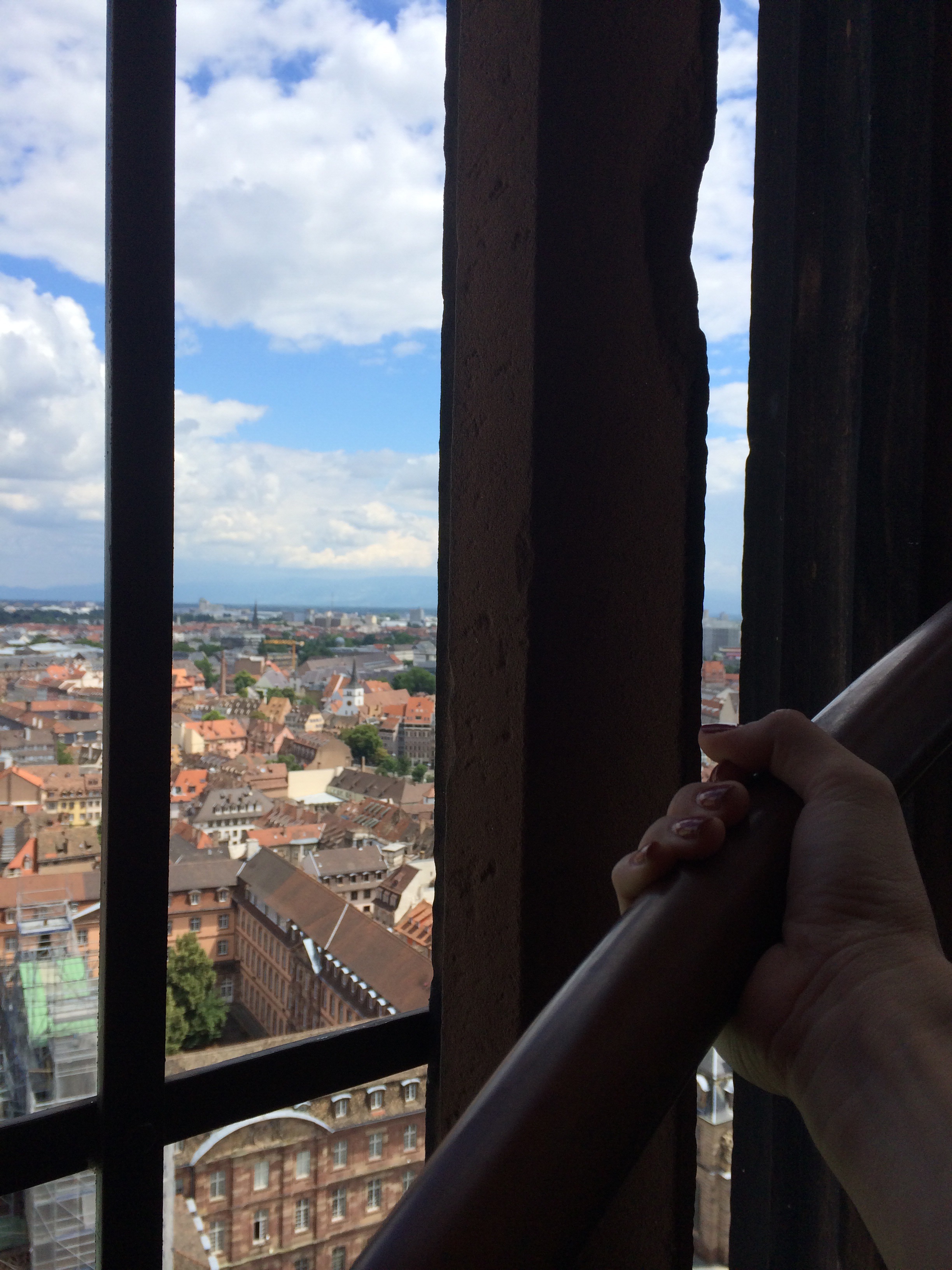
Above, in Strasbourg, it took all my concentration to commit to each step up.  If I took my attention off of just the next stone slab in front of me–if I looked out over the rooftops, or looked up the set of stairs as far as I could see, or stayed still on the steps too long–I got dizzy and I would suddenly feel unsteady, as if I was about to lose my balance and was going to fall.  Objectively, my body was no less-grounded whether my eyes were looking at rooftops or at my feet, but my mind and heart were easily overwhelmed with the task at hand: overcoming my fear of heights in order to be able to enjoy the secure and amazing view at the top of the stairs.

I realized as I climbed that the journey up the spiral stairs was a fruitful way to think about trials in our everyday lives.  Focusing on more than the very next step in front of us, allowing ourselves to lose focus on the present moment in order to try to take in the whole project we’re working through–that’s a recipe for disaster; the only way to not be overwhelmed, crushed by the enormity of the present reality, or drowned in a deluge of fear and negative emotions, is to actively put them out of your mind–to practice putting them out of your mind over and over again, and to choose (and practice!) instead focusing on just the one next thing to do.  Thankfully, in my case, the one next thing was very clear, and very simple–step up.  One at a time.

20140704-083249-30769794.jpg Climbing these stairs at Chartres, just as climbing through trials in life, I didn’t know how long the ordeal was going to last before I arrived at the top and I couldn’t enjoy the views and hints of the reward in the midst of my climbing–it made me feel unsteady and sick!

Just as in life, what got me through was deep, deep breathing.  What is breathing but inviting air–wind–to move through you, to energize, awaken, enliven you?  What is the Holy Spirit but air, wind?

In our trials, throughout our lives, God is eager for us to call upon the Holy Spirit to surround, fill, enliven, energize, and sustain each of us every single step of the way.

What are we good for?

At St. Sulpice this morning, enjoying one of the most impressive organs in the world, it was the altar there and reminded me anew: worshiping God in church on Sunday is the most important thing we do all week.
The beautifully and carefully formed gold candlesticks on the altar are impossibly ornate. It’s not my favorite look or style, but even a commoner like me, not at all first in metalworks can see they are excellently executed, carefully formed, beautiful.

20140622-230440-83080271.jpg

Churches in the past weren’t built as “seconds,” metalworkers didn’t donate their mistakes or castoffs or hurriedly constructed pieces to their church, they gave their best. If any, seconds went to their customers, because the only one who could ever offer payment with eternal consequence is God.
In the Eucharistic prayer (said together, with the priests voice, over the bread and wine every Sunday), “we offer ourselves, our souls and bodies” – we are saying that our bodies, our lives, our very selves, aren’t things that we’ll cling to, grasp, spend for our own enjoyment, glory, but pour out for God. We are committing to give our very best efforts to God, just like 17th-century metalworkers.
Our call as disciples of Jesus, then, is to give our best, and to exhort and help our fellow disciples give their best, most sincere, most excellent offering they can.
We are to spur each other on to learning, training, practice, sincerity, and devotion in everything we take on.
Half prepared, or hurriedly completed, or insincerely devoted efforts are not things God wants.
God does not want unstudied worship, distracted bodies, lazy or hardened or impenitent hearts. One way to understand Cain’s unacceptable offering is that God knew Cain’s heart, and it was not sincere, prepared, devoted to true, full worship.
We practice, learn, test, and assess our worship as we do other parts of our lives because we believe our offerings of our souls and bodies, their condition and sincerity, makes a difference to God.
God cares whether we’ve truly, sincerely committed our work and effort fully to his glory–whether we really mean it and live what we pray, that “we offer ourselves, our souls and bodies to be a reasonable, holy, and living sacrifice” to God.
God seeks to work through us as Christ’s body, the Church; all parts working together, working the most intently and sincerely possible, is the only way to fully serve our Lord.

The Lower Diocese

As of tomorrow, my husband and I will have lived in Columbia for a whole month (!). We’re part of the Episcopal Diocese of Upper South Carolina, and as you dear readers might know (or might not! or might not care one hoot!! which is just fine), there is an Episcopal Diocese of South Carolina, which comprises the lower part of this great state, and has been the subject and site of much upheaval in our denomination of late.

There are myriad articles and essays and sermons which deal with the facts of this unfolding situation; I cannot attempt to describe or summarize them in any authoritative or competitively-excellent way. Here I share, instead, a bit of my lament.

DSC_0044I don’t recall the first time I went to Charleston, but I know it was spring (very brilliant of me) and I know I was taken with St. Philip’s Church. Its steeple is brown and stony and majestic, its shadow is cool, its graveyard is full of wisdom. On my second or third visit, I discovered St. Michael’s Church, just a few blocks away from St. Philip’s, and stood breathless under its white outline. Old churches have always had a hold on me, and these two beautiful sacred spaces were no less gripping. Can you imagine the number of faithful people who have spent their lives praying in those pews, shuffling down those aisles, marking their births, marriages, friendships, and deaths by those walls and windows? Imagining the hundreds of years of prayers soaked into the stones and hanging in the air brings a reverent smile to my face. I close my eyes in the glow of God’s presence in these places, and how parishioners have learned of and experienced God in these spaces.

Two weeks ago, I went to Charleston again, for the first time in a year. It was a big year to have not-been in Charleston (the rupture I allude to above puts the future of these buildings in jeopardy). I teared up when my husband and I pulled into a parking spot near St. Michael’s. My hands caressed the white columns, mournful of the *(figurative–not literal, yet) brokenness in which this beautiful building sits. We walked to St. Philip’s Church, and I remembered my first visit–my enamored attitude with the building despite my ignorance of my call at the time.

God is bigger and more full and more perfect and more sovereign than could be overcome by the loss of these buildings–of course; I know that they are just things, just symbols to us of heaven and of God’s glory, meant to aid us in our worship. However, they’ve been important symbols for centuries–they were spared General Sherman’s fire!–and now they might fall. Their stark beauty, their noble shape–these sacred spaces stand as a challenge to the passing squabbles and divisive disagreements of our day; they survived the Civil War, for heaven’s sake! The brokenness in the Episcopal Church these days is not just a passing squabble or a disagreement, we’re struggling with what it means to love and what it means for Scripture to be authoritative. For at least two thousand years, we’ve been struggling with these things, as Christians, and there has been lots of collateral damage–plenty of lives, which are more important than any building.

But I really hope that these buildings can continue to stand as a witness to us little people of God’s glory, his power, his far-reaching love, and his desire that all may be made one body with him.

Who is my family?

2013-05-13 20.32.03

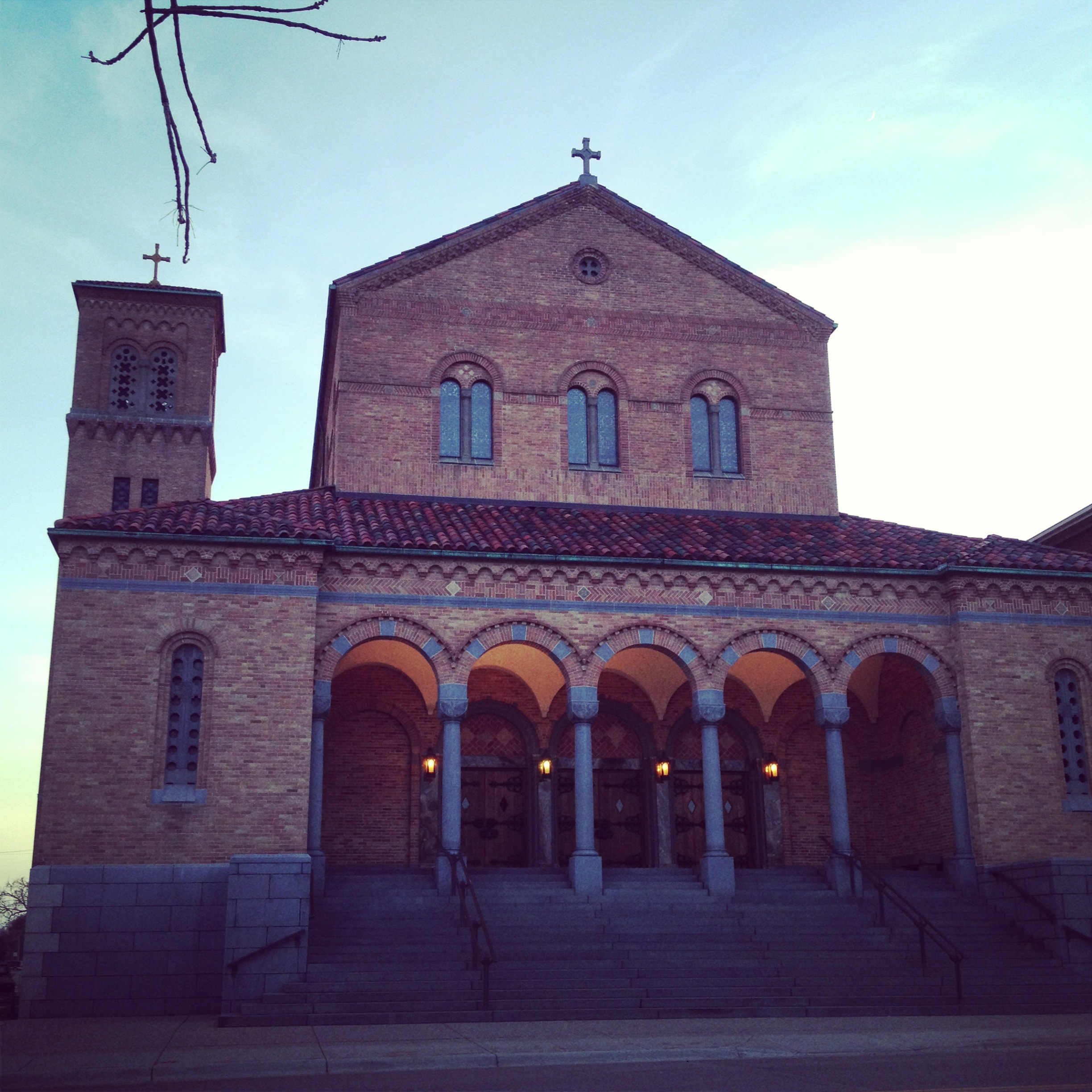
(Cathedral of St. Mary, St. Cloud, Minnesota)

All of my genes come from one county in central Minnesota.  Spending time there as a girl with my father’s family, seeing my paternal family name on gravestones in churchyards, hearing my grandmother’s stories about where the first pioneer of our family settled on “that very hill!”  My mother’s family, from the same area, was the quiet, present, forbidden topic.  I don’t remember a time that my biological parents were together, and rarely visited the area with my mother, so my experience of this county is fragmented, though my relatives may very well have sat next to each other in church.

Last week, I went back there, to St. Cloud, for my great-grandmother’s funeral.  I saw the county and its people through my mother’s eyes again–the dozens of people who came to the wake lived on the same roads I’d traversed numerous times with my father’s family, but hadn’t stopped to introduce myself or say hello.

I remember always being so curious about my mother’s family and her own time in St. Cloud where exactly she practiced throwing pots, where her grandparents had lived and worked, the places that meant something to her and to that ancestral half of me.

Running the St. Cloud State campus the morning of the funeral, I realized that my mother’s family was something like God’s family should be for each of us: my father’s family (while visiting the county) was present, obvious–they sat next to me at the dinner table and drove me around; my mother’s family was there too–in the grocery store, perhaps, or walking along the same street toward a movie–I just didn’t know they were next to me, too.  God’s family is not always easy to identify–we don’t know who is part of our family in God–but we know as surely as they are part of our blood that they surround us and we belong to each other.