

The Mistake of the Mustard Seed – Trinity Cathedral

20131005-220716.jpgIn the Gospel lesson today, Jesus says, “‘If you had faith the size of a mustard seed, you could say to this mulberry tree, ‘Be uprooted and planted in the sea,’ and it would obey you.'” (Luke 17:6)

The mistake is to think that it’s about us.  It’s not about our lack of faith, or the struggles the disciples were facing, asking the Lord, “Increase our faith[!]” (Luke 17:5); it’s not that our hope in the living God measures up to less-than-a-mustard-seed’s worth in the scheme of things.  This passage is one time of many throughout all Scripture in which God explains how things work in his kingdom–in the place he wants our hearts to dwell.

Prophets throughout the Old Testament say again and again, “repent!  turn back!”  And they tell the people to whom they preach that it takes only a little shift to bring God rushing in.  God is waiting at the gates, calling out for us, waiting for us to throw him just a mustard-seed’s-worth of trust, and he will burst open the gates and make things change which seem impossible–even things like moving trees and mountains.

There’s another piece to this Gospel lesson today, and it has to do with the way that God’s kingdom works, too.  The reality that we see with our eyes every day isn’t the whole story of the world.  We learn in Scripture, and often through our experience, that there’s a lot more going on than what we can pick up just by looking around.  Living in this broken, mysterious world, we are used to thinking that power means big chairs and high buildings and offices with lots of windows.  Jesus tells us in our Gospel lesson today that power in God’s kingdom looks nothing like that at all.  By his difficult words about the obedient slave, he shows us the example that he himself will live out when he washes the disciples’ feet.  The least among us will be the greatest.  Those who humble themselves will be exalted.  Grabbing for power is helpful for this life, but giving up power is helpful for eternal life.  We’ve been hearing this message again and again through the last months’ readings, last week we heard about the Rich Man and Lazarus, recently, the Epistle to the Hebrews was exhorting us to hang on to those invisible things that are eternal.  This is the Christian faith.  Giving up our grabby attitude toward power, and turning, even just a little bit, toward our Lord.

Timothy, who is a Christian sort of like you and me–he never met Jesus, and wasn’t one of the “12 disciples”–he was just a normal Christian leader, trying to figure out how to be faithful. He is encouraged  in our Epistle lesson (2 Timothy 1:1-14) this morning, to claim the gift of God he was given through the laying on of hands.

Each confirmed Episcopalian in this room has had the hands of a bishop on his or her head (and you can trace the hands that were laid on our Bp. Waldo, or any bishop, back to who laid their hands on him, and back all the way to Jesus and the disciples!).  You have received this gift of faith; you have turned, even if just a little, toward God, and God has rushed at you!  Of course, you don’t have to go through Confirmation for God to know that you’ve turned toward him; just telling God so, asking him to fill you with his Holy Spirit and his power is all you need.

I know I’m sounding a little Evangelical here, but that’s how I was raised, and anyway, we’re in the South, revivals still go on here every autumn.  Though Confirmation and some versions of “getting saved” are one-shot deals, stepping into a lifestyle that acknowledges and even assumes God’s kingdom is not a one-time faith door-buster.

We turn away from God again and again, and must turn back toward Him just as many times.  We so easily forget that in the world that God rules, in His kingdom, success isn’t measured by where we live, or the sorts of vacations we can afford.  In God’s kingdom, which exists right alongside and tangled up with the parts of the world that have turned away from God, we are encouraged to rely on the power of God, to preach always to everyone the Good News that Jesus Christ is risen, that we need not suffer eternal death.

We are to live with the awareness that the Holy Spirit wants to always work in and through us to help others realize and understand the truth and power of our living God.  We strive to discern God’s voice, and to obey it.
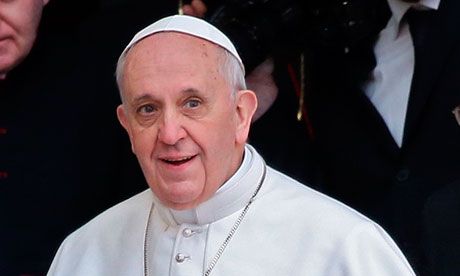
A Novel Leader: Is Francis New News?

Pope Francis

(via Photograph: Alessandro Bianchi/Reuters)

Excerpts from a Guardian article on the Pope:

“‘A person once asked me, in a provocative manner, if I approved of homosexuality. I replied with another question: ‘Tell me: when God looks at a gay person, does he endorse the existence of this person with love, or reject and condemn this person?'”

We’ve heard that sort of answer somewhere before, I think.  Answering a hostile person’s loaded question with another question, gently and compassionately ridiculing the supposed boundaries of the combative question being asked (Luke 10:25-26; Luke 20:3; John 18:33-34).

Explaining his decision to live in “The Casa” (where he was housed during the discernment and election of the new Pope last spring) at the Vatican instead of the tradition Papal apartments: “I cannot live without people.”

What do the first chapters of Genesis lay out for all humanity to read, but that God himself committed in the beginning to never live without people?  Where people are, God is in their midst; God is present.  This is the story of Scripture, this is the Gospel–because of God, incarnate in Jesus Christ, we are never alone.

On women as part of the church body: “The feminine genius is needed wherever we make important decisions.”

Didn’t someone else speak out by word and action about women’s important place in society and in communities of faith?  This other man spoke to women of impure blood, and allowed a prostitute to touch him (John 4:7).


Pope Francis is a man deeply steeped in prayer and Scripture.  He is not upsetting the whole of the Roman Catholic Church, he is not reversing the tide of Roman Catholic theology, or doctrine, or practice.  By the examples above, he’s sticking just about as close to the classic Christian game book as a person can!  Francis is, for whatever reason, someone that our media and our wounded and our skeptics can hear in a way that we haven’t been able to hear and to listen for many, many years.

Isn’t it a beautiful wonder that simply stealing pages from Jesus’ playbook is still, thousands of years later, considered radical and exciting and irresistable?

What is it, do you think, that makes him someone to whom the world is willing to listen?

“No Loss of American Life” Sermon – Trinity Cathedral – Proper 17 C

“Whoever comes to me and does not hate father and mother, wife and children, brothers and sisters, yes, and even life itself, cannot be my disciple.” (Luke 14:26)

In the name of the Father and of the Son and of the Holy Spirit, Amen.

This is the same Jesus who suffers the little children to come unto him and offers an easy yoke and a light burden.  How can this be?  Let us not try to explain away the difficult words with which we are faced this morning; let us reflect upon what this passage tells us about God, and about our relationship to him.

The parables leading up to this passage in Luke, which we’ve been hearing the last few weeks, put an ever-finer point on Jesus’ message and revelation of himself.  Those dearest to him are the crippled, the orphaned—those who cannot repay any a transactional way the kindness shown to them.  Jesus gives his followers a new definition of family here—of who it is that qualifies as our mother and father and neighbor.

We are to love our fathers and mothers and siblings, of course, but we are to love these fellow disciples in the pews next to us, and even more, to love our guests who are eating breakfast in Satterlee Hall right now, to love those sitting in jail, and those who are oppressed, here and abroad.  These are our family members, if we desire to be part of the family of God.

I have a friend from divinity school who came from a good, upstanding family, a long line of doctors and brothers who earned graduate degrees.  When it became clear to his parents that he was going ahead with his foolhardly plan to become a priest, he was told that he’d been a “bad investment” and was financially and emotionally cut off from his family.  He lost father and mother and blood-relations in order to be Jesus’ disciple.  As inconceivable as that story may be, it is almost predictably common in Scripture.  A prophet’s mother or friends or community is always ready to stone him for being a follower of the living God.  The family’s plea may be loving enough—“choose another son to send into the fray, not mine!”—but in this family, born through baptism, I am no more, and just as precious as any other of God’s children

In Lillian Smith’s book, Killers of the Dream, first published in 1949, she recounts the moment that a young student realizes the cost of fighting segregation.  The young woman says, “No matter how wrong you think it is, laws are against you, custom is against you, your own family is against you.  How do you begin?  I guess,” she said slowly, “if you hated your family, it would be easier to fight for what is right, down here.  It would be easier if you didn’t care how much you hurt them.”

We naturally show favoritism.  We love and share bonds of affection with particular people; some of this is just practical—a usual person cannot manage more than about 125 friends at once.  But we also must realize that Jesus insists that the family that is more important than blood is our family of disciples, those who follow Jesus with us, and the family of the poor, the war-torn, the oppressed.  These people are our family, throughout the world—these people are our neighbors.

On the cross, Jesus Christ risked all that he hand—his own life, his relationship with God the Father—in order to be and to stay with us, with all humanity.  We abandoned him on the cross as he bore our sins, and because sin, fundamentally, is turning away from God, he was without God the Father, as well.  Totally alone, in the deepest suffering, though he could have gotten himself down from the cross, Jesus stayed.  Jesus Christ chose to be with us—this is how God reveals himself to us.  As my favorite preacher, Sam Wells puts it: God has chosen never to be except to be with us.

This brings us back to the Gospel text today; as God’s disciples, the followers of Jesus, we are invited and beckoned to join in God’s work here and now, to love not only those for whom we have natural, blood-line, or you-look-like-me kind of affection, but God-given, uncomfortable, I’ve-never-met-you-but-you-are-my-family sort of love for all of our neighbors—realizing that their lives are just as precious in God’s sight.  Jesus died to be with every single person on this planet, no matter where they happen to live.

There’s a Roman Catholic Italian family from Staten Island who now lives in Upstate New York; I met them when I was working in their small town in the Catskills one summer.  I met them by chance—their children were the same age as some children I’d been babysitting one evening, and I’d hardly introduced myself before they were enveloping me in hugs.  Before I left a month later, they gave me a key to their home, saying, “This is your home now, too.”

I was a stranger from another land, but they loved me and cared for me as if I was their daughter.  How might we be able to love and care for those who are our brothers and sisters, whether here in Columbia, or elsewhere in the world?

As writer Glennon Doyle Melton often reminds her readers, “We belong to each other.”

One Sure Thing

20130906-105958.jpgLast weekend, I was in Cooperstown, New York. This is the place where I learned what it was to be a parish priest, where I fell in love with the vocation, and where I’ve been stretched and challenged within an inch of my life to do my best at that job. The places (geographically) where great pain is experienced and lived through are sites of enormous comfort. When I return to Cooperstown, or Grand Lake, or Durham, I feel like the rocks and trees and wooden siding of buildings understand me and are full of those powerful memories–they’re witnesses to the battles fought.

People are witnesses, too, of course, and they can be a comfort, but there’s something about buildings and mountains and lakes and particular bits of earth (on which one stands and remembers a vantage point) that is somehow deeper, perhaps because of their stability and unchangingness. The unsettling thing is that even cities, buildings, and bits of earth change. You remember your backyard growing up as a place of great meaning, but when you return to your childhood home decades later, it’s almost unrecognizable–the trees have grown so that the sun is not at all the same, the new owners have re-modeled the flower beds; it’s not the same place anymore, the place you knew is lost.

God promises, though, that he is the same yesterday, today and forever. In this week’s Epistle lesson, Hebrews 13:1-8, 15-16, we hear the witness of faithful people in the past who believed and trusted that, “Jesus Christ is the same yesterday and today and forever” (v. 8). This is what the church’s Gloria Patri says (“Glory to the Father, and to the Son, and to the Holy Spirit; as it was in the beginning, is now, and will be forever, amen.”).

The first part of Hebrews 13 recalls Abraham, Joseph, and the prophets by their faith-filled acts: Abrahahm “show(s) hospitality to strangers, for by doing that (he) entertained angels without knowing it” (v.2); Joseph was first sold into slavery, then was imprisoned unjustly (v. 3) but didn’t turn away from God because of his circumstances; and the prophets, fairly described as “those who are being tortured” (v. 3) exactly because they refused to turn from God–to renege on God’s promise of being unchanging himself.

“Let marriage be held in honor by all… for he has said, ‘I will never leave you or forsake you.'” (vs.4-5) The witness of Christian marriage is an effort at humans committing–in God’s strength–to be faithful to each other despite changes in themselves and their circumstances. This is the commitment that God makes to us–that he will never leave or forsake each of us, that he will be with us when we have no home like Abraham, or when we are isolated like Joseph, or when we are being persecuted like the prophets. God remains the same, even when we change and when our worlds change.

“Be present, O merciful God, and protect us through the hours of this night, so that we who are wearied by the changes and chances of this life may rest in your eternal changelessness; through Jesus Christ our Lord. Amen.”

(BCP service of Compline, pg. 133)

Jesus, or Pepper Spray?

Last week, my husband took a short overnight trip, leaving me with our 90-pound German Shepherd. Fierce.20130719-151423.jpg

Just in case those burglars got past Benedict, I started digging through our dozens of boxes, almost frantic to find my little can of pepper spray before I bedded down for the night. As I threw belongings out of boxes, searching for the black spray can, I realized, “If someone who wants to do you harm gets as far as your bedroom, God might be more effective than pepper spray…”

did find the spray, and it stayed by my bed, but I also considered what it meant that deep down, I felt calmer with the little metal can next to me (which I can hold, and over which I have control) than I did knowing that God was there with me, too.