Prayer for Lent

“O God! If I worship You for fear of Hell, burn me in Hell,
and if I worship You in hope of Paradise, exclude me from Paradise.
But if I worship You for Your Own sake, grudge me not Your everlasting Beauty.”

(Rabia al Basri, Sufi mystic)

This Lent, consider the forty-day journey as an experiment in adoration.  Seek not what God can do to or through you; seek God himself.

If you seek God in the wilderness–away from everyday distractions, painkillers, and noise, who might God reveal himself to be this Lent?

NBC’s Parenthood. and Jesus.

Shouldn’t we all live in Berkley, California?

Watching last week’s episode, as the four adult siblings gather to support one of their ranks who’s found herself unexpectedly alone, I felt a twinge–my adult siblings live spread throughout the United States, a sad reality for many modern families (though a happy opportunity for each one of us in our life paths).  The many seasons of this television show have always focused around familial support–the kind of love that’s harder to show from far away, since it’s more centered around sitting together in waiting rooms, showing up unannounced with pizza, and struggling through everyday life together.

Though we often do a bad job of it, there’s a reason God calls Jesus Christ his “Son,” and why people are referred to as “co-heirs,” “brothers and sisters,” and “family” throughout Scripture, we all belong to each other (as Glennon Doyle Melton often puts it).  So whether or not we were raised in the same house, we’re now continuing to grow together in the same house–God’s–and we’re called to be brothers and sisters to each other because we all belong to God.

The glorious freedom of Christianity is that we aren’t limited to bloodlines or last names; our family is everyone who belongs to God (which is everyone. period).  Often, I feel a little sheepish or tentative about reaching out boldly–as a sibling might–to offer love, support, a shoulder, to someone; the only way to change our communities is to change ourselves.

Sometimes all we need is some take out and a bottle of wine.

How to be Holy

“The Lord spoke to Moses, saying: Speak to all the congregation of the people of Israel and say to them: You shall be holy, for I the Lord your God am holy.” Leviticus 19:1-2

Holiness is not something that humans come by themselves; it’s something we as spiritual beings can make room for, but we can’t work up on our own.  We are holy because the Lord our God is holy–it is God’s holiness that covers us, that infuses us, and transforms us into holy people.

This week’s lectionary passage goes on (verses 9-18 of the same chapter–see below) to give some specific guidelines about what holy living looks like; each declaration is ended with the same refrain, “I am the Lord” (vs. 10, 11, 12, 14, 16, 18).  It’s a sort of short hand to remind the people at the end of every law delineated that it isn’t the peoples’ own effort that will bring such generous, respectful, strange and particular living about, but God’s grace and holiness flowing through their lives that will enable such curious actions and lifestyle.

Not just the statutes laid out in Leviticus 19, but all the 600-some laws throughout the Old Testament were established by God not to hem his people in, or to cause them to trip up, but to help the people recognize that they were different.  God had chosen them, put his mark on them, and to the world, these people, the Israelites, were supposed to be so different from all the other people that others would ask why on earth they were so strange.  They were strange–or were supposed to be–because they belonged to God; the Lord our God made them holy by his own holiness.

As we butt up against Lent, preparing to go into the desert with the Israelites and with Jesus, we consider the holiness that God graciously clothes us in through his Son, Jesus–not because of anything we do, or anything we promise that we’ll become, but just because each and every one of us is worth loving.  It’s a world full of curious, wonderful, beloved people–and you’re one!

9 When you reap the harvest of your land, you shall not reap to the very edges of your field, or gather the gleanings of your harvest. 10You shall not strip your vineyard bare, or gather the fallen grapes of your vineyard; you shall leave them for the poor and the alien: I am the Lordyour God.

11 You shall not steal; you shall not deal falsely; and you shall not lie to one another. 12And you shall not swear falsely by my name, profaning the name of your God: I am the Lord.

13 You shall not defraud your neighbour; you shall not steal; and you shall not keep for yourself the wages of a labourer until morning. 14You shall not revile the deaf or put a stumbling-block before the blind; you shall fear your God: I am the Lord.

15 You shall not render an unjust judgement; you shall not be partial to the poor or defer to the great: with justice you shall judge your neighbour. 16You shall not go around as a slanderer among your people, and you shall not profit by the blood of your neighbour: I am the Lord.

17 You shall not hate in your heart anyone of your kin; you shall reprove your neighbour, or you will incur guilt yourself. 18You shall not take vengeance or bear a grudge against any of your people, but you shall love your neighbour as yourself: I am the Lord.

giving growth

2014-02-24 15.22.50

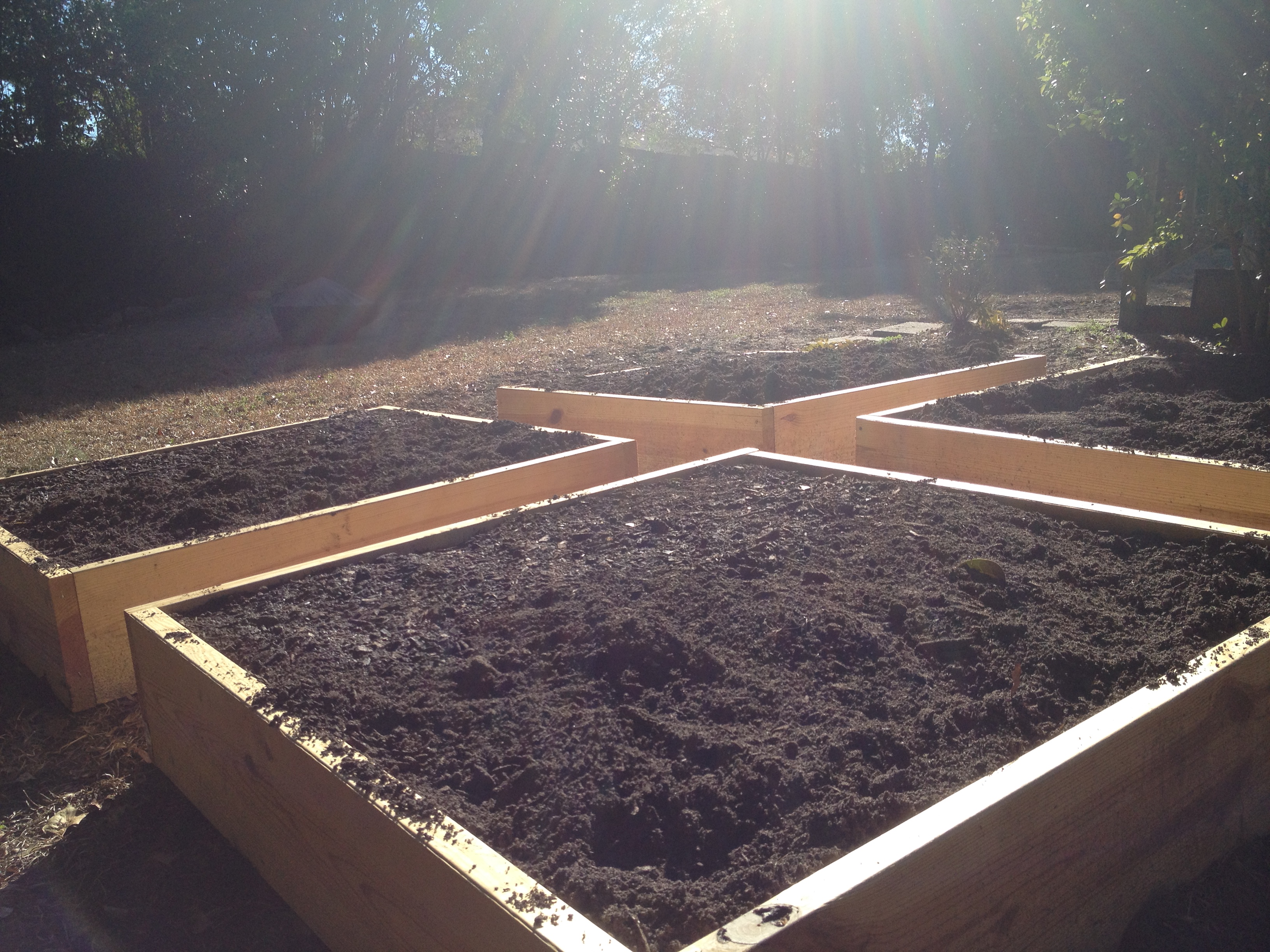
Seeds are such mysterious things.  Here in South Carolina, it’s already time to start planting the hardier stuff–greens, roots, some herbs, so I took advantage of the sunny, warm days over the weekend to fill up my boxes, sprinkle some seeds, and water the soil.  I’m always amazed when I open the little paper packets at how small and wisp-like seeds produce these (comparably) huge, delicious, totally-different-looking fruits and vegetables.  Last week’s lectionary epistle lesson has been bouncing around in my head as I’ve been working the dirt:

“You are still worldly. For since there is jealousy and quarreling among you, are you not worldly? Are you not acting like mere humans? For when one says, “I follow Paul,” and another, “I follow Apollos,” are you not mere human beings? What, after all, is Apollos? And what is Paul? Only servants, through whom you came to believe—as the Lord has assigned to each his task. I planted the seed, Apollos watered it, but God has been making it grow. So neither the one who plants nor the one who waters is anything, but only God, who makes things grow.” 1 Corinthians 3:3-7

Looking around the church (all people who call Jesus their God and Savior, believing in the triune God) these days, it’s hard to ignore the battle lines that crisscross Jesus’ body throughout the world like the scores in a ham.  Screwtape’s words, through C.S. Lewis’ voice, come to mind once more:

“We have quite removed from men’s minds what that pestilent fellow Paul used to teach about food and other unessentials–namely, that the human without scruples should always give in to the human with scruples. You would think they could not fail to see the application. You would expect to find the “low” churchman genuflecting and crossing himself lest the weak conscience of his “high” brother should be moved to irreverence, and the “high” one refraining from these exercises lest he should betray his “low” brother into idolatry. And so it would have been but for our ceaseless labour. Without that, the variety of usage within the Church of England might have become a positive hotbed of charity and humility.”

Of course, part of the trouble is discerning which things are inessential–a literally life-and-death matter which I don’t mean to downplay–but what draws me more this morning  is the solution which Paul offers: God gives the growth.

I can put good soil in my boxes, and plant the seeds, and beg the sun to come and warm up the dark dirt, but all I’m really doing is making room for growth to happen, giving the best environment possible–making room for a miracle to happen.

In our lives, we choose how to use our time–what kind of soil (habits, relationships, mental tape loops) we put in the boxes of our minds, our spirits and our bodies.  We choose the sorts of things we read, watch, eat and ingest–the seeds we plant in our boxes; and we choose how to nurture those seeds with the sunshine and water of prayer, spiritual disciplines, service, and learning.  Then we’ve done all we can–we can’t make growth happen, in our own lives or in the lives of our churches.

We cultivate, plant, and water, but the growth itself is out of our hands; we prepare and we present ourselves–make ourselves open and ready to be transformed.

God, come into the spaces we make and grow us.  Show us how to make room to be open and to be transformed.

The Original “Lean In”

Sheryl Sandberg has stolen from Jesus.  As usual, Jesus is pretty gracious, and as far as I know, Sheryl hasn’t yet been struck dead, but you hear the words of Sheryl’s best-seller in our Gospel text for this morning: “if anyone forces you to go one mile, go also the second mile” (Matthew 8:41).  Sandberg is the COO of Facebook and author of the book “Lean In.”  Her message is more specifically about women in the workforce and in society, but she’s tapped into something much larger, deeper, and more important than how to narrow the gender gap in Fortune 500 companies.

Part of what made her words so popular is that they don’t quite line up with the messages that we’re used to hearing from secular sources.  She challenges her readers that when doors start to close, you should stick your foot in them before they shut completely, when someone won’t answer you, knock harder instead of walking away.  Women throughout history have been known as the necks that move the heads of state; gaining ground through unofficial back channels–there are plenty of examples in the Old Testament alone.  To face problems head-on and refuse to back down is how Sheryl asserts women should tackle the last hurdles toward gender equality.  This is not the way that most women have been taught to respond to resistance; giving away a shirt is not the way most people have been taught to respond to someone who demands your coat.

Of course her audience is women in the workplace, and the dogged ambition that motivates the message might raise some concern, but I wonder why we don’t approach God’s message with the same ruthless determination.  Through Jesus, God teaches us a new kind of math in this Sermon on the Mount: meant to awake in the hearer the story of Moses and Mt. Sinai, Jesus gives a new summary of the law here in the fifth chapter of Matthew.  You hear again and again the refrain, “You have heard it said… but I say to you…”  Jesus is painting the picture of the Gospel as clearly as he can: when someone wrongs you, lean in.  When someone steals from you, lean in.  When all sorts of evil comes your way, batten down the hatches, turn your face toward the rain, and let it do its worst.

The strength to face these trials comes not from ourselves but from God, through the Holy Spirit.  It is only when we’re leaning on God that we can lean in to the kinds of lifestyle that Jesus is outlining for us in the Gospel lesson today, and that’s what the whole of Scripture is about.

In our Old Testament reading today (Leviticus 19:1-2, 9-18), we hear about the ways that God set out for his people, the Hebrews, to behave.  They were to avoid corruption and deception, they were to be generous and fair to each other, to the less fortunate, and to the strangers in their midst.  At the end of each exhortation or law, there is a refrain, “I am the LORD.”  It refers back to the beginning of the passage, where God says to Moses, “You shall be holy, for I the LORD your God am holy” (Lev. 19:2).  It’s a sort of shorthand, you see–every line, every law that’s being laid out by Moses to the people on God’s behalf is about holiness.  It’s about living in a way that imitates God, that makes the world holy like God is holy.  That’s what being “sanctified” is–being made holy.

Even back in Leviticus, God knew that we humans weren’t quite capable of being holy on our own.  God says that his people will be holy because of his own holiness–the promise that God made back in Leviticus came true when Jesus arrived on the scene.  That’s part of the reason why Matthew’s gospel draws so many lines back and forth between the Old and New Testaments–he wants his readers to see clearly that God is fulfilling his centuries-old promises in the person of Jesus Christ.

So, how do we live these words that God has given us today?  How do we “lean in”?

The truth that we know deep down, that we see witnessed to in the pages of Scripture, and that we hear in our prayers every Sunday, is that we can’t “lean in” on our own.  We can’t make ourselves do any good thing apart from God’s power through the Holy Spirit.  We’re helpless to our selfishness, our desire to keep our coats, to do the bare minimum required, to ask for our possessions back as soon as we lend them out.

And so, we pray.  We use the words that God himself taught us through Jesus in the Lord’s Prayer, we use words that faithful people throughout time have used in our Book of Common Prayer, we use our own words, offering up our souls and bodies to be used by God.

What does God do?  He sent his son, our Lord Jesus Christ; we disciples take this gift into our own bodies in the Eucharist every time we gather here together.  He sent the Holy Spirit to transform us into holy people, to give us strength to lean in when we have got nothing left.  From the beginning of God’s relationship with people, he’s always told us that he is only as far away as we push him; he’s always standing just as close as we’ll let him, ready to give us the strength we need to face whatever evil may throw at us to try to destroy us.

“You have heard that it was said, `You shall love your neighbor and hate your enemy.’ But I say to you, Love your enemies and pray for those who persecute you, so that you may be children of your Father in heaven” (Matthew 5:43-45).  No matter how hard evil and violence push, God pushes back with peace and love.  Through his strength, which we gain in prayer and in our sacraments, we can push right back, too.

We have learned through the life, death, and resurrection of Jesus Christ that when death–the greatest evil–does its worst, God’s power is still stronger.  Jesus is the Messiah, the Son of the living God; this is the truth upon which each of us may stand–and when we do, even the gates of hell cannot prevail against us (Matthew 16:16-18).

Amen.