
How I Became Episcopalian, Part 2

There’s an Episcopalian joke I like to tell: some parishioners went to their rector and said, “Father, we want to do a Bible study.  What book should we start with?”  Their rector, taken aback, but quite pleased, suggested they start with the Psalms; he showed them where it was, near the middle of the Bible, and told them to come back in six weeks and tell him what they’d learned.  Six weeks passed, and they came back to his office, rather upset.  “Father!” They exclaimed, “The Bible has stolen its material from the Book of Common Prayer!”

Last week one day, the Daily Office Lectionary assigned Philippians 4:1-9; a passage with 3 or 4 separate highlighter marks in my trusty hard-backed NIV Bible from high school.

The passage epitomizes why I became Episcopalian.  As I read, or listen to, these words, I hear memory verses in verses 4, 5, 6, and 8—sentences I committed to memory as an elementary or high school student:
“4 Rejoice in the Lord always; again I will say, Rejoice. 5Let your gentleness be known to everyone. The Lord is near. 6Do not worry about anything, but in everything by prayer and supplication with thanksgiving let your requests be made known to God.
8 Finally, beloved, whatever is true, whatever is honourable, whatever is just, whatever is pure, whatever is pleasing, whatever is commendable, if there is any excellence and if there is anything worthy of praise, think about these things.”

In verse 4 I hear the lyric to a children’s song I learned more than twenty years ago at home.

Verse 7 is the common blessing offered during Ordinary Time at the end of a Eucharist service:
“And the peace of God, which surpasses all understanding, will guard your hearts and your minds in Christ Jesus.”

When verse 8 is read, I hear part of a prayer said during the service in the Book of Common Prayer called, “Thanksgiving for the Birth of a Child”—a service I relish offering at hospitals when I visit the newest members of my congregation.

The psalms have become the same kind of patchwork quilt for me—snippets and echoes of other Scripture passages pop up in the psalms all the time, and in turn, the psalms are woven throughout our Book of Common Prayer.
The little red (or black) book that guides Christians of the Anglican tradition in their prayer, worship, and study with God is a puree of Scripture, set to rhythm and mashed up to show through its very being how the God of the Old and New Testaments is made man in Jesus Christ.

the liturgy of our lives

“The horror of the Same Old Thing is one of the most valuable passions we have produced in the human heart–an endless source of heresies in religion, folly in counsel, infidelity in marriage, and inconstancy in friendship.  The humans live in time, and experience reality successively.  To experience much of it, therefore, they must experience many different things; in other words, they must experience change.  And since they need change, the Enemy (being a hedonist at heart) has made change pleasurable to them, just as He has made eating pleasurable.  But since He does not wish them to make change, any more than eating, an end in itself, He has balanced the love of change in them by a love of permanence.  He has contrived to gratify both tastes together in the very world He has made, by that union of change and permanence which we call Rhythm.  He gives them the seasons, each season different yet every year the same, so that spring is always felt as a novelty yet always as the recurrence of an immemorial theme.  He gives them in His Church a spiritual year; they change from a fast to a feast, but it is the same feast as before.”

The Screwtape Letters

Here’s (above) how I ended up Episcopalian.  Just as our days have rhythm–wake up, eat, go to school or work, exercise, eat, socialize, sleep–and our weeks have rhythm, experiencing both new things and The Same Old Thing, so why not our worship, too?  Most every church has a liturgy, whether that’s what they call it or not.  Growing up, I went to a church where we’d gather on folding chairs every Sunday at 10am in an elementary school cafeteria.  We’d join in singing together to the words projected on a video screen (this was new technology–no overheads with copied transparencies for us!).  Afterward, we’d sit, and hear the three-point sermon our pastor had prepared.  We’d pray, and then we’d pack up the cafeteria.  This order of service is a liturgy–it’s what we did every Sunday.  In its basic form, it’s exactly what people who worship God have been doing for centuries–millenia, even–when they gather together to worship the Living God.

Near the end of college, I stumbled into a Roman Catholic Church.  It wasn’t totally foreign, I’d been to plenty of services growing up, but this time was different for another reason–there was something about the prayers we prayed together that made me realize that Christians had been praying that prayer to God for thousands of years.  Far from such a prayer seeming worn out or prosaic, somehow, its age gave it great power.

I wonder if some of its power is because it was The Same Old Thing.

Everybody goes to weddings; and everybody–especially lovers of The Princess Bride–knows the first words that are said, “Dearly Beloved…”–right?  When we hear those words, sometimes they sound worn out, but even when they do, we minds can’t help but jump to other times we’ve heard those same words–when Grandma and Grandpa renewed their vows, 50 years on; when you were a flower girl or ring bearer and noticed that you were at your first wedding; perhaps, when you yourself were married.

It’s almost as if all those different celebrations and different moments stacked up in time one on top of the other, so that in a way, all of them were happening again in your mind’s eye.  I think that’s a little bit of what Screwtape means when he says that humans experience reality successively–we think of those events as having happened on May 17, 1999 ,or April 20, 2004, or July 2, 2011–but in another way, a spiritual way, all those moments when those words align all happen at the same time.  It’s not just the family members at Grandma’s and Grandpa’s renewal of vows, it’s all the people who were there the first time round and all the people who were at their parents’ weddings when those same words were said.

I became part of the Anglican Communion because this messy, passionate group seeks to pray together, not only with each other, but with others around the world and throughout time–that all our prayers may, in a way, stack up on top of each other and allow us to see God more clearly by our communion.

The Lower Diocese

As of tomorrow, my husband and I will have lived in Columbia for a whole month (!). We’re part of the Episcopal Diocese of Upper South Carolina, and as you dear readers might know (or might not! or might not care one hoot!! which is just fine), there is an Episcopal Diocese of South Carolina, which comprises the lower part of this great state, and has been the subject and site of much upheaval in our denomination of late.

There are myriad articles and essays and sermons which deal with the facts of this unfolding situation; I cannot attempt to describe or summarize them in any authoritative or competitively-excellent way. Here I share, instead, a bit of my lament.

DSC_0044I don’t recall the first time I went to Charleston, but I know it was spring (very brilliant of me) and I know I was taken with St. Philip’s Church. Its steeple is brown and stony and majestic, its shadow is cool, its graveyard is full of wisdom. On my second or third visit, I discovered St. Michael’s Church, just a few blocks away from St. Philip’s, and stood breathless under its white outline. Old churches have always had a hold on me, and these two beautiful sacred spaces were no less gripping. Can you imagine the number of faithful people who have spent their lives praying in those pews, shuffling down those aisles, marking their births, marriages, friendships, and deaths by those walls and windows? Imagining the hundreds of years of prayers soaked into the stones and hanging in the air brings a reverent smile to my face. I close my eyes in the glow of God’s presence in these places, and how parishioners have learned of and experienced God in these spaces.

Two weeks ago, I went to Charleston again, for the first time in a year. It was a big year to have not-been in Charleston (the rupture I allude to above puts the future of these buildings in jeopardy). I teared up when my husband and I pulled into a parking spot near St. Michael’s. My hands caressed the white columns, mournful of the *(figurative–not literal, yet) brokenness in which this beautiful building sits. We walked to St. Philip’s Church, and I remembered my first visit–my enamored attitude with the building despite my ignorance of my call at the time.

God is bigger and more full and more perfect and more sovereign than could be overcome by the loss of these buildings–of course; I know that they are just things, just symbols to us of heaven and of God’s glory, meant to aid us in our worship. However, they’ve been important symbols for centuries–they were spared General Sherman’s fire!–and now they might fall. Their stark beauty, their noble shape–these sacred spaces stand as a challenge to the passing squabbles and divisive disagreements of our day; they survived the Civil War, for heaven’s sake! The brokenness in the Episcopal Church these days is not just a passing squabble or a disagreement, we’re struggling with what it means to love and what it means for Scripture to be authoritative. For at least two thousand years, we’ve been struggling with these things, as Christians, and there has been lots of collateral damage–plenty of lives, which are more important than any building.

But I really hope that these buildings can continue to stand as a witness to us little people of God’s glory, his power, his far-reaching love, and his desire that all may be made one body with him.

into the cloud. on transfiguration

2013-01-29 08.18.42

“…a cloud came and overshadowed them; and they were terrified as they entered the cloud.  Then from the cloud came a voice that said, “This is my Son, my Chosen; listen to him!” (Matthew 9:34b-35)

20130210-183737.jpg

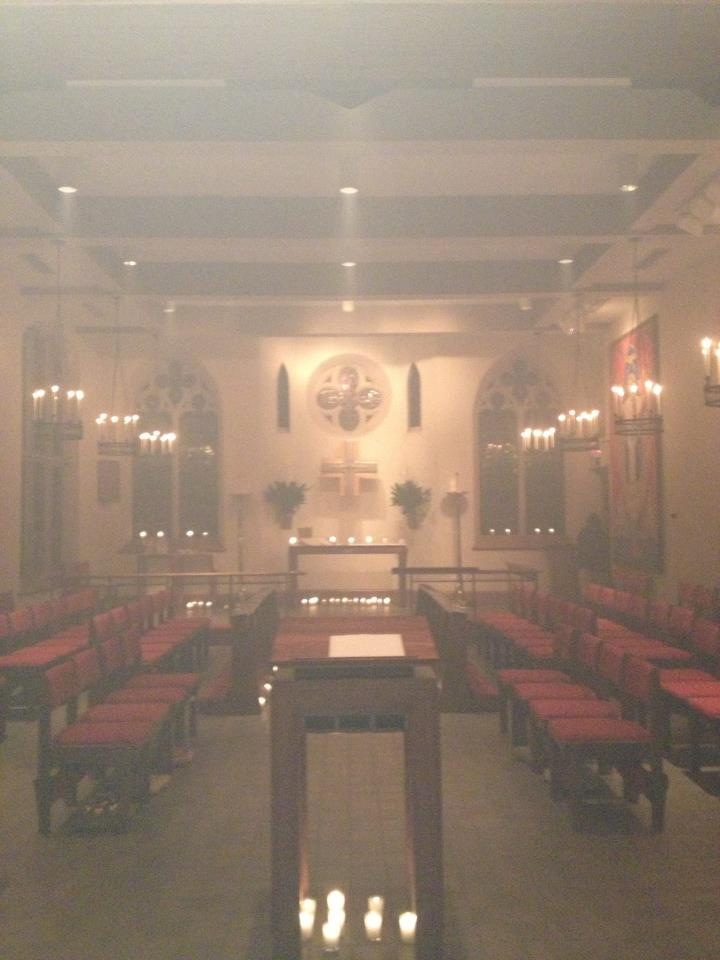
When the Gospel passage of the Transfiguration was read last Saturday evening during our Vigil service, another one of the imports of incense dawned on me.  I happened to be thurifer last week, making me the cloud-maker for the evening; throughout the service, as the incense swirled around us, we quite literally entered a cloud.  The smelly (in a good way, to my nose) incense enveloped us and we dwelt in the closest thing to a blanket of mist that people can easily create themselves.  That’s why we use incense (among many other reasons).  It moves us into the cloud.

It’s not just any cloud.  As we read in our Isaiah Bible study this week (ch. 19), God’s communication with humanity is often through a cloud (this was a big-deal connection to the Church Fathers–see Cyril of Alexandria, Gregory of Nyssa, John Chrysostom)–like the pillar of cloud that led the Israelites through the wilderness, God speaking out of a cloud at Jesus’ baptism, and God and Moses communicating through a cloud on Mount Sinai.  Clouds are often used in Scripture to remind us that God is near and so we use cloud, in incense, to remind us that God is in our midst when we worship together.

Join us at the corner of Wydown & Ellenwood on Saturday nights at 5 p.m. to worship in the cloud…