
Have you ever experienced a celebrity sighting? Until a week ago today, I hadn’t. Last week at lunch, my brother Ross & I braved the Nor’easter and went to Momofuku.

Have you ever experienced a celebrity sighting? Until a week ago today, I hadn’t. Last week at lunch, my brother Ross & I braved the Nor’easter and went to Momofuku.

Just last week, a favorite blogger of mine, Cup of Jo, highlighted this article which suggests a different approach to visiting an art museum: choosing one or two or three art works that speak to you in some way and spending a good chunk of time in front of each one.
When I visited the Met on Friday, I tried it.
There’s a room with three or four El Grecoes; we’ve got one of his Adoration of the Shepherds (above) prints in our dining room, but this time, I was struck by El Greco’s Healing of the Man Born Blind (below).
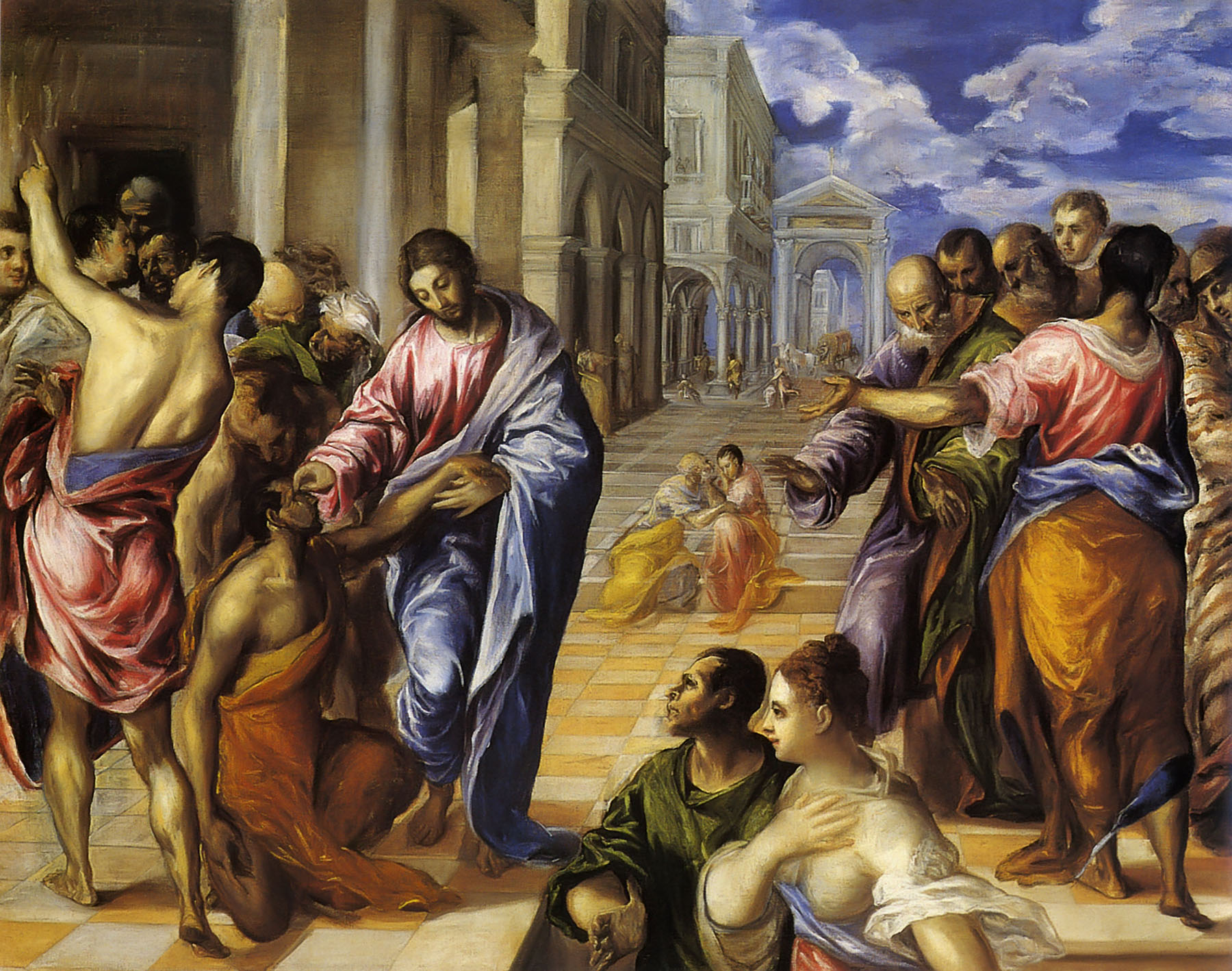
I sat and stared at this painting for probably about seven or eight minutes; studying its intricacies, noticing the way light was reflected off draped clothing, gazing intently at the faces and their displayed emotions. I’d had a really strange and wonderful experience earlier in the visit (to the Metropolitan Museum of Art) with John the Baptist and St. Francis, and the tree of Jesse (more in a post coming soon!), and in this particular image I was struck by how familiar the bald man in the right-center of the picture seemed to me.
And was here was a ton of energy because of what Jesus was doing in the middle of the painting, or in spite of` what was happening with Jesus and the man born blind?
It didn’t even really register with me till I found the photo of this painting online that the characters near the center-bottom of the image, who in the little info card next to the painting in the museum referred to as possibly the blind man’s parents, seem to be at least somewhat inter-racial–of course, I’d observed their skin tone, but it hadn’t struck me as strange till I electronically grabbed the image and remembered it’s about 500 years old.
El Greco is so much about texture, it’s hard to appreciate the image without his super gloppy painting style. It was well-worth a few extra minutes’ time.
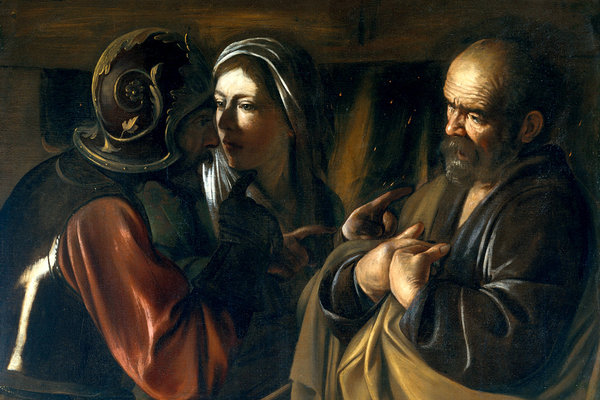
In hot pursuit of Spanish-influenced artists, I sought the Met’s collection of Caravaggios. That day, The Denial of Peter caught me. I sat and watched. Caravaggio’s use of light has captured my imagination since I saw something of his in a museum in Dublin. Peter’s face is fully lit–his aging bald head similar to the one I observed in El Greco’s piece–and all hand in the painting (even his own!) point toward him. We see the glint of the soldier’s armor, and the suspicious eyes of the woman near the fire, all judging whether Peter is part of the rabble-rousing troupe who had populated the courtyard that night.
How many times had I been in that courtyard, full light glaring in my face, trying desperately, defiantly, not to shield my eyes from the truth while at the same time denying its power over me?
Meditating on a few pieces, looking deeply into the true, hard work which the artists had put into their paintings, helped me to understand more deeply God’s movements in our lives.
What do you see in these paintings? Do you have a painting or piece of art that changed or expanded your understanding of God, or the divine, or the world?

Discovered this at the Met today, a painting by Jusepe de Ribera. There’s Peter, holding the keys to the Kingdom, and there’s Paul, with the hilt of a sword (alluding to this martyr’s death) leaned against the wall behind him.
You can see the conviction, passion, and respect each one has for the other. Their faces are only inches from one another, but you can tell, “>especially from Paul’s eyes, that they’re not about to spit in each other’s faces–there is deep, abiding trust and respect and zeal between them. They are brothers through Jesus Christ.
Here, they’re passionately debating the Matter at Antioch, according to de Ribera; which at least in part concerned the place of the Hebrews–Jews–and the Old Covenant since the chronological arrival of Jesus Christ.
I was struck at how this depicts in practically iconic form the strife of our own day and Church (Anglicanism). Because we are a body that stakes its claim on community and incarnation, we’re meant to fight it out and to disagree with vigor (but with compassion and patience!) rather than looking to one supreme ruler to hand down decisions, or breaking up into camps the moment we can’t see eye-to-eye. We in the Episcopal Church haven’t done a very good job of living into the example our brethren present to us above (or in Acts, or Galatians).
The thing I observe to be missing most is respect. More than “tolerance,” respect demands a patient and humble compassion. It is not that we are to cover up or ignore or avoid disagreements at all costs, but that when tension results amidst our convictions, we pursue them patiently, humbly, compassionately together.
May de Ribera’s piece serve as an icon for us, as we seek to be patient, humble, and compassionate with each other and with ourselves.

My “Faith, Hope, Love” series (arranged Hope – Love – Faith)
Preached Sunday, 1 June, 2014; Keenan Chapel @ Trinity Cathedral, 11:15am – you had to be there…
Who knows Rick Steves? Last night, Jordan and I were watching Rick Steves’ travel show–he’s a guy from the Pacific Northwest who makes sense for me of Jordan’s family living half in North Dakota and half outside of Seattle, Mr. Steves’ accent has strong Midwestern undertones, and his boisterous nature reminds me of my brother-in-law. Rick traipses around Europe with his camera crew, giving travel advice and showing off the great sights. We watched an episode he filmed in a French town named Colmar, where there’s a really beautiful piece of art, the Issenheim Altarpiece. It’s been one of my favorite artworks since I learned about it a few years ago.
Back in the Middle Ages, many altars–if the church could afford it–had a painting of Jesus behind them. Up in Cooperstown, New York, where I did my field education work in divinity school, there’s a painting of Jesus ascending (especially appropriate as today is the Sunday we celebrate Jesus’s ascension) behind the altar on the East wall. What’s notable about the Issenheim Altarpiece, as Rick Steves tells it, is that a religious order commissioned it to hang in their chapel, and this religious order maintained a hospital for people who suffered from skin diseases. They were much more serious than they are today, many people died from such diseases in Medieval times. The altarpiece it depicts Jesus being crucified, but his body is covered with pox marks and leprous wounds–he has the skin diseases that those who are looking at him suffer from too. This Jesus enters into the suffering of those who see him; he knows what they’re going through. Rick Steves–he’s Lutheran, you know–goes so far as to say that medicine and painkillers weren’t so effective back then, and that the altarpiece served as a sort of salve for these dear people, saying to them, “Jesus knows how much it hurts.”
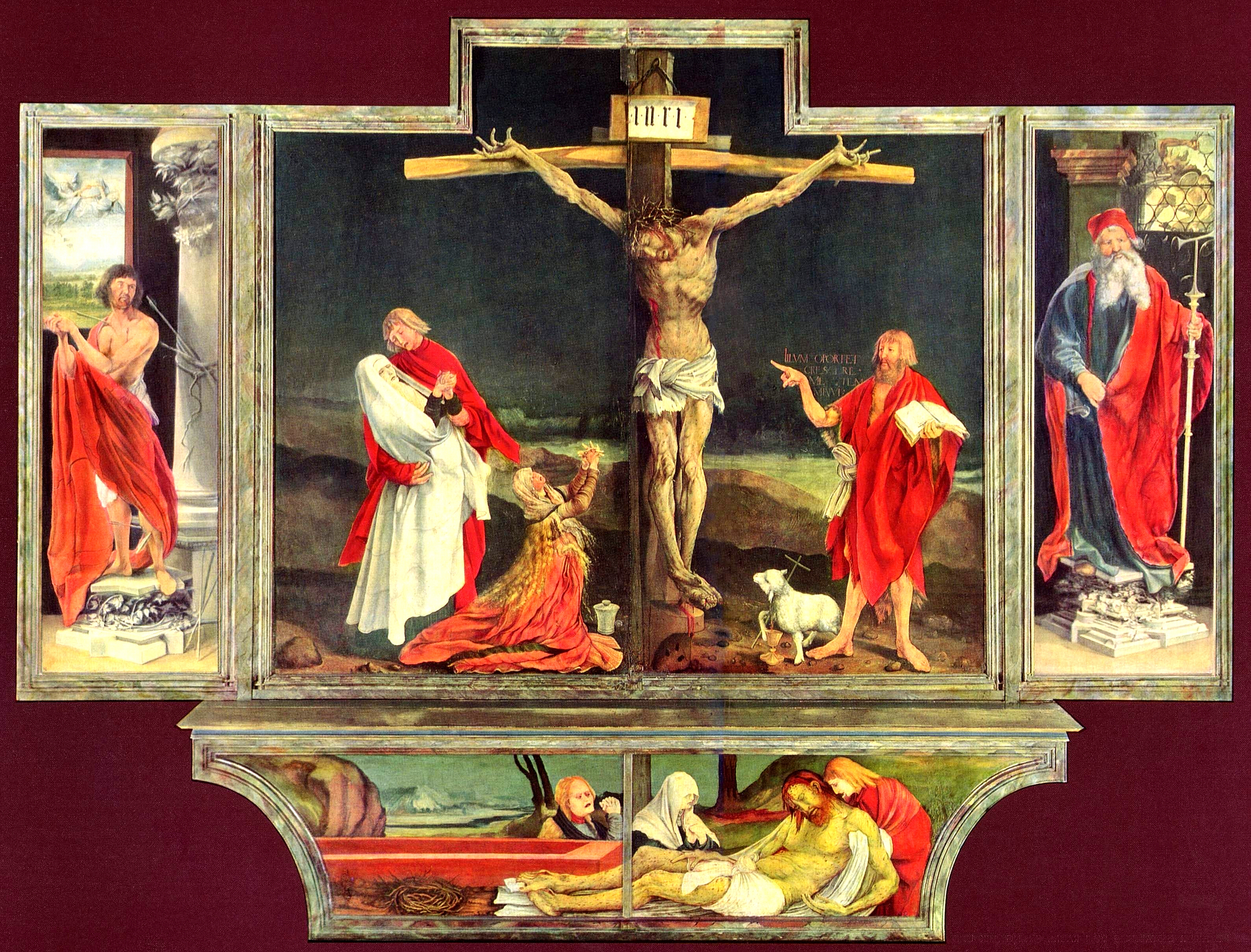
(via wikipedia.org)
In our reading from the book of Acts today, we hear the words of the two angels, “this same Jesus, who was taken from you into heaven will return the same way you’ve seen him go into heaven.” (Acts 1:11) This same Jesus. The same Jesus who has been appearing to the disciples the last forty days, who has nail marks in his hands, who suffered right next to his followers and those he healed–that human person is also God–he has been as close to people as he possibly can, and now he goes back to his Father, as our Gospel lesson puts it (John 17:1-11). Jesus, who sits with us in our sufferings, who knows what it is like to be human, is brought to God the Father, to draw us even closer too. Through Jesus, we are made closer to God, brought ever more into God’s presence.
And what are Jesus’ last words to his followers as he is taken from them? “You will be my witnesses in Jerusalem, and Judea, and all Samaria, and to the ends of the earth.” (Acts 1:8) This verse is a sort of summary or table of contents of the whole book of the Acts of the Apostles–it’s the account of the early church’s development from Jerusalem, which is the first few chapters, out to all Judea which is the few chapters after that, and into Samaria–a wider reach than Judea–in the chapters following, and headed to the ends of the earth–to the edges of the known world in the first century–by the end of Acts.
But you know what? We’re at the end of the earth too–here in Columbia, South Carolina. This is our story. This is our mission, to be witnesses to God’s work in our lives through Jesus Christ. We are called to be witnesses, to talk about how God has change our lives, right here in Columbia.
Last week, Jordan and I went to see my brother graduated from college in New York City. We had some extra time the night before the graduation, so we went to dinner with a friend of Jordan’s who is also doing his graduate work, and lives in the City. I’d met him once, three years ago, and though he’d been married almost two years, neither of us had yet met his wife. It could have been a really awkward dinner–with us really not knowing each other well at all–but they were such holy, open people, we started talking about what God was doing in our lives within fives minutes.
You’re thinking, “that’s what a couple of preachers do!” aren’t you? Well, as the husbands were getting dinner ready in the kitchen, this new friend of mine told how God had been leading her in a very clear, specific direction in the last six months; I got into this business because I love to hear what God is up to in peoples’ lives, so I asked her how this happened, how did she know that God was speaking to her, directing her?
She told me about walking home from church one Sunday with her husband, talking as they always did, and soon the conversation turned, and as he asked her questions to help discern what she was thinking and feeling, it dawned on her all at once what she was meant to do. And she cried, right there outside in the middle of Manhattan (of course, it was Sunday morning, so there weren’t many witnesses).
I started to tell her how it was that I was called to be a priest; but I didn’t tell her the story I usually do–you see, I have two stories. One is about how I was doing a lot of reading and thinking and reflecting and talking the year I worked after undergrad, and how a conversation with my mentor became an “ah ha!” moment–but that’s not really when I knew, that’s not really when I was called.
The story I hadn’t told anyone except Jordan until that night was from earlier on; the summer I graduated, I lived in an apartment, and I was lying in bed one night–I’d just received my first Book of Common Prayer from amazon.com (I don’t recall what possessed me to buy one, but I did), and as I shut the book and lay there, clearing out my mind to go to sleep, the thought floated right into my head–like that game you play as children, pretending an egg is cracked on your head, with the innards oozing down your hair, into your mind–and like a flash, I knew it was true, “You will be a priest.” The realization made me gasp, and then cry, and then I fell asleep.
My new friend put it well, she said something like, “when you come face to face with Truth, what can you do but cry, and submit?” There aren’t good words for what happened to me that night as I was falling asleep, or what happened to my friend as she was walking down the street. They were moments beyond the realm of the explicable.
Which takes me back to Rick Steves.
At another moment in his travelogue last night, Rick was at the Louvre. He was describing the Realist movement, the style of painting in the mid-1800s which sought to portray scenes as accurately as possible. Many artists got quite good at this, studying light and details, using paint to make what looked like a photograph–there are plenty of them featured at the famous Parisian museum. Then along came the Impressionists, who not only let their brushstrokes show on their “finished” canvases, but eschewed this idea that paintings should look like photographs all together. They favored, instead, to use paint to give life to a scene–like Renoir’s depiction of a cafe in Paris, where you can almost hear the people talking, the music playing, and the dancers’ feet tapping. The sense of movement and life captured in Impressionists’ work continues to amaze and delight. They knew there was more to life than the bare facts, the scientific and certain lines and boundaries of a body or an instrument or a street scene. Impressionists captured wind and breath and emotions in a way that Realists never could, a way that science and sociology and anthropology never can.
Today we celebrate the Ascension; next week is Pentecost, and then we spend the next several months in Ordinary time. Nothing to interrupt us, nothing to catch us off-guard, nothing to jazz up the green vestments and altar-hangings, from here till December. But isn’t a lot of life that way? Not just that it’s our longest church season, but that we spend most of our time taking kids to school, making dinner, going to work–banal, common, ordinary stuff (of course, the church season “Ordinary” means “counted”–not “common,” though perhaps it should). Our challenge is to witness to Jesus’ work in our lives, to notice God in the common, ordinary, everyday things.
Then again, what was my experience going to sleep at night back in that apartment in Durham, North Carolina, and what was my friend’s experience walking back from church with her husband, except ordinary and common? Jesus meets us in the ordinary and the common, Jesus finds us and stays with us in our suffering and in our “normal;” God is eager to reveal himself to us in the everyday. We have only to watch, and then to witness; even if it is an experience that is more of an Impression than Realism.
 hope of things not seen