more pomp & circumstance–why process for the Gospel…

As we gather for worship this morning, I’m going to paint you a picture of our life together; something that might—or might not—help us understand and imagine how we work together as one body, how we are God’s hands and feet in the world.

Somewhere near the middle of our Eucharist service, we read from Matthew, Mark, Luke, or John together.  When this happens, have you noticed that a lot of people move?  The deacon, or the celebrant, in the Keenan Chapel services, walks into the middle of the nave, right into the heart of the congregation, if you think of us all gathered here as a “body.”  Once the deacon is there, she proclaims the Gospel to us all.  She’s not just reading what’s written on the page; just like there’s something special about singing together and praying together, as we do when we gather here, there’s something special about listening together—most of us learned about that in kindergarten: we learned how important and transformative it is when we all listen to the same words and instructions at the same time.  Not least, it’s easier for our teachers and leaders to help do their jobs if we’re all paying attention to the same place at the same time.

Many of us turn to face the deacon as she or he shares the Gospel with us from the middle of our gathering.  This is a great and beautiful symbol—someone who has been appointed by God to spend all their time taking the Good News of Jesus’ resurrection into peoples’ everyday lives does that on Sunday mornings, too, in order to remind us that God belongs in the middle of our lives, in the middle of our relationships, as the focus of our attention and our bodies—God is the one toward which we turn and orient ourselves.

Holy, holy, holy is the Lord God Almighty, who was, and is, and is to come!

what a ridiculous outfit

– said by myself, about myself; 10pm last night.

It’s Holy Week over here in Christianity, and as my place of work is rather permissible about dress code, I’ve been wearing a black nightgown since Sunday.20140416-133002.jpg

Sometimes it’s called a cassock, and at the Cathedral, they’re rarely worn (ours is not a particularly stuffy diocese), but I love the frippery and was inspired to wear my black pajamas throughout Holy Week by a Lutheran pastor friend in upstate New York (it occurs to me that he may wear his cassock morning-to-night throughout Holy Week because he serves something like four different parishes, and it’s just impractical to take it off every time he gets in the car to drive to the next church for a service, nevertheless).

I was struck yesterday when a colleague joked with me, “and where’s your big wooden cross?!”  And now you, dear readers, may have a laugh: I hadn’t thought of the cassock as a symbol of suffering or asceticism until that very moment.  Then I realized, of course!–many might see and assume that I was shaming myself, covering my body with black so to be clearly marked as sinful and dead.

My motivation is quite, quite different, however: it’s been my understanding that part of the reason priests have worn cassocks throughout history is to remind themselves that they are dead to themselves (this notion takes stark form when priests lie on the ground during the first set of prayers at their ordination to the priesthood) and alive in Christ (Romans 6:11).

For one, it’s been a bit warm in South Carolina this week, and reminding myself of the moment I laid on a cold stone floor on a December evening is a relieving memory indeed.

For another, wearing a big black dress cuts down on the whistles directed at me while walking down the street.  People stop seeing Emily as an object or a skinny blonde (brunette?) and instead see me as a curiosity, or maybe even as a person.

Finally and mostly, I am a priest, called to point to Jesus in front of others (just as we’re all called to do!), and Holy Week gives me the push I need to drag the beautiful drama of the relationship between God and people out into the world.  We put on special clothes when we go into the sanctuary to worship, clothes that remind us of what we believe we’re doing.  For this week, I’ve gathered up the courage to dance around Columbia’s public streets in those clothes, marching my belief in Jesus as the Son of God into every place I walk.

For whatever reason, I flourish on contradiction; I am addicted to irony.  I joyfully prance around in dark, trench-coat-like clothes, knowing that the death of my ego is the beginning of my real life.  My church growing up didn’t allow women to be spiritual leaders, but instead of leaving the whole project behind, I held onto my Evangelicalism for dear life and became a minister anyway.

Isn’t the biggest (and best) irony of all time that God came to earth to be a human, and if that wasn’t enough, he lived as a poor servant, and if that wasn’t enough, he allowed himself to be unjustly put to death–and if that wasn’t enough, HE CAME BACK TO LIFE! (but I’m getting ahead of myself–it’s not Sunday yet, people.)


Fake It Till You Make It – Third Sunday in Lent – Church of St. Michael and St. George

2013-01-30 08.31.56

In the St. Michael School chapel this year, I’ve been telling lots of Bible stories.  The windows in St. George’s Chapel, where we meet, provide vivid images and reminders of God’s history with his people, and I’m grateful for the cheat-sheet!

On our first day back after Christmas break, I was inspired to tell the story of Moses and the burning bush.  I’d been trying to think of a gentle way to talk about reverent behavior during chapel time.  You see, I don’t have any children of my own yet, so I’m still under the false impression that anyone under the age of 15 can sit still and listen for a full five or ten minutes together.  So, I hoped that telling them about the way that God told Moses how to behave around him might stick in their brains the idea that they should behave differently around God’s house, too.

I told them about how God called Moses by name, and how he told Moses to take off his shoes.  To really drag the point home, I tore my heels off in front of them, right in the middle of the chapel.  We talked about what it might be like for us to take off our shoes—not literally, the older children realized, but what a sort of analogous thing might be in our culture and in our way of worshiping.

I asked them what it might mean to take off our sandals.  One child, who has clearly heard the story before, quickly raised his hand and said, “it means respect!”  …As he realized the import of his answer, he sheepishly took off his baseball cap.  Further, he suggested that perhaps we shouldn’t run or yell in the chapel.  Another child said, “Well, the bush told him to!”  She hit on an important point—sometimes we don’t know why we’re asked to do what God says, but being faced with a burning bush, being faced with God’s presence, we can sense it’s something we shouldn’t question.  Like when our parents told us as young children to get down in the basement because of a tornado warning—we may have questioned them about what to wear to school in the morning, but in a moment we know is danger, we simply trust.

I closed by asking them to imagine whenever they came into chapel that there was a burning ball of fire right over the altar—a frightening image that I hoped might help them remember that God’s presence was in chapel with them, and though God’s presence is exciting and wonderful, there are also ways we should honor the place we worship God.

Judging from the running and yelling that went on this week after so many days off of school for snow, I think we still have a ways to go in teaching the children what it’s like to be in God’s presence.

Telling the kids the story of Moses and the burning bush made me think closely and seriously about the ways that we figuratively “take off our shoes” when we come near to God, and what it means for us to “take off our shoes” or to be changed when we enter into God’s presence.  We have to learn how to behave, of course, we don’t do it instinctively, just as was revealed by the children’s responses to my questions.

When I visited our newest parishioner a few weeks ago as a one-day-old baby in the hospital, I quietly knocked on the hospital room door, I slowly and calmly opened the door, I tiptoed toward the new family, and gently asked after their health.  When the moment came, I very carefully took the little baby boy in my arms and spoke to him quietly and soothingly.  This picture is very different from the first time I met my baby brother when I was two and a half years old—my parents had to tell me, “Emily!  Don’t poke his eye out…  Please be gentle!  Don’t scream, speak softly!”  I had to be taught how to behave around a little baby, just as Moses had to be told by God how to behave in his presence, “Moses, take off your sandals.”

We “take off our sandals” by standing when we hear the Gospel proclaimed to us, by kneeling to pray—in a few moments, we will stand together as the celebrant invites us to “lift up [our] hearts unto the Lord” as we begin the Great Thanksgiving and enjoy Communion together.

The game changes when we get close to God—our lives are changed. This is a strange, unnatural, uncomfortable thing, just like it was unnatural for me as a toddler to be quiet and calm and gentle to my baby brother.  It’s become a natural way to behave around little babies, but it wasn’t, at first.  Of course, we’ve learned from the Bible that God isn’t particularly concerned with comfort, he made Moses take off sandals in the middle of the wilderness, for heaven’s sake!

At my last church, in Cooperstown, New York, I met with a parishioner in the local coffeeshop one afternoon.  He was a doctor by trade, but had been very active in the local theater company for decades.  We started talking about all these various actions we take during church services and all the prayers we say every week.  Most of the language is the same week in and week out—how did it help us at all to say the same things over and over?  Drawing in his experience with preparing to play a part in a production, this parishioner wondered if our worship on Sunday mornings was sort of like rehearsing for a play.  He said, “During the last weeks right before performing, you’re practicing your part so often and so fully that the line between your identity and part you’re playing starts to blur.  You take on this person’s mannerisms, attitude, and perspective, you start to become that person.”  The process is uncomfortable at first, it’s not natural, because it’s not who you are, but soon enough, you become comfortable with that character, and it becomes very easy to join in the play.  The result is that when you know the character so well, if something goes wrong on opening night, you can still stay in character because you’ve become that person, and that’s when the fun begins.  When you have practiced so long and so hard, you have become what you’ve practiced being, and you’re able to play.

 

into the cloud. on transfiguration

2013-01-29 08.18.42

“…a cloud came and overshadowed them; and they were terrified as they entered the cloud.  Then from the cloud came a voice that said, “This is my Son, my Chosen; listen to him!” (Matthew 9:34b-35)

20130210-183737.jpg

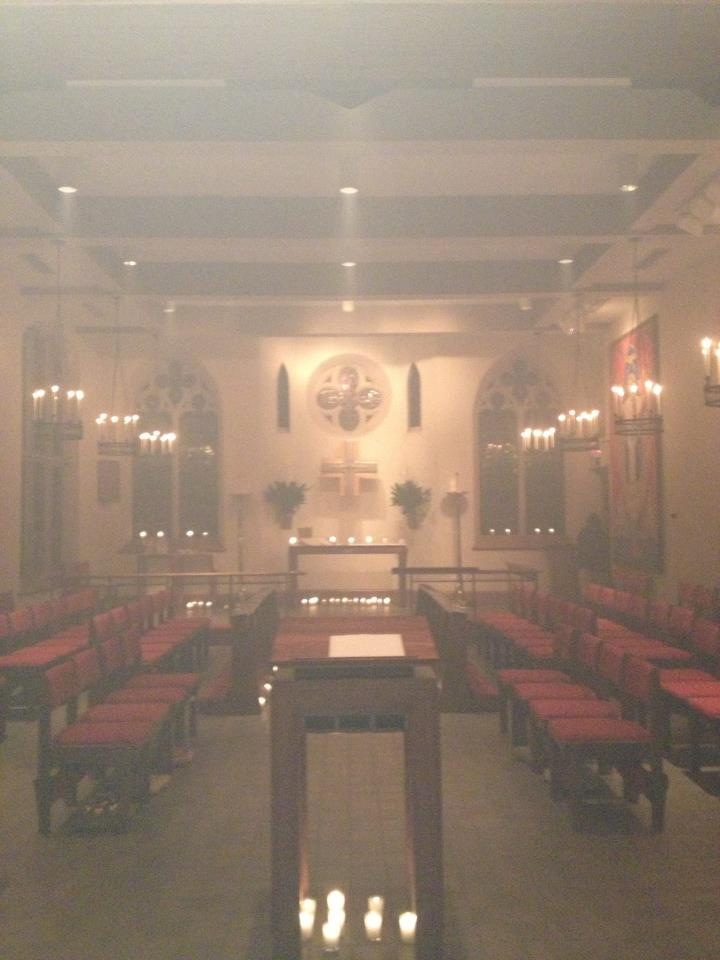
When the Gospel passage of the Transfiguration was read last Saturday evening during our Vigil service, another one of the imports of incense dawned on me.  I happened to be thurifer last week, making me the cloud-maker for the evening; throughout the service, as the incense swirled around us, we quite literally entered a cloud.  The smelly (in a good way, to my nose) incense enveloped us and we dwelt in the closest thing to a blanket of mist that people can easily create themselves.  That’s why we use incense (among many other reasons).  It moves us into the cloud.

It’s not just any cloud.  As we read in our Isaiah Bible study this week (ch. 19), God’s communication with humanity is often through a cloud (this was a big-deal connection to the Church Fathers–see Cyril of Alexandria, Gregory of Nyssa, John Chrysostom)–like the pillar of cloud that led the Israelites through the wilderness, God speaking out of a cloud at Jesus’ baptism, and God and Moses communicating through a cloud on Mount Sinai.  Clouds are often used in Scripture to remind us that God is near and so we use cloud, in incense, to remind us that God is in our midst when we worship together.

Join us at the corner of Wydown & Ellenwood on Saturday nights at 5 p.m. to worship in the cloud…