Feast of the Transfiguration

Scripture

Have you ever tried to take something away from a toddler? Phew. Jacob is getting old enough to be aware of his desires and to express them with much zeal, and if he offers a book to me but he doesn’t want me to actually take it from his hands, he will throw himself on the floor, face to the ground, and sob. He hardly speaks 3 words, but how he feels about something being forcibly removed from him is abundantly clear. 

I wonder how we feel when something is forcibly removed from us. We probably feel about the same as Jacob does, though we express it differently. When our health or physical able-ness drains away bit by bit, or is ripped out from under us in one fell swoop, when the community or relationships that moored our lives drop out at the bottom, when reality is so changed that we hardly have words for the new world that we are shunted into – we might be mad, we might be sad, we might feel hollowed out and dry-mouthed and as if we are strangers, in a strange new land. 

I don’t believe that God rips our health from our hands, or that God is the one who drags us away from the life we love, or that God is responsible for the changes of our circumstances. He isn’t the one to blame when cancer strikes or when divorce happens or when addiction takes hold. These are evil things that prowl at our doors and claw into our homes because of the brokenness of this world. These are sad facts of what reality is in this fallen life. 

And the real problem is denying their power over us. I don’t really need to tell you this – you have seen in your own life the way that abuse distorts a human heart. You have witnessed with your own eyes the way that cancer and terminal illness wastes away precious people. You know the destruction that death and dissension and denial itself wreaks on us. We know that the battle is really within us. That evil isn’t just all around, but that the line between good and evil runs through every human heart. And this battle can often feel like it is against our very selves; that the grief we feel consumes us, that the anger wells inside of us without end, that the pride and the despair and the wrongs done to us and the righteous indignation and the terror of insecurity isn’t just something to fight against, but is knit into our very souls. 

And that’s what makes it so hard to let go of. The anger is not us, it is an emotion that passes. The grief is not us, it is a wound that can heal. The despair and the righteous indignation are blankets to protect us from the searing heat of life. The terror of insecurity is our signal that we’ve put our eggs in the wrong basket. So we cling to these things because they at least feel better than what we fear might happen or might be required of us if we were to let them go. These things, our grief, our anger, our despair, in a way, they keep us safe, the hem us in by making things stay the same, by making us stuck. If we are planted in anger, we do not need to change. If we are in a siege against insecurity, we cannot possibly move outside the walls. If we are sleeping in our grief, we need not be roused to another unpredictable day. And yet, what kind of life is that?

See, God doesn’t take our grief out of our hands, we must offer it to him in order to transform it. He won’t forcibly remove the sins we hold dear, even though he is God, and he could do it if he wanted to. 

I wonder whether one of the reasons he doesn’t do that is because, just like a toddler, if it’s taken from us, we cling to it all the more, we refuse all the more to release its power over us. If we don’t recognize in ourselves that we need to let go, give it up, nothing God can do will change our minds. 

We must always ask for a soft heart, a heart of flesh, in order to surrender those demons; we can’t even do that without God’s help. We must ask to be released from them. And that’s exactly what happens in the passage after the Transfiguration in Luke.

Hear the Word of God: “On the next day, when they had come down from the mountain, a great crowd met him. And behold, a man from the crowd cried out, ‘Teacher, I beg you to look at my son, for he is my only child. And behold, a spirit seizes him, and he suddenly cries out. It convulses him so that he foams at the mouth, and shatters him, and will hardly leave him.’” (Luke 9:37-39) 

This man offers up the suffering of his son. He begs on his behalf for deliverance. Somehow, physical illnesses seem easier to give over to God than the griefs in our hearts. But the anger that eats us up and the denial that corrodes our minds is no less fatal than diseases that afflict the body. I wonder if that’s why there are so many stories of Jesus healing people of demons and of mental illnesses Scripture – those internal battles are important to God, just as much as our flesh and our bones. 

So I believe it is not at all a coincidence that the story immediately following today’s Gospel lesson on the Transfiguration is a story of healing a boy’s spirit and mind. 

In the Transfiguration, we learn that God reveals new facets of himself to us all the time, and we see that we are always changed by close encounters with the divine — just like Moses in the Old Testament lesson. In prayer, we offer up bits of ourselves, and God takes whatever it is we deign to offer him and he transforms it before he gives it back to us.

So in today’s passage, Jesus goes to the mountain to pray, and in his humanity, on our behalf, offers himself to God — we see this by looking, too, at the passage before where he speaks of his death, as well as the subject of the discussion between him, Elijah, and Moses.

All of this happens in front of Peter, James, and John, and then, God in Jesus gives back to us a revelation of his glory and he answers these men’s questions about who Jesus is by showing them Moses the redeemer, and Elijah the great prophet. Jesus himself the fulfillment of these promises, embodying and enacting the relationship between God and humanity in the confines of his very flesh. 

Jesus and his disciples go to pray, and what does it say that the disciples do? They’re weighed down with sleep, that sweet bliss of unconsciousness, right? I wonder if the same might be said for our desire to be asleep to, to deny, to not look at or acknowledge the wounds we cling to, and the pain we grip, and the grief we hold so close. What might it mean to be awake as we pray? 

How might God be revealed to us if we open our eyes wide in the presence of God, despite temptations to doze off to the truth of ourselves? What might we see if we are attentive to our internal surroundings, to our hearts, as we approach God’s presence? Scripture tells us that these beloved disciples were heavy with sleep, “but since they had stayed awake, they saw his glory.” Not only that, but the were enveloped by a cloud, they heard a voice from the sky, they were struck silent by the experience. In a word, they were changed. 

My  beloved Brothers and Sisters, may we have the courage to offer ourselves to God, to be awakened to the truth of ourselves, to have hearts soft and malleable for the Great Potter, and to joyously await the revelation of God in Jesus Christ. Amen. 

Pool Party; Father, Son, and Holy Spirit

Notre Dame Baptismal FontOver the winter, Grey Wilkes learned to swim.

Having recently moved to a house with a pool, her parents wanted to make sure she could navigate the waters as soon as possible, safety fence notwithstanding. Instead of floundering in the waters, Grey has learned, should she fall in, to float on her back and then to kick her way to the edge. I wonder if our encountering the mystery of the Trinity might be a little bit like Grey learning a new response to being dropped into water; rather than reacting with fear and seeking to control the water around her, to become master of it, she now calmly floats, allowing the water to be what it is, finding her place in it, and then using her newly acquired habit to relate to those waters.

I have a tendency to come to things like the doctrine of the Trinity and to splash about, all throat-clearing and weight-shifting and brow-furrowing. “Well you see, there’re three. And there are, I mean, there is, one. God. Three. God. One.” Generally, my mind and mouth become a tangled mess, and my spirit just leaves the building completely, shaking her head and rolling her eyes as I splish and splash and in not too much time, end up drowning in words and phrases and analogies and nonsense. So I wonder if maybe we’re meant to learn a new response to mystery. Continue reading

Sermon, Last Sunday of Lent

IMG_1081Today’s sermon preached at St. A’s, the raising of Lazarus and Grandpa Chuck’s death.

Sermon Audio

It is because of my grandfather’s death that I stand before you this morning.

During a particularly difficult moment in my ministry, my grandpa Chuck, after whom Charles is named, fell ill and breathed his last. We were living in South Carolina at the time, far from snowy Minnesota, but I still visited him a few times in his last weeks and was even there to give him last rites the day he died.

Back home, I was struggling with my call, feeling stonewalled at every turn, denied at every door, frustrated with pouring so much effort into what seemed like a bottomless chasm. It was more than exhaustion, or a period of thankless plowing through; I was suffocating, like a flame submitted to a snuffer, gasping for enough air to keep breathing. In some ways my depression felt very much like death. Continue reading

A Tale of Two Brothers

nicoles-picture“There was a man who had two sons.”

Jesus was preaching to sinners and tax collectors—the societal scum of the earth—but the pharisees and scribes were listening in too—the acceptable, impressive, and righteous of social standing.

Now when these men who were accounted as righteous—the socially-impressive Pharisees and et cetera—heard Jesus say those magic words, “there was a man who had two sons,” in their minds, these learned Jewish men immediately put their money down on the younger son. This was because in the Old Testament, all the stories they’d ever heard about who their God is and how this God interacts with humanity, the younger son always wins. It may be something about cheering for the underdog, though I suspect it tells us more about who this God is than who he likes to cheer for—this is a God of surprises. Way back in the beginning, the first set of brothers on earth, Cain and Abel; they both make offerings to God, and God is pleased with Abel’s offering (we’re not exactly told why). Then, last week we heard about Abram. Amos alluded to the two sons that he had—it won’t surprise you, the younger one is the one God chose to use for his great promise of progeny. Perhaps one of the most significant brother pairs is Jacob and Esau, Jacob steals Esau’s birth-blessing which he’s owed as the oldest son, and Jacob ends up being named Israel, a name we know and use to this very day in connection with the Jewish people.

So back to the sons in our parable: the Jews who were listening knew exactly who to root for.

And Jesus continues: The younger son, when he was adult-enough, asked his father to split up all the family assets and to give him the piece he had coming to him.

Can you imagine what it would be like if your child came to you and said, “Hey, someday you’re gonna die, and in your will, I know you’re gonna be pretty generous; so, why not just give it to me now, and I can enjoy your generosity while I’m still young?” “Over my dead body!” you might say—the son is treating his father as if he’s already dead. But for whatever reason, the father listened and did just as the young son asked. A few days later, the boy took all that cash in a duffel bag, and he left home.

Cut to the montage in Vegas, the private planes, the champagne running free, and whatever else you want to imagine is tied up in “dissolute living.” Last weekend I saw a show called “House of Lies,” and I suspect that one of those characters is this son.

Then the stock market crashes. It’s 2008, or, the proverbial 2008. The son loses all his money, and he’s dying on the street. He’s thinking about his life, and he realizes what a fool he’s been. All the stuff didn’t give him peace and security, it didn’t really make him happy. He’s bet on the wrong life, he’s gone far down the path of seeking stuff and security, and it all left him for dead.

So he turns around and goes back home. He’s not expecting a ticker-tape parade, or even to be let in the front door. Imagine it’s Downtown Abbey: he’s shuffling up the drive, trying to get his words right, wanting to ask if he could be a field hand, or maybe an assistant to the gardener, or the livestock manager. Just something that will give him a roof over his head and some food in his belly.

But his father is sitting in the library, and sees that familiar gait coming up the gravel drive. Before the son is able to make to the back door, his father intercepts him and crushes him in a enormous hug. A party is quickly organized and the best wines are pulled out of the cellar, surely to Carson’s dismay. And echoing the butler’s disapproval, the older son arrives from a hard day of agenting and wonders what all the fuss is about. This respectable, dutiful older son catches sight of his lost young brother, and rolls his eyes with a sigh. “Oh, of course you’ve come sniveling back. Father, you can’t be serious—how can you celebrate this kind of behavior? I won’t have it. I’m going up to my room.” And even though he sounds much like Lady Mary, he’s a man, I assure you.

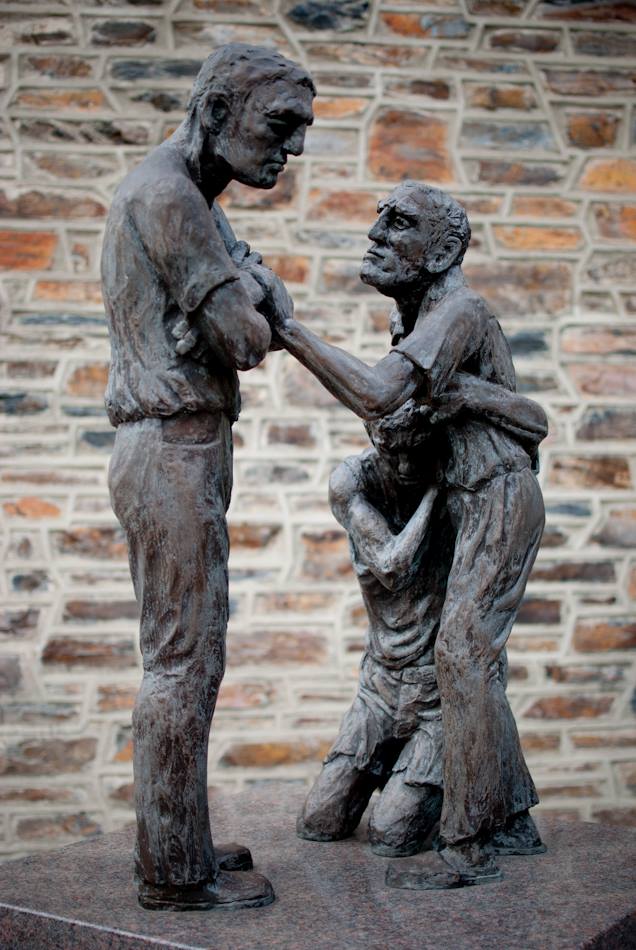
There’s a sculpture at Duke Divinity School of this moment in the story, the younger son is kneeling at his father’s side, Dad has an arm around him. The older son stands hardly within reach, with his arms folded across his chest. the father reaches out a hand to hold on to the older son, a sort of lifeline, desperate for reconciliation and wholeness, now that the family unit is back within reach.  And what happens next?  We don’t know.

That’s where Jesus ends the parable. 

fractured families – breaking societal rules – holding a grudge – count someone (friend, brother, parent) as “lost” – beyond the pale, beyond help. UNFORGIVABLE

So the respectable Jewish listeners, having put their money on the younger son, sit there scratching their heads. The son who messed up—to put it mildly—the one that they had been primed to support, he ended up breaking all the rules, sluffing off his family, and then, even though he had disobeyed every law that the Jews were so careful and fastidious to keep, this son was accepted again into the family, he was even celebrated. What could Jesus mean by that?

Do any of you have family members who are “lost”? Are there friends or people in your life who have abandoned you, or done something unforgivable? Is holding a grudge against them your wall of protection? Maybe they just stopped calling or they’ve gone off with some kind of substance to try to find peace there. Do they know that they can come home? What would happen if they did?

As for the tax collectors and sinners who were listening to this parable, they’d received no such training in Jewish lore, and they probably thought, “Ah ha! The older son! Surely he’s the one to bet on.” Usually the oldest son would receive the extra blessing, an extra share of the family fortune, fortune smiled on him—why wouldn’t you cheer for this character?

These social pariahs might aspire to be this brother, to be the upstanding, responsible, well-cared-for, safe brother. He’s hard-working and respected, invited to all the right clubs and social engagements. But the danger of that kind of life, or the danger of wanting it for its own sake, for the sake of being respected and rich and secure, is that you’re looking for the trappings of the lifestyle and not the life itself. The older brother had the shell of this full life, but not the heart of it.  His smallness of heart when his brother returns betrays him; it’s almost as if he is jealous that his brother enjoyed such freedom and adventure. The older brother isn’t pursuing hard work and respectability out of his own desire for good, honest work, or for love of his family and the position they hold, but because he thinks he should do it, because it’s what he thinks is expected of him.  Likewise, those listening who are desperate for respectability and wealth are shown that in themselves, they are just trappings, not the real stuff of a life that is whole and happy.

It’s really the tale of two lost sons.

One leaves home physically, takes a bunch of possessions and fills himself up with food and booze and all kinds of things that numb the deep hunger he has to be known. The other son stays home, seems to do all the right things, follows all the protocols for blessing and accomplishment, seeming to have no sin or darkness to hide at all. But as the tax collectors and sinners find by the end of the parable, this son, too, has sin he needs to acknowledge. He’s hidden it well, and he’s distracted himself with lots of good deeds and sacrifices for the sake of the family. But he’s run away from home too. He’s run away in his heart and is just as lost as his brother.

There is nothing so fickle and wayward as the human heart. And there is nothing which has more worth to God than each of our hearts, than winning the affection of each and every human heart.

I think that’s why Jesus ends the parable where he does: he leaves the question with hearers of every stripe and sort: will you repent and come home?

God our Father says, “Please come back, in both heart and soul; it’s just not home without you.”

The way back home is to say out loud that we have run away, to admit we’ve tried to cover ourselves up and pass ourselves off as just fine, doing okay, not in need of anything. It’s hard to admit that we’re lost and need to be found. That we’re cold and we’ve spent all our inheritance and we just want to belong again.

We’re encouraged during Lent to do some of that soul-searching, to admit that we’ve run away, and then to find our way back home.

The message that both sides needed to hear, both the ritually-righteous and the socially-sinful, is that God the Father, the God who Jesus reveals to us, is more interested in mercy than in sacrifice.

Younger son’s repentance leads him to be ready to sacrifice, to be a slave in his own home. He desires no claim of his birth or title or name, he expects no mercy.

The older son has given all the right sacrifices, he’s fulfilled all the obligations and expects to be judged on his sacrifices, he hopes that his right action—no matter his motivation—will show him worthy. In the end he is expected to have mercy, and to display forgiveness; all the sacrifice doesn’t matter if his heart is not merciful toward his brother.

It’s not that there is no grief or consequence or price to be paid for the sin and destruction wrought on the family—indeed, the estate is diminished at least by half, but in the midst of that price, what matters even more than sacrifice and than respectability is restoring wholeness, restoring relationship, bringing back unity.

This is what God does when Jesus dies on the cross. Jesus doesn’t go to the cross, unjustly condemned, because it is the sacrifice that ought to be made, that’s part of it and theologians rightly argue that Jesus’ sacrifice for our sin is part of the story, but another part is that God in Jesus shows love and mercy on the cross. Jesus is jeered by the onlookers: “Come down from there, save yourself, prove that you are full of all power and that you are God.” Jesus decides instead to show that he is God by living and dying in love and mercy, by enduring what a human would have to endure if you or I had been unjustly condemned. This is how God chooses to bring us home, God in Jesus forgives our wickedness, loves us completely and steadfastly.

So now it is up to you and up to me: do you have the courage to say “Father, I have sinned against heaven and before you”? Do you have the humility to respond with honest repentance and to come back home, in heart and soul?

image via