Molten Chocolate Lava Cakes

My most-fave homemade dessert, which has only six ingredients and is ready in 20 minutes, is made more than twice a week in the Hylden house.20140708-211928-76768876.jpg

Gather: 2 tablespoons Smart Balance or butter, 2 ounces chocolate (I use 85% cacao, but you can use your favorite), 1/4 cup sugar, 1 teaspoon vanilla, 1 whole egg, 3 tablespoons flour.

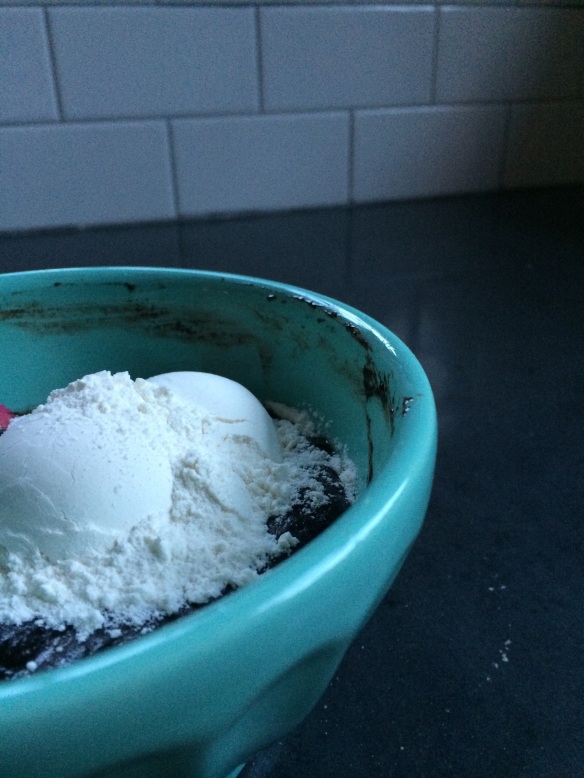
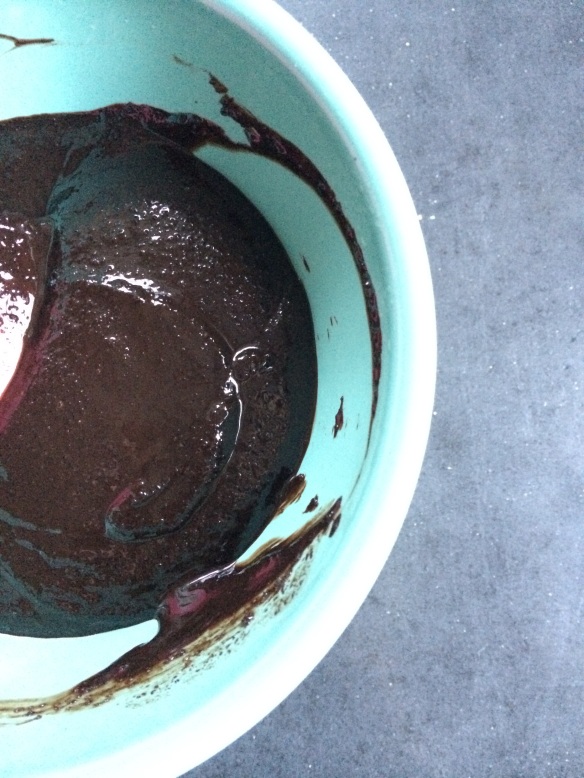
First, melt the butter & chocolate together in a small bowl and stir. Then add the sugar to the mixture and stir well. Next, add the egg–stir until the mixture changes texture, it will pull away from the side of the bowl. Add vanilla, if desired, then gently fold in flour–stir until just combined.20140708-211930-76770057.jpg
Divide between two greased ramekins (or teacups, or small bowls) and bake at 375 F for 13 minutes. Immediately remove from oven, invert a plate on the ramekin, and then invert the ramekin onto the plate–remove ramekin and serve.

20140708-211928-76768277.jpg


Pilgrim’s Reward

When I reached the top of the cathedrals in Chartres and Strasbourg, gorgeous, expansive views awaited.  But in each place, it wasn’t just the long distance vision that greeted me, but deeper revelations which wouldn’t have been so clear from the ground.

IMG_2281

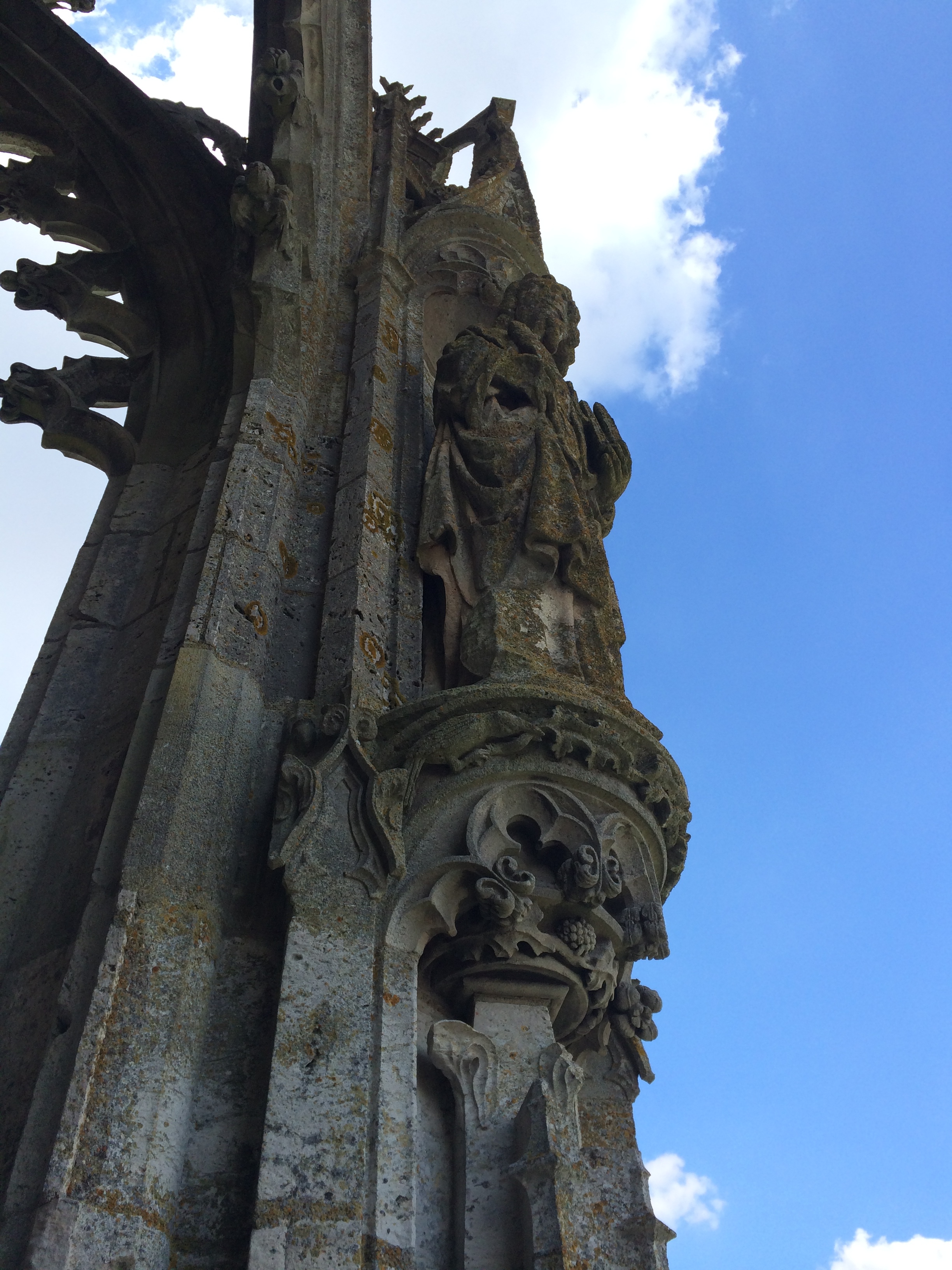
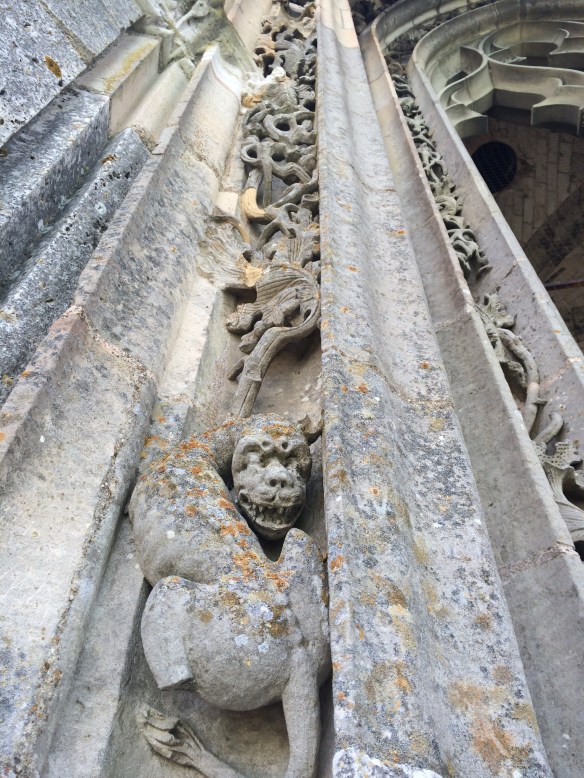
In Chartres, there were life-sized statues, intricate gargoyles, and mischievous little creatures crawling (in stone) all over the upper reaches of the Gothic spire.  What good did they do up there, completely hidden from the ground?  Even in the cathedral’s heyday, how many people scaled the tower and once up top, noticed the intricate stonework?  They were made and fitted up there because the stone workers knew that God could always see their work; their efforts were for God’s glory and God’s delight–not primarily for fellow humans to enjoy.

IMG_2282

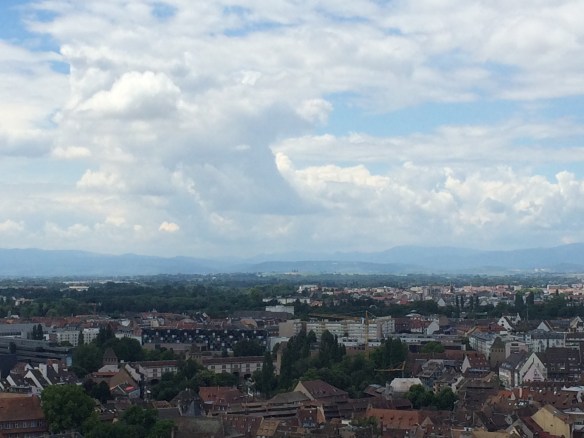
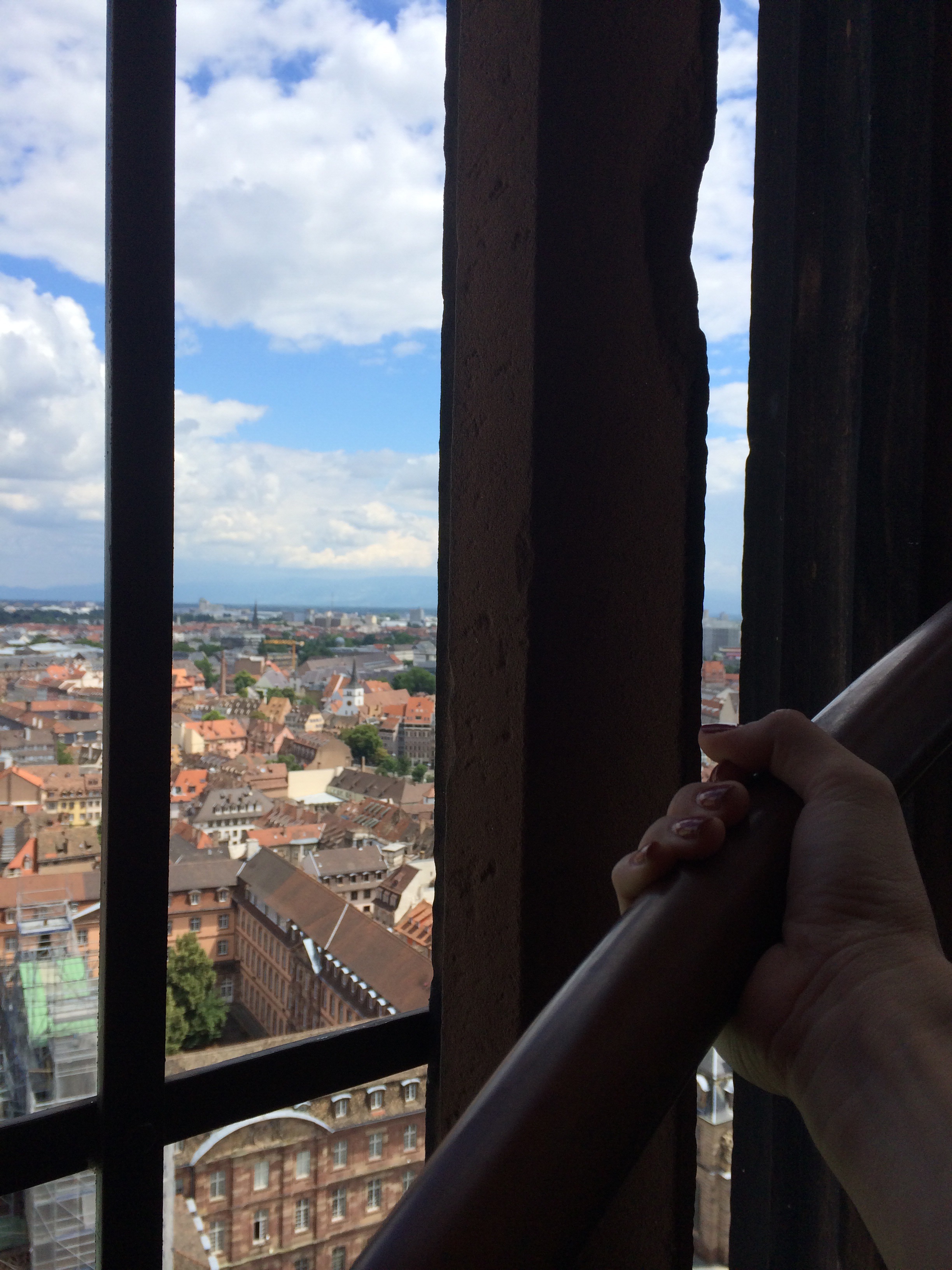
At Strasbourg, going up to the spire landing allowed a view of the surrounding mountains, land where my ancestral family had lived for years before immigrating to the US in the mid-1800s.  Seeing the land that is, in a way, in my bones and my being helped me understand why I’d so fallen in love with the Blue Ridge mountains back home in North Carolina–where I’ve come from, and maybe a bit of who I am.

IMG_2498

Courage and Pilgrimage

Over the last few weeks, I did a lot of stair-climbing.  It wasn’t just at our walk-up rental in Paris, but in museums, castles, cathedrals, old hilly towns, terraced gardens (aren’t you sympathetic for my knees?  …not so much?).  By far, the most terrifying climbing, as one might imagine, was in the cathedrals–two of which enticed us up into their spires to enjoy the great heights which Medieval builders scaled.

20140704-083248-30768970.jpg

Above, in Strasbourg, it took all my concentration to commit to each step up.  If I took my attention off of just the next stone slab in front of me–if I looked out over the rooftops, or looked up the set of stairs as far as I could see, or stayed still on the steps too long–I got dizzy and I would suddenly feel unsteady, as if I was about to lose my balance and was going to fall.  Objectively, my body was no less-grounded whether my eyes were looking at rooftops or at my feet, but my mind and heart were easily overwhelmed with the task at hand: overcoming my fear of heights in order to be able to enjoy the secure and amazing view at the top of the stairs.

I realized as I climbed that the journey up the spiral stairs was a fruitful way to think about trials in our everyday lives.  Focusing on more than the very next step in front of us, allowing ourselves to lose focus on the present moment in order to try to take in the whole project we’re working through–that’s a recipe for disaster; the only way to not be overwhelmed, crushed by the enormity of the present reality, or drowned in a deluge of fear and negative emotions, is to actively put them out of your mind–to practice putting them out of your mind over and over again, and to choose (and practice!) instead focusing on just the one next thing to do.  Thankfully, in my case, the one next thing was very clear, and very simple–step up.  One at a time.

20140704-083249-30769794.jpg Climbing these stairs at Chartres, just as climbing through trials in life, I didn’t know how long the ordeal was going to last before I arrived at the top and I couldn’t enjoy the views and hints of the reward in the midst of my climbing–it made me feel unsteady and sick!

Just as in life, what got me through was deep, deep breathing.  What is breathing but inviting air–wind–to move through you, to energize, awaken, enliven you?  What is the Holy Spirit but air, wind?

In our trials, throughout our lives, God is eager for us to call upon the Holy Spirit to surround, fill, enliven, energize, and sustain each of us every single step of the way.

The Older Sister

First person (imagined) narrative of the older sibling in the Prodigal Son parable (Luke 15:11-32), delivered during Soul Stories, Soul Food

20140706-162552-59152812.jpg

photo by the incomparable Roger Hutchison.

Oh, hello.

You must all be here for the feast—my brother’s feast. So you’ve gotten the news, he’s back! Isn’t that wonderful?

My dad aged so much when he left; when my brother asked for his inheritance a few years back, I didn’t think that Dad should give it to him, because I knew my brother, Josh, was just going to spend it all. He’s never had the self control or the wisdom or the foresight that I have to plan for the future, and to work hard for it.

Anyway, my dad did give it to him, because Josh is his youngest child, and the youngest child… well, I don’t want to offend any youngest children in the room, but, usually the baby of the family gets whatever he or she wants. Can you tell I’m an oldest child?

Well, what happened to Josh was really just too bad—he took his money, and he went out West. He bought himself a Mercedes roadster, and he drove all over California. Then, he went over to Las Vegas, “to really strike it rich”—he said in his postcards to me.

This was not how our father raised us. He raised us to be respectable. We did our homework–*I* got A+’s, of course, but Josh didn’t do so bad himself. We were raised to accept our responsibility, to make good on the investment that our father was making in us—to fulfill the destiny we were given with our good education and good upbringing, to join our father’s life in the family business, or at least become a doctor or a lawyer or a banker.

But that wasn’t good enough for dear Josh; he’s a dreamer. He plowed his own way, with his Mercedes and his bright lights. Eventually, though—you’ll remember, being that you’re father’s friends, here for the banquet—the postcards stopped coming. Josh’s leaving made father seem older, but the not-knowing, the mystery and pain of disappearance—that’s what really wracked him. He walked our long, long driveway himself every day to check the mail. Then, the worst—when he stopped checking the mail. He gave Josh up as dead.

He sent people to look for Josh, to see if we could at least recover his body, at least have some kind of closure, some kind of scrap of evidence to lay the whole messy, emotional debacle to rest. But no one turned anything up—nothing to confirm whether he was alive or dead.

Then, finally, you remember—we had that memorial service for him, if he wasn’t dead, he surely wasn’t coming home again, Father figured, and we might as well move on with our lives. I have to tell you, I was relieved. All this searching and not-knowing and walking down the long driveway was taking up so much of Father’s time and resources, so much of his energy, his money—I was running the business all by myself! I could do it, I was good at it, but it was exhausting. Further, it seemed like Father just assumed I’d always do it—I felt taken advantage of. Josh, who had always gotten more attention when we were growing up, was STILL getting more attention even though he was gone now.

And now—you know the story—he’s back. Yay… And here you all are, showing up to celebrate the prodigal’s return! I’ll never forget, I was bringing Father his tea on the porch, he was practically bedridden, when he pushed me to the side to get a better view of the driveway. I was taken aback at the strength he showed—I had no idea the old man had it in him still. He pulled himself up out of his chair, wobbly but resolute, and shielded his squinty eyes from the sun. He shouted, “Josh?! Josh! Is that you, my son?!” as he started down the porch stairs. I turned and squinted, too, trying to catch Father’s arm—the poor man must have been going crazy in his grief.

Father was already halfway down the long drive, already almost to this stranger who was hobbling up to our home. “What audacity,” I thought, “for someone so poor and stinky and flea-eaten to come through our beautiful gate and wend his way up to our house. What was this person thinking? Why did he think we had anything to offer him? Couldn’t he go to Trinity, to the homeless breakfast? Why would he come to our house—where we LIVE, where WE live?” It was inconceivable that anyone would try to invade our space.

Then, of course, I realized it was actually Josh—alive, coming home. Father was so, so excited, you could see the years of worry melt from him, he seemed as if he was as young as when Josh had left. Father’s eyes came alive, he practically danced a jig. He started yelling and shouting—the servants came, it was really a scene, I must tell you… It was all chaos and unkemptness—Father started pulling off his clothes to put them on Josh, who was practically naked, having gambled or given or lost everything he’d been given.

Can you believe that? All his inheritance—down the drain! He didn’t have a shred left. After he ate, Father sat him down, having not taken his eyes off of Josh the whole time, and asked him what made him come home. Josh said he’d been sitting on the street in a big city, begging, covered in fleas, trying to barter his clothes for some bread, and the realized that even the lowest worker here on Father’s estate had it much better than that, and perhaps he would be allowed to come back and to work here. Father laughed, slapped Josh on the back and said, “Nonsense! You are my son! You were dead, and now you’re alive again! I never thought I’d get to see you again! You are my son, you will be just as before, learning to manage the business, here, with your sister.”

I couldn’t believe it. I mean, of course, I’d missed Josh, too, and I was so grateful he was alive, but there are rules, there’s the inheritance, not to be crass—but now Josh got half of MY inheritance, too? And Josh gets all this?–this great big party with everyone from the whole town? I followed all the rules, and I haven’t even had a birthday party in years—I’ve been trying to keep the family together! I’ve sacrificed everything for this family, for its upkeep, to keep the business going, to make sure there IS an inheritance, and here Josh swoops in and is given it all back.

I wonder if my father even loves me at all. He doesn’t run to greet me when I walk down the driveway. It’s almost as if he doesn’t notice me at all—it’s just assumed I’ll always be here, I’ll always do the right thing, dutiful Emily.

I guess it’s up to me, though—this resentment, holding on to the past, keeping score, assuming I know what’s going on in Josh’s mind and heart, and in Father’s mind and heart—it could eat me up. I could spend all my time concerned about how much I’ve gotten in response to what I’ve given, and how much Josh has gotten, and what I think he deserves; but maybe what’s more important is Josh himself, and my father himself—looking for the good in them, trying to follow my Father’s example and enjoying the company of who ever comes across my path, never losing hope that our family will be whole again, as God promises us.

 

What are we good for?

At St. Sulpice this morning, enjoying one of the most impressive organs in the world, it was the altar there and reminded me anew: worshiping God in church on Sunday is the most important thing we do all week.
The beautifully and carefully formed gold candlesticks on the altar are impossibly ornate. It’s not my favorite look or style, but even a commoner like me, not at all first in metalworks can see they are excellently executed, carefully formed, beautiful.

20140622-230440-83080271.jpg

Churches in the past weren’t built as “seconds,” metalworkers didn’t donate their mistakes or castoffs or hurriedly constructed pieces to their church, they gave their best. If any, seconds went to their customers, because the only one who could ever offer payment with eternal consequence is God.
In the Eucharistic prayer (said together, with the priests voice, over the bread and wine every Sunday), “we offer ourselves, our souls and bodies” – we are saying that our bodies, our lives, our very selves, aren’t things that we’ll cling to, grasp, spend for our own enjoyment, glory, but pour out for God. We are committing to give our very best efforts to God, just like 17th-century metalworkers.
Our call as disciples of Jesus, then, is to give our best, and to exhort and help our fellow disciples give their best, most sincere, most excellent offering they can.
We are to spur each other on to learning, training, practice, sincerity, and devotion in everything we take on.
Half prepared, or hurriedly completed, or insincerely devoted efforts are not things God wants.
God does not want unstudied worship, distracted bodies, lazy or hardened or impenitent hearts. One way to understand Cain’s unacceptable offering is that God knew Cain’s heart, and it was not sincere, prepared, devoted to true, full worship.
We practice, learn, test, and assess our worship as we do other parts of our lives because we believe our offerings of our souls and bodies, their condition and sincerity, makes a difference to God.
God cares whether we’ve truly, sincerely committed our work and effort fully to his glory–whether we really mean it and live what we pray, that “we offer ourselves, our souls and bodies to be a reasonable, holy, and living sacrifice” to God.
God seeks to work through us as Christ’s body, the Church; all parts working together, working the most intently and sincerely possible, is the only way to fully serve our Lord.