kale salad

not interested in turning on the stove?  me either, these days–summer makes me dread anything that would add even a degree to the temperature inside my house.


20140616-073918-27558796.jpg

As long as you’ve already cooked up some farro (I make a double or triple batch at once) and toasted some almonds, this salad is totally free of any heat-emanating device, and it’s the lunch and dinner that’s both virtuous enough and delicious enough that we eat it by the bagful:

  • 8 oz (or so) kale (original recipe via smittenkitchen calls for lacinato, but I use anything) chopped up or torn up–into small pieces
  • 1/2 cup uncooked farro = 1 1/2 cups cooked farro (in a pot with water, boil till the grains are tender; drain)
  • 1/3 cup dried cranberries
  • 2 oz feta, crumbled
  • 1/2 cup chopped almonds, heavily toasted
  • 1 small shallot, minced (or 2-3 green onions, sliced)
  • 2-3 Tablespoons chopped dill

Dressing:

  • 3 Tablespoons olive oil
  • 1.5 Tablespoons apple cider vinegar
  • 1 Tablespoon Dijon mustard
  • 1 teaspoon honey
  • Salt & Pepper to taste

Dump all the ingredients into a big bowl; pour dressing ingredients into a small jar or covered container, shake vigorously, pour over ingredients–mix everything well.

Because the kale is strong, this can sit in the refrigerator for a few days; because it is so delicious and balanced, it won’t last that long

Trinity & Unity

I had two best friends in elementary school; Sarah and Maggie.  Sarah and I lived just 10 houses apart, and we were born 10 days apart–as 9-year-olds, we thought this was very significant; Maggie lived in another town.  Maggie and I both had younger brothers and therefore shared the suffering of older sisters–a unique and very heavy cross we bore; Sarah was an only child.  Sarah and Maggie had been going to the same school together since pre-K; I was new in the fourth grade.  Though we three were devoted to each other and loved each other, there always seemed to be one of us on the outside; a pair of us was always a little bit closer than the other.

Three seems to be one of the most challenging numbers for a group of people to navigate; with two, you’re just a pair, with four, there are two pairs, and once you get to five or six, it’s really just a party.  Three is an awkward number when it comes to close relationships, and yet, that’s exactly the number that God chose to use to communicate to us who he is.  The most challenging of all numbers for a relationship to succeed–that’s the number God uses to reveal to himself to humanity.

Though it’s wrong both to say that God is more unified than diverse, or more diverse than unified, both angles are a bit much to cover in one morning–or at least are beyond my ability to capture succinctly, so I’ll focus on God being three-in-one.

There are many images, or analogies we’re given in our daily lives to help us try to understand how God is three and also one; marriage, though between two people, not three, is a picture of more-than-one-becoming-one.  In Genesis it says “the two became one flesh.”  Some of you know well the challenge of being unified with someone who is very different from you; many of us have seen the beautiful results of a couple who have consistently, for decades, put their unity ahead of their own individual ways. Another picture we see of many-being-one-body is the church.  Now, I don’t have to tell you that we haven’t done a great job of staying as “one” over the last many centuries.  Even before the Protestants and Roman Catholics split off, the Eastern church, the Orthodox Church, split off back in the 11th century, and another branch of churches left in the 5th century–we’ve been doing this all throughout history.  What has happened more recently in the lower part of our state is nothing new. There’s been a lot of upheaval here in the last months, and people have gotten up from the table, they’ve left the room, they’ve removed their presence from us.  We’re left incomplete without them, our church body isn’t whole because we’re missing them.  All our “persons” aren’t here.We worship a God who is Father, Son, and Holy Spirit – three person, one unified God.  The first thing we learn about God in Genesis is that God is singular–it wasn’t, “in the beginning ‘gods’ created the heavens and the earth.”  The three persons of our Triune God aren’t grabbing for the spotlight, crazed to be heard, insisting on their own way or their own distinctiveness.  In the first words of the first book in which God tells us about himself, we meet a creative, compassionate, life-giving, self-sacrificing God.We live in a time and culture that emphasizes individualism.  Our grades in school, our paychecks at work, our email addresses, and our cell phones have one name on them, they belong to one person individually–each of us.  It’s easy to forget that we can’t rely on ourselves, that thinking of individuals as the building block of society is a rather modern notion.This week, Jordan and I are leaving for a trip to see cathedrals in Northern France.  We’ve been doing research and I’ve been calling on my Gothic Cathedrals class from undergrad to prepare.  Did you know that most of those famous cathedrals took more than 100 years to complete?  Not only was life expectancy shorter then, but people who were masons, working hard on the building wore their bodies out even sooner – even 3 and 4 generations might pass before the work was done.Most of those cathedrals are known for the town in which they’re located–Chartes, Cologne, Amiens–the identity is based not on a particular architect or stone mason, but on the community, the whole.  The whole church and community as one.  The name of every person who worked on the building isn’t written down or remembered – what they knew themselves to be working toward wasn’t their own glory or their own kingdom or for the importance of their particular voice, but to glorify, point toward, lift up God’s name, God’s identity.

The church, God’s people on earth, Jesus’ hands and feet in the world–us–existed long before we came along, and will be around long after we’re gone.  Our work is not to be heard or to be remembered or to be concerned and proud and angry about what makes each of us so terribly unique, but to do as Paul exhorts us in this morning’s epistle reading from 2 Corinthians,

“11 Finally, brethren, farewell. Become complete. Be of good comfort, be of one mind, live in peace; and the God of love and peace will be with you.

12 Greet one another with a holy kiss.

13 All the saints greet you.

14 The grace of the Lord Jesus Christ, and the love of God, and the communion of the Holy Spirit be with you all. Amen.” (13:11-14, NKJV)

more pomp & circumstance–why process for the Gospel…

As we gather for worship this morning, I’m going to paint you a picture of our life together; something that might—or might not—help us understand and imagine how we work together as one body, how we are God’s hands and feet in the world.

Somewhere near the middle of our Eucharist service, we read from Matthew, Mark, Luke, or John together.  When this happens, have you noticed that a lot of people move?  The deacon, or the celebrant, in the Keenan Chapel services, walks into the middle of the nave, right into the heart of the congregation, if you think of us all gathered here as a “body.”  Once the deacon is there, she proclaims the Gospel to us all.  She’s not just reading what’s written on the page; just like there’s something special about singing together and praying together, as we do when we gather here, there’s something special about listening together—most of us learned about that in kindergarten: we learned how important and transformative it is when we all listen to the same words and instructions at the same time.  Not least, it’s easier for our teachers and leaders to help do their jobs if we’re all paying attention to the same place at the same time.

Many of us turn to face the deacon as she or he shares the Gospel with us from the middle of our gathering.  This is a great and beautiful symbol—someone who has been appointed by God to spend all their time taking the Good News of Jesus’ resurrection into peoples’ everyday lives does that on Sunday mornings, too, in order to remind us that God belongs in the middle of our lives, in the middle of our relationships, as the focus of our attention and our bodies—God is the one toward which we turn and orient ourselves.

Holy, holy, holy is the Lord God Almighty, who was, and is, and is to come!

feral days

These are wild, wild days, my friends.

Having misread a description of the days between the Ascension and Pentecost, I momentarily thought that these 10 days were yet another huge party–or camping trip?–we Episcopalians were obligated to enjoy; some sleuthing revealed that they were set aside as totally-boring-normal-common days, “ferial” meaning “free”–as in free-of-a-feast.   A bit more digging uncovered that both “feral” and “ferial” seem to be from the same Latin root, though with exact opposite meanings, depending on how seriously one feasts.

With the deep conviction that how we behave and the things that we do affect who we are and who we become, we try to jump into the Bible and live inside its stories as much as we can.

So what are these in between kind of days here, and what can we learn from them?  What does it mean that Jesus has ascended, but the Holy Spirit hasn’t come yet?  Why didn’t Scripture mash those events all together?  Why was there some time in between?

We’re still in the season of Easter, of feasting and rejoicing over Jesus’ resurrection and the hope and promise of salvation which that event offers to every one of us in every one of our seemingly hopeless situations.  But Jesus isn’t “with us” in the way that we’ve been contemplating since the end of December; Jesus has ascended, not that Jesus was quite as predictably present since his resurrection anyway–with all the surprising appearances out and about.

We’re living in the surprise of the resurrection, the surprise of Jesus’ very fleshy but also mystical appearances, the surprise of his ascension.  Another big surprise is coming down the tubes, we know–Pentecost and the coming of the Holy Spirit–but for this moment, I wonder if we should be overcome with, and be on the lookout for, surprises.

Almost halfway through 2014, what surprises have this year brought in your life?

An Effort to Tame the Holy Spirit – sermon written after the fact…

Preached Sunday, 1 June, 2014; Keenan Chapel @ Trinity Cathedral, 11:15am – you had to be there…

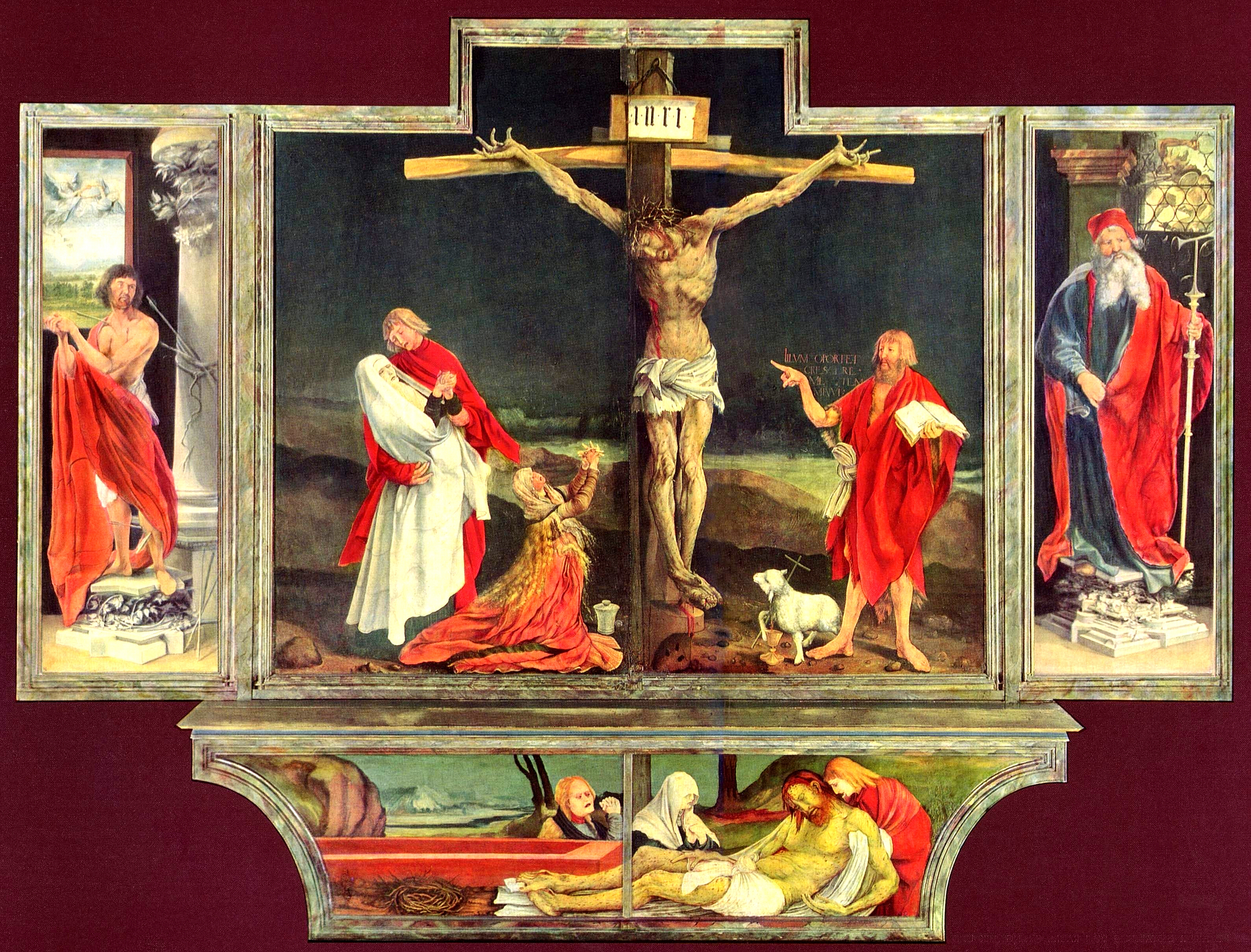
Who knows Rick Steves?  Last night, Jordan and I were watching Rick Steves’ travel show–he’s a guy from the Pacific Northwest who makes sense for me of Jordan’s family living half in North Dakota and half outside of Seattle, Mr. Steves’ accent has strong Midwestern undertones, and his boisterous nature reminds me of my brother-in-law.  Rick traipses around Europe with his camera crew, giving travel advice and showing off the great sights.  We watched an episode he filmed in a French town named Colmar, where there’s a really beautiful piece of art, the Issenheim Altarpiece.  It’s been one of my favorite artworks since I learned about it a few years ago.

Back in the Middle Ages, many altars–if the church could afford it–had a painting of Jesus behind them.  Up in Cooperstown, New York, where I did my field education work in divinity school, there’s a painting of Jesus ascending (especially appropriate as today is the Sunday we celebrate Jesus’s ascension) behind the altar on the East wall.  What’s notable about the Issenheim Altarpiece, as Rick Steves tells it, is that a religious order commissioned it to hang in their chapel, and this religious order maintained a hospital for people who suffered from skin diseases.  They were much more serious than they are today, many people died from such diseases in Medieval times.  The altarpiece it depicts Jesus being crucified, but his body is covered with pox marks and leprous wounds–he has the skin diseases that those who are looking at him suffer from too.  This Jesus enters into the suffering of those who see him; he knows what they’re going through.  Rick Steves–he’s Lutheran, you know–goes so far as to say that medicine and painkillers weren’t so effective back then, and that the altarpiece served as a sort of salve for these dear people, saying to them, “Jesus knows how much it hurts.”

Mathis_Gothart_Grünewald_019

(via wikipedia.org)

In our reading from the book of Acts today, we hear the words of the two angels, “this same Jesus, who was taken from you into heaven will return the same way you’ve seen him go into heaven.” (Acts 1:11)  This same Jesus.  The same Jesus who has been appearing to the disciples the last forty days, who has nail marks in his hands, who suffered right next to his followers and those he healed–that human person is also God–he has been as close to people as he possibly can, and now he goes back to his Father, as our Gospel lesson puts it (John 17:1-11).  Jesus, who sits with us in our sufferings, who knows what it is like to be human, is brought to God the Father, to draw us even closer too.  Through Jesus, we are made closer to God, brought ever more into God’s presence.

And what are Jesus’ last words to his followers as he is taken from them?  “You will be my witnesses in Jerusalem, and Judea, and all Samaria, and to the ends of the earth.” (Acts 1:8) This verse is a sort of summary or table of contents of the whole book of the Acts of the Apostles–it’s the account of the early church’s development from Jerusalem, which is the first few chapters, out to all Judea which is the few chapters after that, and into Samaria–a wider reach than Judea–in the chapters following, and headed to the ends of the earth–to the edges of the known world in the first century–by the end of Acts.

But you know what?  We’re at the end of the earth too–here in Columbia, South Carolina.  This is our story.  This is our mission, to be witnesses to God’s work in our lives through Jesus Christ.  We are called to be witnesses, to talk about how God has change our lives, right here in Columbia.

Last week, Jordan and I went to see my brother graduated from college in New York City.  We had some extra time the night before the graduation, so we went to dinner with a friend of Jordan’s who is also doing his graduate work, and lives in the City.  I’d met him once, three years ago, and though he’d been married almost two years, neither of us had yet met his wife.  It could have been a really awkward dinner–with us really not knowing each other well at all–but they were such holy, open people, we started talking about what God was doing in our lives within fives minutes.

You’re thinking, “that’s what a couple of preachers do!” aren’t you?  Well, as the husbands were getting dinner ready in the kitchen, this new friend of mine told how God had been leading her in a very clear, specific direction in the last six months; I got into this business because I love to hear what God is up to in peoples’ lives, so I asked her how this happened, how did she know that God was speaking to her, directing her?

She told me about walking home from church one Sunday with her husband, talking as they always did, and soon the conversation turned, and as he asked her questions to help discern what she was thinking and feeling, it dawned on her all at once what she was meant to do.  And she cried, right there outside in the middle of Manhattan (of course, it was Sunday morning, so there weren’t many witnesses).

I started to tell her how it was that I was called to be a priest; but I didn’t tell her the story I usually do–you see, I have two stories.  One is about how I was doing a lot of reading and thinking and reflecting and talking the year I worked after undergrad, and how a conversation with my mentor became an “ah ha!” moment–but that’s not really when I knew, that’s not really when I was called.

The story I hadn’t told anyone except Jordan until that night was from earlier on; the summer I graduated, I lived in an apartment, and I was lying in bed one night–I’d just received my first Book of Common Prayer from amazon.com (I don’t recall what possessed me to buy one, but I did), and as I shut the book and lay there, clearing out my mind to go to sleep, the thought floated right into my head–like that game you play as children, pretending an egg is cracked on your head, with the innards oozing down your hair, into your mind–and like a flash, I knew it was true, “You will be a priest.”  The realization made me gasp, and then cry, and then I fell asleep.

My new friend put it well, she said something like, “when you come face to face with Truth, what can you do but cry, and submit?”  There aren’t good words for what happened to me that night as I was falling asleep, or what happened to my friend as she was walking down the street.  They were moments beyond the realm of the explicable.

Which takes me back to Rick Steves.

At another moment in his travelogue last night, Rick was at the Louvre.  He was describing the Realist movement, the style of painting in the mid-1800s which sought to portray scenes as accurately as possible.  Many artists got quite good at this, studying light and details, using paint to make what looked like a photograph–there are plenty of them featured at the famous Parisian museum.  Then along came the Impressionists, who not only let their brushstrokes show on their “finished” canvases, but eschewed this idea that paintings should look like photographs all together.  They favored, instead, to use paint to give life to a scene–like Renoir’s depiction of a cafe in Paris, where you can almost hear the people talking, the music playing, and the dancers’ feet tapping.  The sense of movement and life captured in Impressionists’ work continues to amaze and delight.  They knew there was more to life than the bare facts, the scientific and certain lines and boundaries of a body or an instrument or a street scene.  Impressionists captured wind and breath and emotions in a way that Realists never could, a way that science and sociology and anthropology never can.

Today we celebrate the Ascension; next week is Pentecost, and then we spend the next several months in Ordinary time.  Nothing to interrupt us, nothing to catch us off-guard, nothing to jazz up the green vestments and altar-hangings, from here till December.  But isn’t a lot of life that way?  Not just that it’s our longest church season, but that we spend most of our time taking kids to school, making dinner, going to work–banal, common, ordinary stuff (of course, the church season “Ordinary” means “counted”–not “common,” though perhaps it should).  Our challenge is to witness to Jesus’ work in our lives, to notice God in the common, ordinary, everyday things.

Then again, what was my experience going to sleep at night back in that apartment in Durham, North Carolina, and what was my friend’s experience walking back from church with her husband, except ordinary and common?  Jesus meets us in the ordinary and the common, Jesus finds us and stays with us in our suffering and in our “normal;” God is eager to reveal himself to us in the everyday.  We have only to watch, and then to witness; even if it is an experience that is more of an Impression than Realism.