The Canlis Salad

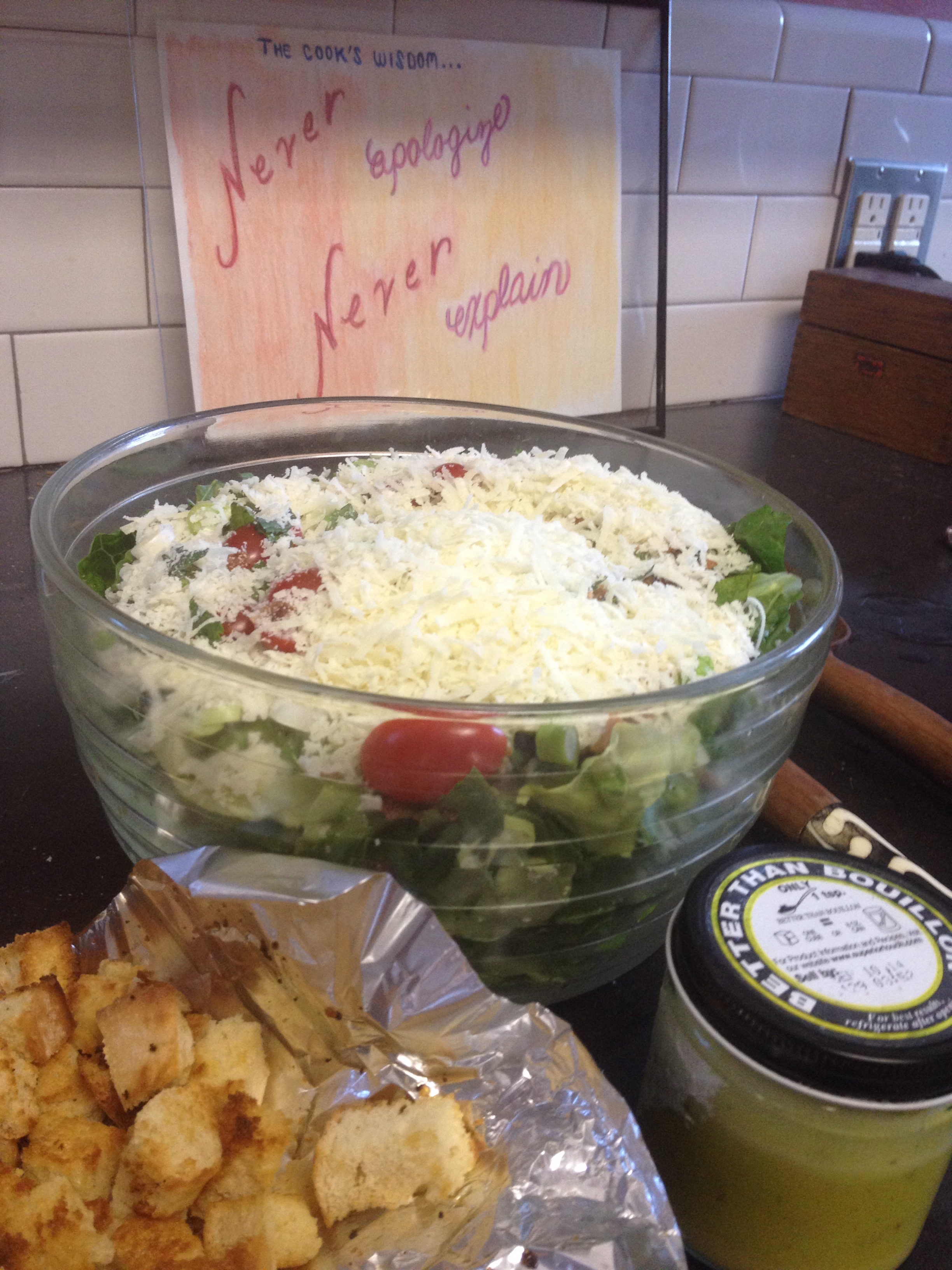
It takes a very special salad to make it onto a company dinner menu twice in one week.

20140226-162843.jpg

This SALAD is that special. Served simply with chicken (once grilled, once roasted) this dish makes magic at the table.

I learned it last year while living in St. Louis, a former waiter of the famous Canlis restaurant in Seattle lived nearby and brought this exact salad to a potluck. How lucky we were!

Though ripe for improvisation as encouraged in the recipe, make as written at least once – it’s worth the effort to keep the strange looking ratios. You will be rewarded! Enjoy all spring long…

breathing in silence

Sometimes it’s easy to notice God–like if there’s a voice from heaven, or a burning bush.  Sometimes it’s not as easy to notice God, he might even seem absent, but I believe he’s always there, only as far away as your arm can push him.

Recently, breathing has taught me a lot about God; when I spent a night with a roommate at a retreat a few weeks ago, as I turned over in the middle of the night, I noticed that I could hear her breathing.  It was slow, and steady, and deep.  Its rhythmic pulling through her lungs lulled me back to sleep.

I realized that if it’d been daytime, I wouldn’t have heard her breathing, though often people sit much closer to me than we had been in the room the night before.  There are so many other noises, distractions, demands during the daytime that take our attention away from our own breath and from the sound of others’ breathing.  It doesn’t mean that the noise of their lungs is gone, but that other noises are louder, more insistent, more immediate.

I wonder if it doesn’t have something to do with how we’ve trained our attention; whether, if we wanted to, we could shift our ears’ attention to noticing others’ breath, the living force that keeps each of us going every moment of every day.

If we let it, I wonder if each others’ breath, each others’ understanding of and reflection of the Holy, might shift our attention to the deeper, most-immediate parts of our lives–God’s presence around us all the time.

The Israelites, My Bros & Sises

Deuteronomy 5:23-27

23When you [Israelites] heard the voice out of the darkness, while the mountain was burning with fire, you approached me [Moses], all the heads of your tribes and your elders; 24and you said, ‘Look, the Lord our God has shown us his glory and greatness, and we have heard his voice out of the fire. Today we have seen that God may speak to someone and the person may still live. 25So now why should we die? For this great fire will consume us; if we hear the voice of the Lord our God any longer, we shall die. 26For who is there of all flesh that has heard the voice of the living God speaking out of fire, as we have, and remained alive? 27Go near, you yourself, and hear all that the Lord our God will say. Then tell us everything that the Lord our God tells you, and we will listen and do it.’

The people feel like they can’t bear to listen or to be near to God’s voice.  They’ve got a healthy respect–even fear–of God, which is sometimes missing from our modern understanding of the Creator of All That Is.  They’re convinced that God’s presence will consume them, burn them up.

Isn’t that what we should desire?

And yet, I feel just like the Israelites–“let me have my little life in my tent at the bottom of the mountain (Deut 5:30), leave me alone to my regular, everyday stuff; don’t upset everything I know now by the all-consuming flames that are part of experiencing you, God.  My reality right now is bearable, I don’t really want to know what would happen if it was all burned up.  I don’t even really want to know what would happen if it all rose from the ashes again.”

They ask Moses to go and listen for them, so that God’s presence and voice isn’t quite so close, so that they themselves don’t have to go through the agony of truth and transformation–someone else can do it for them.

We see and know from Scripture as well as our daily lives that no one else can transform for us–we’ve got to go through the changes ourselves for them to have any real power in our lives.

Shouldn’t we want God to be near?  Shouldn’t we desperately desire for the transforming heat to melt away the extraneous parts of our lives?

The problem is that when the heat comes close, when God starts burning things away in us, it’s uncomfortable.  Any time something hurts, whether it’s stretching us, or poking us, or singeing us, there’s an opportunity for growth.

Though I want to close my eyes and hum real loud and drown out the invitations to grow, the only way to be close to God, to be transformed, to get out of the little, narrow, grey everyday lives we live, is to let the difficulties wash over us, to let  God come close to change us and to pour his strength into us–that’s what Moses let happen to him.

Lessons on Self-Worth from Facebook

Do you ever stop yourself from doing something good, because you know there’s something better that you could do?  (and then, end up not-doing the better thing and do no-thing instead?)

In The Happiness Project, Gretchen Rubin uses the example of her friends’ birthdays: she’d mean to send them a card, or call them on the phone, but either the day passed and she forgot, or pulling out stationery and finding a stamp, or digging up a phone number just was too high a barrier, and she’d let another birthday–and another chance to connect–pass by.

Her dilemma hit home for me: if I couldn’t think up some clever or especially meaningful thought or wish to share on a friend’s facebook page for his or her birthday, I just said nothing at all.  My mind got used to ignoring the little birthday candle at the top of my newsfeed every day.

Rubin swallowed her pride, gathered all the pertinent birthdays into a program with requisite email addresses, and vowed to send an email to each person every year on their birthday.  Sure, a card or a phone call would have been “better,” but if the barrier to those actions was just high enough to keep her from completing them, an email was definitely better than nothing.

On my birthday earlier this year, I noticed that it wasn’t the clever memories or sayings that delighted me as well-wishes showed up on my newsfeed all day.  The messages that surprised and delighted me most were  from those people with whom I hadn’t had contact over the last year, but who took just long enough to notice that it was my birthday, and to write two or three words on my wall.  Just knowing that they’d thought of me warmed my heart and I started to see what it is that’s meant when we say “it’s the thought that counts,” or “90% of life is showing up.”–I’m often tempted to think that something’s got to be personalized, or super creative, or fantastically complex to be a good gift, or to be a job well done.

In and of ourselves, who we are when we’re just sitting on the couch, our very presence–that’s plenty for most people.

God created us to be fantastic, personalized, creative people just as we are, without energy-sapping window-dressing, complicated choreography, or intense planning.  Just sitting on the couch, doing nothing, “contributing” (in an economic sense) nothing–we’re plenty.

A Strange Thing Happened at Trinity Cathedral

A poem inspired by several independent experiences of Ash Wednesday at Trinity this year, shared with me over the course of the week:

As we prepped for Lent, we were all very clever,
We had last dinners out in spite of the weather.

We emptied our houses of sweets and libations,
Dashing to the grocery store for kale and healthful rations.

Wednesday dawned, and we traipsed to church in the rains,
Our challenging food-fasts at the top of our brains.

We knelt in our pews, and the Holy Spirit hovered:
we heard, “Not food—it’s your heart I want covered.”

Look inside—what is it that’s holding you back?
Is it worry that makes you think you’re in lack?

Or maybe it’s anxiety that eats you up;
or achievement that runs over your cup.

Whatever the vice that puts up a wall
between you and your Lord, between you and us all—

God wants to take it away;
so loosen your grasp,
ask him when you pray.

As we sojourn through a Holy Lent,
Remember it’s not garments that’re rent—

It’s our hearts which need loving, honest evaluation;
For God living in us, it’s the best preparation.