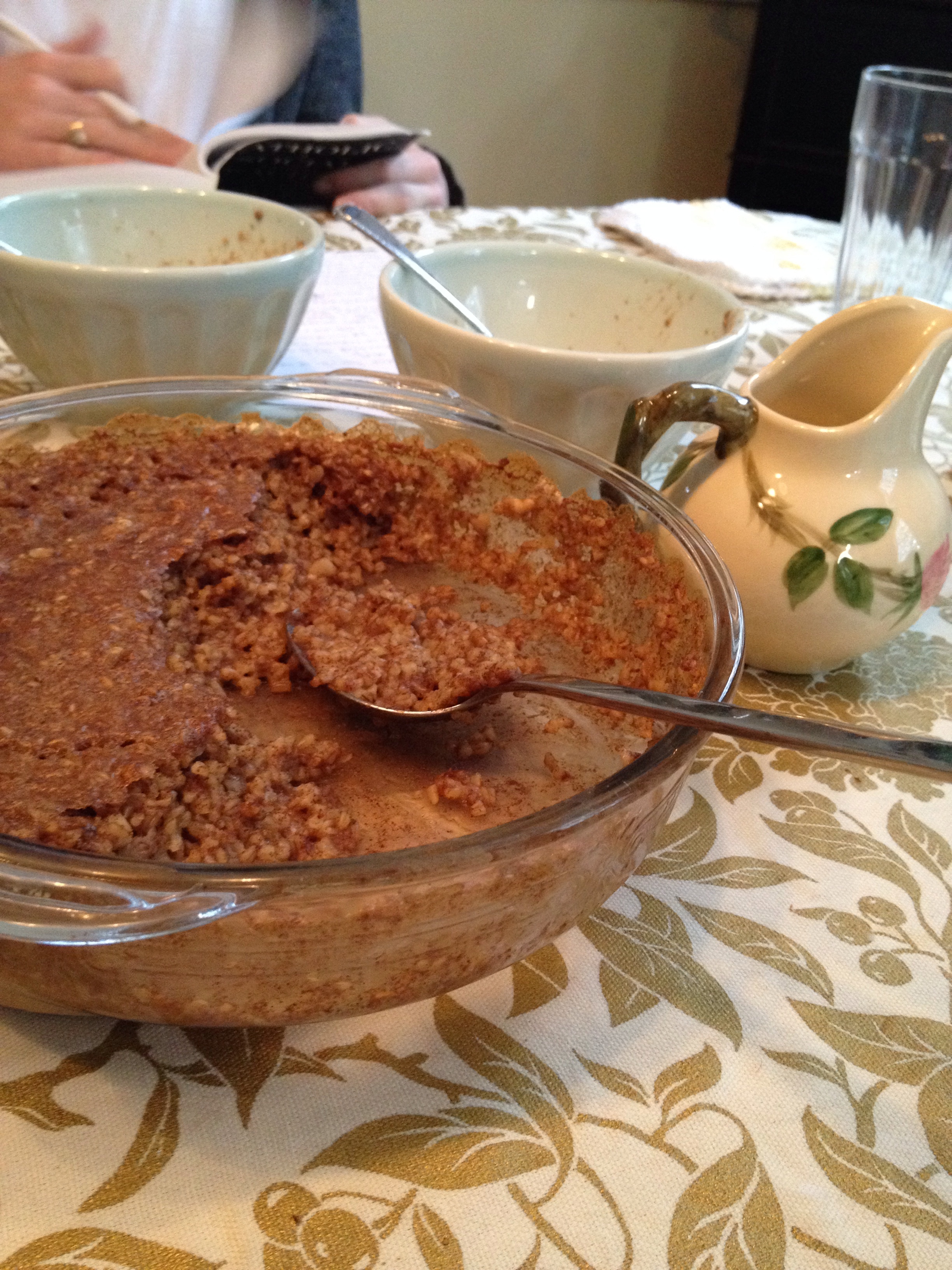
The Definitive Refectory Baked Oatmeal Recipe

20140129-122128.jpg

Isn’t this how problems are usually solved?  You study the problem, consider the issue from all angles, perhaps even try a few solutions, but you never quite get it right till you walk away and then come back to the problem again later (okay, not always, but sometimes that’s true, and it was definitely true with respect to this long-sought-after recipe).

Six years after graduating, I have finally cracked the Baked Oatmeal code of the (now-defunct) Refectory recipe.  The secret, as released last week on Facebook, is steel-cut oats.  In hindsight, I should have tried swapping them out for the oft-called-for old fashioned rolled oats years ago; the texture of my attempts were never quite chewy enough, and you never could really differentiate the classic rolled-oat-shape in the Refectory original.  Without further ado, with two methods:

Ingredients:

1 1/2 cups steel-cut oats

1 1/2 cups water

1 cup milk (extra for serving)

1 egg

1 teaspoon baking powder

pinch of salt

1/4 cup sugar (extra for serving)

1 teaspoon – 1 Tablespoon cinnamon (extra for serving)

Methods:

Overnight method – combine oats with water, egg, sugar, salt, and cinnamon in a large bowl, cover and refrigerate overnight.  In the morning, preheat oven to 350 degrees, add milk and baking powder to the oats, and pour into an 8×8, 9×9, or pie pan.  Bake for 25 minutes, till brown on top.

Morning method – combine oats with water and boil till water is absorbed.  Pour oats into a large bowl, add milk, sugar, salt, and cinnamon.  When oat mixture has cooled somewhat from mixing the other ingredients, add the beaten egg and the baking powder.  Pour into baking dish and bake at 350 degrees for about 25 minutes.

Relive college.

The Problem of Death – On Which to Chew

More Screwtape, its timeliness almost shocks:

“How much better for us if all humans died in costly nursing homes amid doctors who lie, nurses who lie, friends who lie, as we have trained them, promising life to the dying, encouraging the belief that sickness excuses every indulgence, and even, if our workers know their job, withholding all suggestion of a priest lest it should betray to the sick man his true condition!  And how disastrous for us is the continual remembrance of death which war enforces.  One of our best weapons, contented worldiness, is rendered useless.  In wartime not even a human can believe that he is going to live forever.”

(The Screwtape Letters, by C.S. Lewis, a satire; a collection of letters from a senior tempter to a greener demon)

Ostensibly written during the outbreak of WWII.  The first sentence reminds me especially of the situation faced by the characters of Brideshead Revisited on the declining health of the patriarch–no one wanted to let him know that he was dying; how far we’ve come from the prayer in the Great Litany of the BCP that we “would not die suddenly and unprepared.”

Anyone else (with me), suffer almost constantly from “contented worldiness”?

Bended Knees – On Which To Chew

Reading Screwtape Letters* for the first time in perhaps 10 years; how salient it continues to be decades after its release is a testament to the un-changing-ness of human nature, the problems, vices, and struggles that face every person throughout time.

“One of their poets, Coleridge, has recorded that he did not pray ‘with moving lips and bended knees’ but merely ‘composed his spirit to love’ and indulged ‘a sense of supplication’.  That is exactly the sort of prayer we want; and since it bears a superficial resemblance to the prayer of silence as practised by those who are very far advanced in the Enemy’s service, clever and lazy patients can be taken in by it for quite a long time.  At the very least, they can be persuaded that the bodily position makes no difference to their prayers; for they constantly forget, what you must always remember, that they are animals and that whatever their bodies do affects their souls.  It is funny how mortals always picture us as putting things into their minds: in reality our best work is done by keeping things out.”

*a satire by C.S. Lewis, comprised of letters from one demon, or tempter, to another younger and less-experienced tempter; “the Enemy” in the quotation above then, is God.

No Rights

Today we celebrate the feast of Florence Li Tim-Oi, the first woman ordained priest in the Anglican Communion; she served during World War II during a time of duress in Asia.  Because of the controversy of her ordination, she resigned her license after the end of the war.  I want to consider why our church ordains women and what that means for who we believe God to be, and what we believe to be the vocation–or job–of every Christian.

Having been raised–theologically-speaking–in the house of Stanley Hauerwas at Duke, “rights” language makes me very uncomfortable.  It’s not that women have a “right” to serve just like men do, as priests–none of us, as followers of Jesus, has a right to do anything, so the argument goes.  What I mean to say is that when we were drowned in the waters of baptism and raised up out of them by the grace of God, all our rights were washed away–the only claim that any baptized person has is our belonging to God in Christ–we follow the lifestyle that leads to the cross.  It’s not about us as individuals anymore, it’s about what’s best for God’s kingdom and God’s people.  Our only right is to pick up our cross and walk in Jesus’ footsteps.

Looked at this way, women ought to be ordained and to serve as priests, bishops, and whatever else in the church because God gifts both women and men with the sorts of talents that are useful for church leadership, development, evangelism, and the like.  Part of my frustration growing up was that my parents told me that I should use the gifts God had given me–which were pretty clearly gifts for leadership, teaching, and speaking in public–and my church was telling me that I couldn’t do those sorts of things because I was a girl.  An early Christian and theologian said, “that which God has not assumed, God cannot redeem”–what was important about Jesus–God in the flesh–was not that he was male, but that he was human.  God assumed humanity, became a person, not God-became-male.

So if God doesn’t care if you are a man or a woman, as the passage in Galatians says today (3:23-28), I wonder if God cares if you are ordained or not.  In the Gospel (Luke 10:1-9) lesson, Jesus sends out 70 of the people–probably all men–who had been following him around, instructing them to try out this ministry-and-evangelism thing.  Perhaps they were like itinerant preachers, or circuit-riders, the way that Methodism spread in the United States, but I suspect they may have been more like immigrant workers, or bi-vocational evangelists–people who did “normal” work, but who shared their faith in the God who became a person because of his love for each human.

My uncle was visiting this week, and one morning he told me about his work at a major home-improvement store.  He talked about how he builds relationships with customers, whether they are regulars or someone he just interacts with for 30 seconds or a few minutes.  When someone is looking for a realtor key holder (those cases that have a code to punch in that holds the key–i don’t know what those are called otherwise!), he shows them where they are, but if they seem open to it, he asks them what it’s for, and as they start to have a conversation, he helps them think through the implications of the change they’re making to their home (whether it’s for security, or convenience, or whatever).  Even though he’s just a “normal” worker, he reaches out to the people he comes in contact with and walks with them in their lives, if only for a few minutes, to help them know they’re not alone, to offer his expertise and wisdom, and to help them to make the best decision for their project.

Every Christian in every job is called to this kind of work.  God came to earth in Jesus to prove how much he wants to know each of us; Jesus didn’t run away even from being murdered on a cross to show us that he loves us more than he loves anything else, even life; God raised Jesus from the dead to reveal that he is the most powerful force in the universe.

As baptized Christians, we come forward to receive the Eucharist in order to be healed and be filled with that same power; when we allow God to be active in our lives–giving up our “rights,” he does more through us than we could know or imagine on our own.  God has called each and every one of us to be missionaries for the sake of his kingdom and his people, to go out as sheep in the midst of wolves, trusting in his will.  We are primarily identified by our status as Christians, not as men or women or as priests.  We’ve all been given a vocation in baptism, and that is to grow in relationship with God through Jesus Christ, and to introduce others to Him.  Amen.

Weak Coffee & Steeping

20140123-103826.jpgO everlasting God, you revealed your truth to your servant Phillips Brooks, and so formed and molded his mind and heart that he was able to mediate that truth with grace and power: Grant, we pray, that all whom you call to preach the Gospel may steep themselves in your Word, and conform their lives to your will; through Jesus Christ our Lord, who lives and reigns with you and the Holy Spirit, one God, for ever and ever.  Amen.

(Collect for the feast of Phillips Brooks, Bishop of Massachusetts, 1893)

My husband Jordan and I are fortunate to agree on the most important things–religion, politics, and how many coffee beans constitutes a decent cup of coffee.  I’m not sure where he developed this sensibility, though, because my in-laws have a disturbingly divergent understanding of hot coffee.  Whereas 1-2 tablespoons-per-cup is the norm at our house, and we admit it might be a little excessive, up in the North Dakotan Hylden house, 2 tablespoons is enough for an entire pot.  We all joke when we’re up there for holidays, we call it “coffee water” and we speak about experiencing “the idea of coffee” when we partake of the morning brew.  To be honest, it’s got less color than my afternoon cuppa Earl Grey.

I think Phillips Brooks is something like the coffee us younger Hyldens drink.

The collect written and prayed to remember this fellow disciple speaks of us being “steeped” in God’s Word, and it is clear from his many sermons which still instruct and inspire today that Phillips Brooks was a stellar example of a life steeped in Scripture, worship, and prayer.

It’s as if God, in the forms of Father, Son, and Holy Spirit, are the coffee grounds, through which our lives–water–is poured.  The most potent brews are those which use lots of finely-ground beans.  The water is transformed, it’s hardly recognizable as water anymore, but becomes a different sort of liquid.  For one thing, instead of being hydrating water, strong coffee, on the whole, is a dehydrating beverage; steeping in coffee grounds completely reverses the effect that the water has on our bodies.  Studying Scripture, praying, and attending worship can have the same powerful result in our lives.

As Episcopalians, we believe that worshiping together is the most powerful sort of brewing to which we can subject ourselves.  Do you know Drip Coffee, downtown, or in Five Points?  They don’t make pots of coffee from a coffeemaker like we have on our kitchen counters; they grind each serving of beans individually, tap them into a single-serving filter, and use an expert method to slowly pour the hot water over the grounds, so that the water takes on the beans’ aroma, taste, and caffeine in a special and intense way.  Episcopalians,and Anglicans throughout the centuries, have believed that worship is that kind of steeping.  It’s when we’re together, seeking God as a community, that God is most clearly with us–we need each other to know God best.

To carry the analogy a little further–maybe too far, but here I go!–often, when I go into Drip, I ask them which coffee I should get.  Is the Peruvian best?  Or does Kenya have a great taste this week?  The baristas are quick to explain the differences between the kinds of beans that week–which ones are more chocolatey, or have more fruit in them.  In order to know those sorts of things off the top of their heads, the baristas do a lot of tasting and reading and studying of their beans.  Phillips Brooks, for one, and many other fellow saints in the history of our church, and today, have spent a lot of time steeping in Scripture, studying, tasting, reading, and meditating on God’s Word–getting to know the God revealed in Scripture through the Father, Son, and Holy Spirit.  By becoming very familiar with the way that God often talks and acts, Bishop Brooks could more easily point out God’s work to his churches, and bring them along in knowing and recognizing and growing with God all the more.

When we show up to worship, if we’ve been reading, studying, and praying Scripture, we’re much more attuned to God’s voice, and we can hear in our hearts what God wants to say much more clearly.  May we hide God’s Word in our hearts through study and prayer, that we may become ever more deeply steeped in the particular coffee grounds which are the only living and almighty God.  Amen.