Grey’s Anatomy & Jesus

I’ve found my true calling: recognizing (“rationalizing”?) the echoes and underpinnings of the Christian message in popular television.  It’s a difficult job–watching lots of television and searching as for a needle in a haystack to find something true to affirm–but it’s the calling I’ve been given.  (tongue-in-cheek, my friends)

But seriously: in this year’s season finale of Grey’s Anatomy, a main character realizes that she and her ex-husband/companion/lover (that is, they got divorced in order to keep their love alive…) have mutually exclusive life goals, and that she must end the relationship.  The nugget of wisdom I heard in all this mess was this woman telling her not-husband, as he tried to convince her that their relationship didn’t have to end over the difference they suffered, “It’s already happened.”  He’d had a desire to adopt a child, and while it was only a desire, it was one that he dwelt on and dreamt of, all the while, not telling her.  It didn’t work out, and he didn’t try to adopt the boy, but the not-wife knew that the damage had already been done.  The irreversible change in their relationship had already happened, though he hadn’t made any physical, procedural, or preparatory moves toward this life change.

“You have heard that it was said, ‘You shall not commit adultery.’  But I say to you that everyone who looks at a woman lustfully has already committed adultery with her in his heart.'” (Matthew 5:27-28)

In our relationships, how much damage is done by both the fleeting thoughts and the thought-patterns that we allow to seep into our heads?  I’m aware that just by saying out loud to everyone who asks, “this move has been bewilderingly easy and wonderful!”  I’m teaching myself to believe it’s true (of course, it helps when, as in my case, it happens to be true!).  Hearing yourself, or someone else, say the same positive thing again and again makes it seep into your head and heart, and you begin to believe it–because it’s true (a lot of life is which details we choose to underline).

However, if we aren’t active about the sorts of things we habitually say and think, we easily slip into negative habits and thought patterns, looking at others with contempt, focusing on our exhaustion (as we complain to everyone how tired and achy and over-worked we are). Or, in the case of our favorite Grey’s Anatomy characters, our minds run away with us and our plans, knowing that at some point the new life we’ve created in our heads will come crashing down when reality–that is, trying to life out this dream-life–sets in.

There are times and places for honest discussion about those things in life which are challenging, and perhaps even suffocating for us, but being aware of our mental tape loops  can allow us to create new, powerful, more truthful thought-and-speaking patterns about our lives.

With (spoiler alert!) Yang & Hunt on GA, Christina Yang knows that Owen Hunt’s foray into fatherhood through adoption in his mind has already planted the growing seed of desire which will turn to resentment; “it’s already happened”–our thoughts count.

pouring yourself out

This morning, we threw away a carton full of raspberries.  They were big and juicy and red and just the right amount of tart (a week ago).  I was saving them for something special.  I never did discover what the special thing was, and while I was working hard to save them–seeing them taunting me on the refrigerator shelf every morning–they grew moldy.  All my difficult work, saving them up for something special instead of enjoying them NOW, ended up to be for naught.  My effort to enjoy them later ended up meaning that I never got to enjoy them–though I’m sure the mold spores enjoyed the berries very much.

Reflecting on moments and phases of life when I’ve been more generous with my time and energy, I know that those are the times I’ve been most happy.  Then, more often than my generous moments, I get grabby with my time.  I want to protect my moments and hours, to save them up for something.  But why am I saving this precious time?  Where is it all going?  It goes into watching netflix and lolling around the house, into using up the energy on my wandering, worrying mind–which is not fun at all.

It’s like on high school track team, when our coach, Mr. Barney, told us to leave it all on the track at the end of a race.  Why else had we trained our muscles for weeks and eaten carefully for days and stored up our energy that morning?  I remember always being afraid that I would leave too much on the track–that my strength would give out before the end and I would just fall over, or that I’d just stop, or… whatever it is that happens when you really get to the end of your physical rope (can you tell I never really quite got there?).  Because of course a 16-year-old who’s in decent shape should be worried about falling over after running half a mile (see “worrying mind” above).

Let’s worry less and leave more of ourselves in the moments of our lives.

“work/life balance” versus energy-giving/energy-sapping

In the last few months, I’ve start to run into articles challenging this pervasive idea of a “work/life balance.”  The work/life balance idea is that our lives generally don’t fit into neat 9-to-5 boxes anymore, and with the growth of families where both parents work, the lines between our home lives and work lives continue to become more blurry.  We’re supposed to divide up the hours of the day or the week, and commit some to the “work” column and others to the “life” column–maybe bloggers work mornings, take the afternoons off to be with their children, and then work a few evenings a week.  For me, putting parts of days or weeks into “work” and “life” baskets creates pressure to be ALL WORK or ALL LIFE at particular moments and inevitably, bits of the other try to sneak in.

Enter Lifehacker’s “When (and If) You Should Ever Work for Free,” and ABlogAboutLove.com’s “I Don’t Believe in Work/Life Balance, I Believe In Managing Energy.”

Managing energy and looking at the sorts of things that bring you joy provides a different set of categories for evaluating your life.  I’ve heard people talk about their lives as a wheel, too–with God at the center, and all the rest of your activity (or non-activity!) expanding from that one central place.  I wonder if this “managing energy” method–though I’m not sure what I think about this “limited energy” idea (as described in ablogaboutlove.com’s article)–might be helpful to get on the path toward getting God to the true center, touchstone, and energy source.  I’ll be that if God is the true energy source, our energy wouldn’t be so limited…

Bringer of Life and Joy – Third Sunday After Pentecost – Trinity Episcopal Cathedral, Columbia, SC

1 Kings 17:8-24

It’s like the climax of a James Bond movie, when the hero has gotten himself into some incredible situation, and you can’t see any way out—you know that he’ll survive, he always does, but you can’t imagine how it will happen.  Watching those movies we have hope.  We are even certain of Bond’s coming success.  The widow in 1 Kings today had no hope.  Her personal stores of food were gone, the country’s stores of food were dwindling; she was at the end of her rope.  The widow had lost hope—from her perspective in life, there really was no way out.

Elijah arrives on the scene and asks the widow for water and food.  I imagine she somewhat bitterly retorts, “Food?  Yeah, wouldn’t some food be great about now?  As you well know, prophet-man, we haven’t got much food these days.  Just as sure as your God is the most powerful, me and my son are dust—we’re about to eat our Last Supper, and then all we can do is wait for death.  So, yeah, I’d love to have some food about now, too.”  Women probably didn’t presume to have such an attitude with men at the time, especially a non-Hebrew woman speaking to a holy Hebrew prophet, but her honest response—that they had no food to share—was still a departure from the expected course of conversation.

Elijah isn’t ruffled.  “Okay,” he says, “fair enough.  So, go and make the food you’re talking about—keep to your plan—but give me the first loaf you make, and if you show by that action that you really trust that my God is most powerful, he will keep food on your table.”

The widow told Elijah that she knew his God was truly in charge, and now Elijah challenges her to act on what she’s declared.  Like it says in the book of James, “You believe there is one God?  Good!  Even the demons believe it—and shudder!”  Elijah asks, “What is your response to recognizing that this God I serve is the only true God?  Will you place all your trust in his grace and love?”  The widow does.  She offers to God, through Elijah, the cake baked with the last bit of flour and oil—but of course it turns out not to be the last bit of food, for what Elijah said was true, and what the widow asserted was true—God has power over death, and provided food enough for the widow and the prophet and her household.

“The end!”  Can you see the scrawled across the screen in your mind?  What a lovely story that was about a woman growing into a trusting disciple of the living God.  Well, the widow’s bold faith is part of the story, but by scaling back our focus and looking at the context of this story, we can see that there’s a lot more God is revealing to us.

First, there’s the second part of the story between Elijah and the widow, where the widow’s son, spared from starvation, then succumbs to a horrible illness.

There’s also the context of these two stories in the larger story of Israel—what’s happening on a nation-wide scale while the widow is discovering the broad implications of the statement of faith she’s made.  Elijah had spoken with the King of Israel, Ahab, at the time, and as happened often to kings of Israel, Ahab had forgotten that he wasn’t really the one in charge.  Ahab’s stubborn, prideful heart was keeping him from reaching out to God, who longed to save the people suffering from the famine and truly had the power to do so.  The leader’s refusal to admit his limitations and to ask for help caused his people to suffer and die.

Viewed from this vantage point, it becomes clear that God is not just showing us a snapshot of an Old Testament saint, her story sandwiched by the nation’s woes.  God is revealing something about himself to us—acting in our lives to show us who he is.

So who is God, as revealed in the two stories about the widow’s household and the larger story about the famine in Israel?

God makes food out of nothing to keep the widow, her son, her household, and Elijah alive during a far-reaching famine.  He listens to Elijah when the prophet takes the widow’s dead son into his arms and cries for mercy.  He does not coerce King Ahab to trust him.

God is the giver of life.  We see this part of God very clearly in Jesus—resurrection, bringing life where there is death, is what God is about.  Resurrection is part of God’s identity.

This May, my great-grandmother died.  Her funeral was held in Minnesota, and because of our moving schedule to come here, I was free to be able to go and be with my family.  As the weekend ended, my husband Jordan’s family called him to ask if he could help with planting—he’s from a farming community in North Dakota.  I had plenty of time, so after the funeral, I decided to drive North instead of back south to St. Louis, and spent a few days with them, especially with Jordan’s mother.

More than thirty years ago, another death took place in May—it was Jordan’s older sister, who was stillborn.  On the anniversary of her death, his mother had been praying about her sadness over not being able to raise a daughter, and as she tells it, less than a week later, I made the unexpected trip to North Dakota.  God heard the prayer of my mother-in-law and gave her life and joy in the form of two daughters as wives to her sons.

One of the lessons my mother-in-law has taught me is to view life with more wonder and joy.  I am often like the widow, grumbling about picking up sticks, grumbling about the lack I see in some area of my life, muttering under my breath about others.

In the Scripture this morning, God invites us through Elijah to live in a way that requires God to be the giver of life.  King Ahab is not willing to let God take charge, and he is not forced to do so—though the consequences are serious.  In a similar way, God invites us to let him give us life through Jesus Christ, his son.  In Jesus, God reveals himself to be the one who brings life and joy to places of death and darkness.  Like my mother-in-law, who brought her experience with death to God, we can bring to him our experiences with death, whether it is the end of a loved one’s life, a broken relationship that has left us in the dark, or a nationwide problem that we recognize we need God to be able to overcome.

Of course, we see that even the return of rain to Israel is not the end of the story.  In Jesus Christ, God reveals himself to be the giver of life in the most powerful, most personal way.  We meet our life-giving Lord for the first time in baptism, we meet him again and again at the altar as we eat the life-giving bread he gives us, and we have a sure hope of eternal life as we trust God’s power to overcome death and darkness.

Each Sunday is a little Easter—we celebrate every single week the power that our God has over sin and death.  As we bring before God the places of darkness and death in our lives, let us also respond to his invitation to each one of us.  God says through his son Jesus, come to me, and I will give you life, that you may live with joy.

Who is my family?

2013-05-13 20.32.03

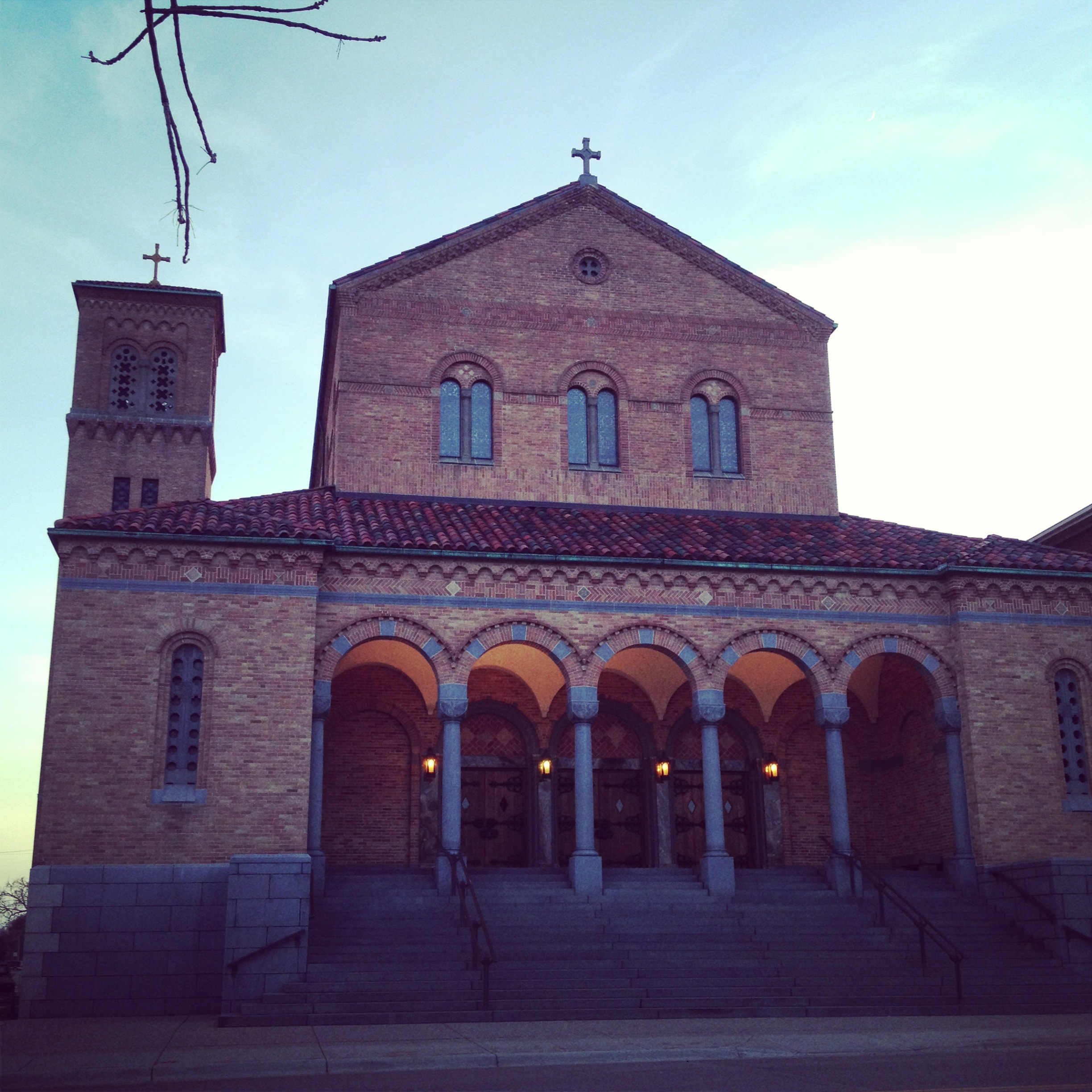
(Cathedral of St. Mary, St. Cloud, Minnesota)

All of my genes come from one county in central Minnesota.  Spending time there as a girl with my father’s family, seeing my paternal family name on gravestones in churchyards, hearing my grandmother’s stories about where the first pioneer of our family settled on “that very hill!”  My mother’s family, from the same area, was the quiet, present, forbidden topic.  I don’t remember a time that my biological parents were together, and rarely visited the area with my mother, so my experience of this county is fragmented, though my relatives may very well have sat next to each other in church.

Last week, I went back there, to St. Cloud, for my great-grandmother’s funeral.  I saw the county and its people through my mother’s eyes again–the dozens of people who came to the wake lived on the same roads I’d traversed numerous times with my father’s family, but hadn’t stopped to introduce myself or say hello.

I remember always being so curious about my mother’s family and her own time in St. Cloud where exactly she practiced throwing pots, where her grandparents had lived and worked, the places that meant something to her and to that ancestral half of me.

Running the St. Cloud State campus the morning of the funeral, I realized that my mother’s family was something like God’s family should be for each of us: my father’s family (while visiting the county) was present, obvious–they sat next to me at the dinner table and drove me around; my mother’s family was there too–in the grocery store, perhaps, or walking along the same street toward a movie–I just didn’t know they were next to me, too.  God’s family is not always easy to identify–we don’t know who is part of our family in God–but we know as surely as they are part of our blood that they surround us and we belong to each other.