
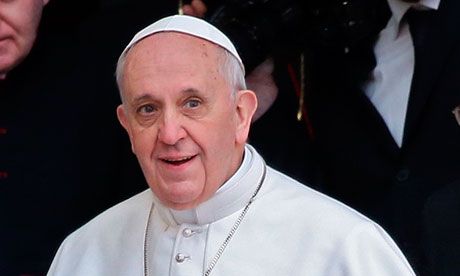
A Novel Leader: Is Francis New News?

Pope Francis

(via Photograph: Alessandro Bianchi/Reuters)

Excerpts from a Guardian article on the Pope:

“‘A person once asked me, in a provocative manner, if I approved of homosexuality. I replied with another question: ‘Tell me: when God looks at a gay person, does he endorse the existence of this person with love, or reject and condemn this person?'”

We’ve heard that sort of answer somewhere before, I think.  Answering a hostile person’s loaded question with another question, gently and compassionately ridiculing the supposed boundaries of the combative question being asked (Luke 10:25-26; Luke 20:3; John 18:33-34).

Explaining his decision to live in “The Casa” (where he was housed during the discernment and election of the new Pope last spring) at the Vatican instead of the tradition Papal apartments: “I cannot live without people.”

What do the first chapters of Genesis lay out for all humanity to read, but that God himself committed in the beginning to never live without people?  Where people are, God is in their midst; God is present.  This is the story of Scripture, this is the Gospel–because of God, incarnate in Jesus Christ, we are never alone.

On women as part of the church body: “The feminine genius is needed wherever we make important decisions.”

Didn’t someone else speak out by word and action about women’s important place in society and in communities of faith?  This other man spoke to women of impure blood, and allowed a prostitute to touch him (John 4:7).


Pope Francis is a man deeply steeped in prayer and Scripture.  He is not upsetting the whole of the Roman Catholic Church, he is not reversing the tide of Roman Catholic theology, or doctrine, or practice.  By the examples above, he’s sticking just about as close to the classic Christian game book as a person can!  Francis is, for whatever reason, someone that our media and our wounded and our skeptics can hear in a way that we haven’t been able to hear and to listen for many, many years.

Isn’t it a beautiful wonder that simply stealing pages from Jesus’ playbook is still, thousands of years later, considered radical and exciting and irresistable?

What is it, do you think, that makes him someone to whom the world is willing to listen?

from the outside looking in

The trip I took was supposed to be a retreat.  It was supposed to be a break from the everyday stresses of ministry.  Instead, it made me oh-so-homesick…

The Double-Ivy sitting across from me at dinner waxed on about aspiring to have children–after business school was finished, of course–I couldn’t suss out whether there was any sort of partner in the picture, but quickly remembered that the real “problems” of family building these days weren’t whether there was an emotional support network or even a partnered relationship, but whether you could produce or procure the sort of child you meant to have (with enough money, of course, these are hardly obstacles either).  Immediately, I was reminded of Expecting Adam, the book written by a Double-Ivy, about being married to another such creature, having done all sorts of strange things like getting married right after college, and having a child at 25, and accidentally getting pregnant with another two years later, as graduate school started for each of the spouses–and then doing the most-strange thing: not having an abortion.

I mentioned this book to my dinner companion, and she seemed intrigued.  Then, I mindlessly waltzed into a mine field: “Oh, and most of the book is really about how she found out that the baby she was carrying had Down syndrome, and she still didn’t abort him.”

She was confused.  “But the child would start out so far behind.  Why would a mother wish such a difficult life on her child?”  Behind what?  I ask myself, behind in what?  I knew exactly what she meant by “start out behind;” I had spent time in that world, where value is based upon one’s intellectual contribution to society, where success means climbing to the top of the academic and societal heap.  Still, I voiced my query, if only in an attempt to jar the norms of my conversation partner’s world, just a little: “So far behind?  What do you mean?”  “Well, the child would suffer so much.  It just seems unfair, if you know going in that life will be so difficult, why make someone suffer through it at all?”

My bubble is too thick; why do Downs syndrome children suffer?  It has been too long since I’ve been in that world to remember why it is exactly that this brand of eugenics is okay, how this kind of sorting and killing is fundamentally different than Nazism–choosing which lives are the ones worth nurturing (for lots, lots more, see Conceiving Parenthood).  Spoiler: it’s not okay, it’s not different.  The slippery slope is actually a cliff, and if there are babies dying, we’ve already found ourselves over the cliff’s edge.

Expecting Adam asks, as I did: how it is, exactly, that Downs children are so much more broken that they ought not even live?–and comes out the other end still wondering.  That is–how is it that a Downs person is suffering, or “far behind,” or has a “difficult” life?  The answer which the author finds is that a Downs person suffers no more than any other–than any person who has the “correct” number of chromosomes, or the wrong sort of desires, or not enough food, or not enough family.

At dinner last night, my interlocutor suggested that it was the difference between the suffering and problems that you can control, and those which you can’t–you can control whether a Downs syndrome child is born to you, you cannot control how other children treat your progeny on the playground (though that is changing, too).

Affluent, Ivy-educated people can afford to say things like that; to assert that they hold this thing called “control” and can wield it over their lives (and the lives of others).  Lots of people can’t afford to imagine that they are in control of their lives, or that children are possessions to choose and to plan for and to control.

Human control over our own lives is an illusion anyway; we cannot control whether we make babies with “abnormalities” or whether we are victims of an accident or disaster.  The more we are able to recognize and relax (lean in?) into the un-control which marks our lives, the more we are able to instead seek and cultivate a relationship with the only, only presence which is willing and able to be with us throughout all this un-control–God.


Who Are We?

A wise woman blogging through a difficult transition recently wrote that she’s “trying to set energy aside for dealing with life’s daily hiccups before they derail [her].”  Immediately, I knew what she meant; I call it “emotional fat”–that energy, a shock-absorber, that keeps spilled milk from becoming a puddle of tears and torn-out hair.

Sometimes we lose our way when it comes to an equal-and-opposite reaction, or even better–no “reaction” at all, but being a non-anxious presence in the midst of upheaval.

Coming back from a place of emotional-boney-ness (which may come up suddenly and without warning, or you may know very well whence it comes, but it’s still unexpected when its impact is so great) takes time, of course, and it happens gradually, with the help of loved ones, and sometimes doctors, and often (for me) chocolate and pastry.  Then one day, you look back, and though you’ve got plenty of new stressors, you realize you don’t even want that pastry you promised to yourself for completing the task–the task being done is plenty, or perhaps the task itself was a joy.  You make a mental note, “Remember, Self: you love this task which you do.  You may not think so, but the moment you get yourself out of bed, or into the car, or onto the phone, you love the way the task reminds you of who you are, and the way the task helps you to be connected.”

I wonder if some of the emotional-boney-ness comes from losing track of who you are.  We are the relationships we have–I wouldn’t be Emily if I didn’t have two brothers who live in NYC and with whom I became who I am; I wouldn’t be Emily if I didn’t have lots of family of varying blood-relation splattered all over the globe.  Apart from our relationships, we don’t exist, and being un-connected can sort of make us feel as if we aren’t there at all.

On the deepest level, the relationship which truly defines us is Jesus.  God came to rub shoulders with each of us, and in relationship to us, with so much love, peacefully, willingly gave up his life for each of us, that we may all be together at the end of time with no death or disconnection ever again.  Our worth and energy and emotional fat comes from working to believe* that God really does love you so much as to give up everything for you.

*this is “faith,” and it is a gift, not something we can really work our way into, but it does seem that we’re told a lot of lies about our worth and what makes us worthy.  we continue to pray.

I have fallen in love with Henry Purcell

Our choir has been singin’ Purcell’s “I was glad” like it’s their job (ahem, “vocation”–and indeed, it is!).  His setting of Psalm 122 has been crawling around the corners of my mind and heart since I first heard it a few weeks ago at choir camp.

(via)

Check out a recording here (listen to the young ladies of Trinity–and men–at the 11:15am service’s Anthem, and to the adult choir’s Anthem at Evensong from this past Sunday, the 18th).

And the psalm itself, as a meditation this cloudy Tuesday morning:

1 I was glad when they said unto me: We will go into the house of the Lord.

2 Our feet shall stand in thy gates: O Jerusalem.

3 Jerusalem is built as a city: that is at unity in itself.

4 For thither the tribes go up, even the tribes of the Lord: to testify unto Israel, to give thanks
unto the Name of the Lord.

5 For there is the seat of judgement: even the seat of the house of David.

6 O pray for the peace of Jerusalem: they shall prosper that love thee.

7 Peace be within thy walls: and plenteousness within thy palaces.

8 For my brethren and companions’ sakes: I will wish thee prosperity.

9 Yea, because of the house of the Lord our God: I will seek to do thee good.

(via)