
Good Friday

You notice, don’t you, the anniversaries of important events? Not just weddings and birthdays, but funerals, anniversaries of difficult diagnoses, the dates when tragedy struck or an accident happened. Our bodies remember, too. 

And so I find it’s not a surprise that Holy Week and especially Good Friday, feels heavy the world over. There’s a cosmic echo we just can’t shake, this ultimate tension that is imprinted on our internal calendars, on the time keeping of the whole world; we know in a deep part of us that something happened, something big, on this day. 

Today we remember and re-enact the pivotal moment of time. Two thousand years ago, today was an experiment. What would happen if evil killed God? What would happen if God didn’t use his God-power and just stayed, just died, along with us?

The love of God incarnate had never been tested this way. What would happen to the fabric of the universe? Would God’s love win? What would that winning look like? 

It didn’t look the way the disciples assumed, with swords and uprising and political revolution. It didn’t look like the Pharisees expected either, with peaceable conformity and cultural-convention-concerned movements. I wonder if it is the way that we suppose it is, either. I wonder whether the hints of resurrection in our own lives, whether the victory of God in our  midst, is in a form that we recognize and celebrate and follow. 

I’ll be honest, brothers and sisters. The odds aren’t in our favor. More often than not in Scripture, the people have it all backwards. More often than not in Scripture, the disciples get it all absolutely wrong. More often than not in Scripture, the prophets are murderd and the world turns away from the truth and the principalities and powers and contemporary victories are on the side opposite God. 

Indeed, in the end, on this day, Good Friday, the disciples abandon Jesus. Peter denies Jesus three times. At Golgotha, there were the women, and according to John’s account, himself as well. All like sheep had gone astray, each one to his own way, and he bore on himself the iniquity of them all. 

How could it be that winning, that victory, could look like death on a cross? This is not at all how it ought to have been. Power is security and luxury and leisure. These are the rewards for work well-done. That’s the lesson that the Pharisees took from the Old Testament, surely. But that’s not the message that Jesus bears. 

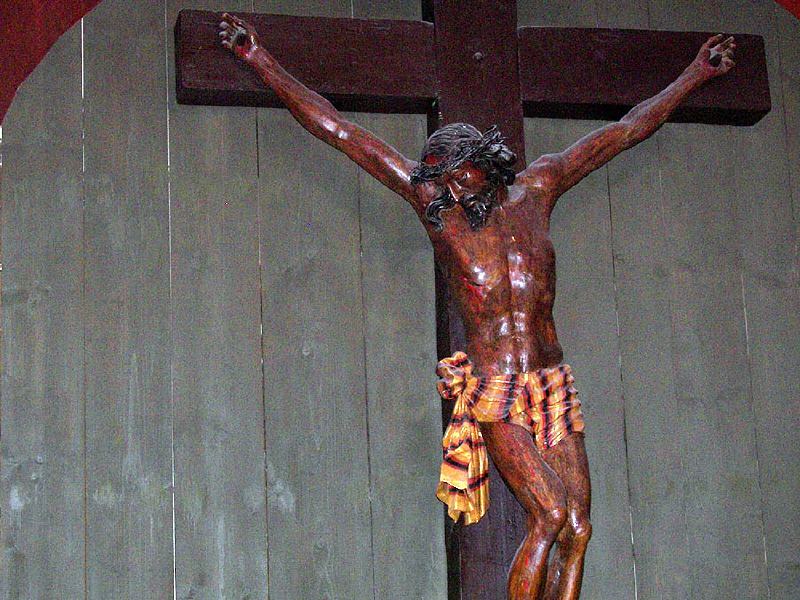
Jesus’ method is the same as his message, and the God revealed in Jesus Christ came to be with us. For thirty years, for 90% of his life, he spent his time just being. Growing up with friends and loved ones in Nazareth. Learning the family trade from Joseph his father. Going to synagogue and growing in wisdom and serving his community. He spent 9% of his life, those three years of itinerant preaching, teaching and healing – some call it his active ministry, but I wonder whether perhaps the whole of his life is an active ministry. And when he was in Jerusalem, when he was on the cross, he did the bit that only God could do, no human could endure the cross for our sake, but him. He stretched wide his arms upon the cross that everyone might come within the reach of his saving embrace. 

We see God’s love in this: no matter the cost, God in Jesus Christ stayed with us. Even when death came to pierce his hands and feet, Jesus would not abandon humanity. Even when he was ridiculed and striped and given the death of a criminal, Jesus did not call upon the powers at his disposal to save himself – because to do so would be to abandon his humanity, to pull the God card and not stay with us as his creation to the very end. 

On that Friday afternoon two thousand years ago, the world ended and we feel its echo, its grief, even today. Everyone wondered then: is this what winning looks like? Perhaps we still wonder today – is this all there is, is this what winning looks like? Our bits of grief rub up against this most grievous day, our pain at brokenness, illness, injustice, loneliness in our lives, is irritated and cracked open at Jesus’s sacrifice this day. Grief touches grief, and there is no day in the history of the world more full of grief than this one. The fears and sadness and wrongness of all the world is held by Jesus’ arms today. 

And back then, on that hill outside Jerusalem, even those who believed that somehow God would make good of this tragedy could not imagine how to come out the other side of this darkness. 

And maybe that’s you today. Maybe you wonder how you will come out the other side of this darkness. Maybe the way ahead is just pitch and obstacles and grief too deep for words. Here is the good news for you: God has been there, too. God is there with you now. God will lead you through this darkness and  oblivion because he has trod this path before and it does not scare him. He has overcome death and brought life, and he will do the same for you in whatever temporal battle you are facing today, and at the end of your own life, and at the end of the life of the world. 
“And people from the whole Judean countryside and all the people of Jerusalem were going out to him, and were baptized by him in the river Jordan, confessing their sins.” (Mark 1)

Can you imagine being eager to repent of your sins? Are you one who would have rushed into the wilderness, hopped in your car and high-tailed it to Cameron Parish, if you’d heard that some prophet had showed up there and was baptizing people? 

That sounds nice for other people. Maybe somebody else needs to go unburden themselves, but I’m okay right here. God can change a heart from anywhere, he doesn’t need me to go to Cameron parish or West Texas or Honduras to find salvation and listen to some fire and brimstone preacher. I can repent just fine right here in the quiet of my pew, without any histrionics or wailing or embarrassing outbursts. We have order – we are Episcopalians, for goodness’ sake.

But it’s not really about being Episcopalian or avoiding uncomfortable shows of emotion. It’s about fear, isn’t it? I wonder if we might be afraid of what God requires of us in judgment. 

Last week at the 8:30am service, Fr. Jake preached to open the Advent season, and he relayed a striking image from a C.S. Lewis novel that opened to us the way it might look when Jesus comes to judge and cleanse us. I think it might have looked different than we expected. 

So maybe that’s a good question to ask: what do we expect the exposing and purging of our sins to look like? 

Did any of you see the Anne of Green Gables with Megan Follows from the 1980s? (Who didn’t?!) There’s a scene where she’s a teacher trying to inspire her drama students to really get into playing Mary Queen of Scots, and she throws herself across the stage to cling to the skirts of whoever the other character is, maybe Queen Elizabeth the First, and yells, “Save me, sweet lady!” That’s one of the first images that bursts to my mind about begging for forgiveness. The debasing oneself, the physical and figurative lowering toward the dust. T

And we can easily imagine, too, the way that we might have experienced confession and punishment growing up – a stern voice saying, “well, tell me what you did wrong.” That hot, prickly feeling on your neck and back, maybe even bowing your head in shame and sadness in this expectant silence. Perhaps there were physical consequences too, privileges removed, or pain inflicted to help teach us a lesson.

Our world judges wrong in courtrooms, with testimonies and standing up alone in the truth or in sin. We are not so far removed, only a few hundred years, from pillories and the cutting off of ears or hands. 

Gosh, who would want to invite that kind of awful pain, and to be exacted from the Lord of Lords – the almighty one of ultimate power. What excruciating destruction he could bring to our lives! Surely it’s more than we could even imagine.

Yes, I would be one of those who would demur the invitation to go and be cleansed in the wilderness. I am not eager to have my sins nailed up next to me, or to have a scarlet letter sewn to my shirt, or to serve a sentence in a dank dungeon. Nobody really does, right? 

So I wonder if the exposing and purging of our sins for Jesus’ sake might look different than what we expect. I wonder if Jesus’s redemption and facing of our faults might be surprising in view of what the world teaches us that restitution looks like. 

Consider: back in the garden, when Adam and Eve had disobeyed, God sought them in the cool of the day. He didn’t come immediately the moment he knew they’d sinned. He didn’t stomp over and throw lightning bolts, he didn’t nail them up to a cross literally or figuratively, he didn’t even slap their behinds or waggle his fingers at them. With compassion and regret, he laid out the consequences of their actions; I get the sense that if it had been possible to ignore the price of their actions, he would have, but you see, they’d made a choice to not-trust God, and from that point, God still wanted to protect them as much as he could, and so the consequences provided a sort of boundary line to do what he could to keep them safe while being in the wide world. 

Later, we see in the Gospels how Jesus interacts with those who come to him with humility, knowing their sins. Often these are the people who society reminds of their shortcomings all the day long. But Jesus doesn’t pile on with the cultural expectations of shunning tax collectors and ignoring prostitutes. Those who recognize their imperfections, those who are humble about their sins, those who come to Jesus holding their sins out in front of them, are received how?

Jesus looks with compassion, Jesus takes time to sit with these people. Jesus gently wipes their tears and listens to their burdens and pronounces them forgiven. 

This isn’t the shunning or shaming we might expect. This isn’t the hot anger and lightning bolts that we often assume power will wield. This God revealed in Jesus Christ deals gently with those who recognize their darkness and who seek to heal from evil. And that’s the difference, isn’t it? I wonder whether the people who went out from Judea and all the surrounding countryside and who poured out from Jerusalem were the ones who knew they were already in darkness and already mired in the wilderness of sin. 

I wonder whether these people who sought John the Baptist and his cleansing in the river Jordan recognized that the trip to the wilderness was really not so much geographical as it was spiritual. And that they were, in truth, already there. 

Already in the wilderness. Already lost and parched. Already feeling heavy and burdened by the weight of their lives. Already wandering in guilt and regret. I wonder whether any of this feels familiar to you.

What we find in Scripture, not least in the prophecy from Isaiah this morning, is that this God, unlike rulers in the world or idols of ancient times, uses his great power when he’s doing good, not when he’s meting out consequences. The God revealed in Jesus Christ is a God of mercy, the prophet Hosea tells us, and when “he comes with might, and his arm rules for him, his reward is with him… he will feed his flock like a shepherd; he will gather the lambs in his arms.” This God is abundant in his power for mercy, for gentleness and nourishment, for forgiveness, for light and health and thriving and hope. 

The powers of this world are harsh and dark and full of punishment. The consequences are dire – the wages of sin is death – but the gift of God is eternal life. God’s kingdom, the ruling order that Jesus ushers in through the incarnation, is founded on the power of God’s love, not the power of pain or punishment or shame or evil. So as we approach God’s throne of grace, our confession of sin need not be fearful or defensive. We may rest knowing that the purging of our sins will hurt only in so far as it is hard to extricate ourselves from darkness, and that the love of God is a cleansing, healing salve to our sin-sick souls. 

Juneteenth

The dismantling of racism in one’s own heart, mind, and life, is a continual project. It never ends. There’s no finish line till you die and — I believe — God pulls the scales from your eyes in front of his Judgment seat (Lord, have mercy upon us). We are never fully relieved of the sin of racism until we are made perfect on the other side of the grave. This is true of all our sins — we are never made perfectly patient or perfectly kind or courageous or loving, etc etc. But who would argue that if we cannot achieve perfection in being anti-racist, we should just not even try? Nobody. Nobody ought argue that.

So I offer a small snapshot of my own journey on this Juneteenth, praying that this might be as a twig on the fire of anti-racism in our country.

I had never heard of this day till I moved to Texas. In a way, it makes sense, I guess, because it’s a Texas-centric event, but because this territory was the last holdout of enslavement in the United States after the Emancipation Proclamation, it is unassailably a date of immense importance to the history of justice, equality, and freedom in our entire nation.

It didn’t have to do with me — white girl from the Midwest — so I didn’t know, and I didn’t care.

Then I started ministering at a mixed-race church. St. Augustine’s is black (40%), white (50%), Asian (5%), and Hispanic (5%), and cultural humility is the sun salutation I try to remember to practice each and every day. The people of this church are immensely gracious, and while Juneteenth was mentioned in conversation and I could tell it was hallowed, it was veiled by my ignorance.

The first summer that Juneteenth came around, it was a strange piece of Americana. “What an interesting story! Huh. News traveled so slowly back there in the 1800s! Silly!”

The second summer that Juneteenth came around here, it was something I knew I should know something about. “Oh yes. A grave day. Hmm. We should uh, remember that.”

[The third summer, I’ll be honest, I was 36 weeks pregnant and the heaviest I’ve ever been and in 90 degree temps with a toddler. There wasn’t much awareness of anything.]

And today. I’ve been thinking about Juneteenth coming all month, turning its bittersweetness over and over in my mind, trying to imagine what it means and holds and looks like and feels to my black brothers and sisters, but I know I’ve been thinking about it because of George Floyd’s public murder, and protests to racism and police brutality, and adjusting my instagram follows. But here I am, white lady priest in a blessedly diverse congregation of the faithful, trying to keep myself uncomfortable for the sake of the Gospel.

I wonder whether the planation owners — enslavers — really didn’t know for 18 months that slavery was outlawed (I suspect they damned well knew, and just got away with what they could. Because that’s what I’ve seen humans do. We get away with what we can). What did freedom look like and mean when it finally came? And has it, in the ensuing 150 years, really “finally come”?

Sin is easy because it’s comfortable. It’s often The Most Comfortable thing to do. What’s uncomfortable is educating yourself, sitting next to people whose skin (and income and upbringing and culture and life) is not like yours and listening. Actively listening. Listening with humility. Letting the listening make you uncomfortable, challenging your boundaries and your suppositions and your perspective, and then deciding to give into the transformation that listening and discomfort invites.

Habits don’t change overnight. We must choose and work at our habits and our racism every single day to start to chip away at the sin that clings so closely (Hebrews 12:1). It has taken years, and death, and unrest, and a faithful community, for me to start to ingest the importance of Juneteenth. To start to ask questions and to bring this holy-day into my life and imagination and practice.

This is the Gospel. That Jesus, God crucified and raised, calls all people, all nations, to himself. That God made all humanity free and equal and precious in his sight. That all people are called to see the indwelling Spirit (ru’ah) of God in one another.

Jesus opens wide his arms of love on the hard wood of the cross that ALL may come within the reach of his saving embrace.

God, so clothe us in your Spirit that we, reaching forth our hands in love, may bring those who do not know you to the knowledge and love of you; for the honor of your Name. Amen.

On the Other Side of the Grave

ERH Sermon photo 05 05 2019

A sermon on John 21; Third Sunday of Easter

Haven’t we been here before? Is it just me who has some deja-vu? There’s a fire, there’re lots of questions aimed at Peter, he seems to be getting defensive as the line of conversation continues — this just happened, didn’t it?

Yes, there are significant similarities with the scene outside the courts the night before Jesus’s crucifixion, it’s a generally-accepted interpretation that these parallel narratives have a relationship to each other, and that’s what I’m curious about this morning. What does it mean to link these two events, what do we learn about how God works — what do we learn about his character — through this scene on the beach in early morning?

If,perchance, you weren’t at a Good Friday service a few weeks back, just like I missed them, here’s the story we’re working with. In chapter 18 of John (vs. 15-18; 25-27), as night wears on, Peter stands with servants and officers gathered outside by — you guessed it — a charcoal fire. He’s asked three times, once by each of three different people, “you’re one of that man’s disciples, aren’t you?” “Didn’t I see you in the garden with him?” Each of the three times, Peter quickly and easily says, “oh no, that wasn’t me.” Now Jesus had told him that this would happen, that Peter would deny Jesus, and that it would happen before dawn came, “before the rooster crowed” (John 13:38). Understandably, Peter wrankled at this prophecy when Jesus gave it at the Last Supper table, just a few hours before these events unfolded.

Continue reading

Will Good Really Win?


Rembrandt_-_The_Three_Crosses_(second_state)_-_WGA19086

It’s been a hard week to have the tv on, or listen to the radio, or even to read the morning paper. Each day has carried fresh horror and violence, from religious extremism to the effects of mental illness, from random and tragic natural disaster to carefully planned and executed extinguishing of life.

One of my coping mechanisms when faced with a relentless barrage of bad news is to escape to another world — that is, to Netflix.

This past week, I’ve been in 1950’s Madrid, observing life at a department store, cheering on the seamstresses and delivery boys who work day and night, and shaking my fist at the selfish and scheming minority shareholders in the company who leaks scandals to National Enquirer to hamstring their opponents and make furtive phone calls from the smoky back rooms of bars.

Late in the season, I realized that this series’ power over me had less to do with scintillating dialogue or all-consuming love stories; the real center of this show is the fight between good and evil. A piece of me knows that because it’s a television show, and because it’s the love-lorn-style drama it is, that eventually, good will prevail. It’s a long road, and I know it will take till the very last episode, but somehow, the honest and good will win over the dark, and evil and scheming.

Back in the real world, I wonder, when a child at Disneyworld encounters an alligator — will good really win?

When a member of Parliament loses her life in broad daylight — will good really win?

When yet another friend is diagnosed with cancer — will good really win?

And these are to say nothing of the ache still present in Charleston a year later, and the raw wound in Orlando today.  And refugees from Syria, and mothers and babies in South and Central America living at the mercy of Zika.

How on earth will good ever win?

This is the same question that Elijah asks God in our Scripture passage this morning. Continue reading