Healing in the Jordan River – Trinity Cathedral

2 Kings 5:1-15 & Luke 17:11-19

When you stepped over the threshold of the building you’re sitting in this morning, you left the United States of America.  You left American society.  Be not afraid! (have you heard that one before?)  You see–it’s more that you entered God’s Embassy than that you left American soil, but here, in the church, we are now on God’s turf.  Here, God’s rules carry the day, we are on holy ground that has been consecrated to be the place where we encounter God in the sacraments and are changed by our interaction with the Holy One.  The rules here are different than the ones we often follow outside these doors, the social customs are different here than the ones we’re used to following walking down the streets of Columbia, South Carolina.  These differences aren’t just nuances or quirks–there is significance to the way that God’s kingdom works; it’s sometimes in opposition to the way we’re used to behaving.

Here, in the Bible, we see dozens of accounts that show us the way that God desires for the world to look.  When we read holy Scripture together we learn about God’s kingdom, the world that we step into when we are in this holy place, the world that God desires for all of creation to become.  This morning, we read the story of Naaman, a powerful Syrian who is paradoxically, a sufferer of leprosy.  In the ancient world, leprosy was a disease the counted its victims among the weak, the marginalized; people with leprosy, as we saw in today’s Gospel lesson, were separated from society, ostracized.  Naaman, however, somehow manages to preserve his place of power despite this disease, though he clearly desires very much to be rid of the affliction.  Who is it that notices the skin lesions and suggests where he might seek treatment?  His Israeli slave girl–this nameless girl has a quotation in Holy Scripture, how strange that a being not even considered a real, full person by her society would get a shout out in the Bible.  She says that there’s a prophet in her home country who could definitely cure her master’s ailment.

Naaman goes to this holy man, Elisha, and parks his chariot outside Elisha’s front door.  Naaman clearly expects Elisha to dash out to his driveway and greet his Most Esteemed guest.  Elisha does nothing of the sort–he sends his servant out the front door with a message.  Naaman’s eyebrows raise, verse 11 says that he “became furious”–Elisha, this big-time prophet, was supposed to hurry out to the chariot and wave his hands about and shout in a loud voice.  Look at your Bible, it actually says that!

To add insult to injury, another low-life is now giving Naaman directions…  The messenger tells Naaman that if he will go and wash in the Jordan River seven times, he will become healed of his ailment.  Naaman grumbles.  Not only is the Jordan River a pathetic stream compared to the wide, beautiful rivers of Syria, but what sort of pathetic quest is a bath?  Couldn’t Naaman, the great military general at least prove his strength or daring or mental acuity in order to be healed?

For a third time, a servant corrects Naaman (I’m almost surprised that more slaves and messengers and servants aren’t killed or banished in this story!), saying in verse 13, “Well, sir, if you had been told to do something super impressive, you would have dashed right off to do it.  Why not go do this super easy thing?  We might even get back home in time to catch the end of the football game!”  Naaman takes a deep breath–I think he must be a very patient, and exceptionally magnanimous nobleman of his time–and agrees with the servant.  He makes his way down to the Jordan River, he immerses himself seven times–which is the Biblical number which means “complete” or “total”–and Naaman’s skin is made, it says, “like the flesh of a little child.”  “As smooth as a baby’s bottom,” if you’ll pardon the saying so early in the morning.

Did you catch that?  Naaman is in danger of societal death, perhaps even bodily death, depending on how bad his leprosy was, and Elisha sends him to be baptized in the Jordan River, which heals him.  Naaman, the Syrian, the foreigner, is made healthy and whole again by command of a holy man and the application of a bit of water.

Naaman has borne the insubordination and the humiliation of being directed about by his slave, Elisha’s messenger, and a servant; he has submitted himself to the “easy” task of taking a bath instead of showing his might and earning his reward.  He returns to Elisha–Naaman himself goes up and knocks on the prophet’s front door this time–and says, “Indeed, now I know that there is no God in all the earth, except in Israel; now, therefore, please take a gift from your servant.” (v. 15)  Naaman still wants to make sure he pays his debts and doesn’t leave himself beholden to anyone.  He’s got a reputation to uphold, and he can’t let it get out that he’s dependent on this holy man for his healing.

Elisha can sense when he’s being bought off, and will have nothing of it.  He doesn’t want an offering with psychological strings attached, God’s power is not for sale, and nor is the truth of God’s healing to be silenced with gold.  Naaman has learned–he’s been brought very low throughout this experience, and catches himself where he’s gone wrong.  He changes his request, asking instead that he might have some soil from Elisha in order to build an altar that Naaman himself might use for his worship of the Living God when he goes back to his own land.  I imagine Elisha finally smiled and nodded.

Naaman finally realized what the slave girl and the messenger and the servant had learned long ago because of their necessarily vulnerable place in society: you cannot do anything to insulate yourself from God.  Naaman tries to use his impressive strength and mind, desiring a more demanding cure, and then tries to use his money–all to keep God at arm’s length.  He finally learns that whether he pledges 2% or 55% to God, none of it is close to a repayment of the life that God, through the Jordan River, has given back to Naaman.

What would you pay for your life being saved?  We pay plenty to doctors and car makers and insurers and our government for protection, safety, and insulation from danger or dangerous circumstances.  God, through Jesus Christ, has saved us from eternal death.

Have you come back to Jesus’ feet, glorifying God and praising him with a loud voice?
Morning Prayer & I-85 Exits

Back in June, when I made my first voyage back to my hometown* (Durham), about ten minutes out from my best friend’s home, I realized that we NEEDED cheese for our Sunday night repast. Flipping my brain quickly into cheese-emergency mode, I thought, “Must get to Whole Foods (only cheesey place open on Sunday nights). Where am I now? How to get there fast?” And my brain then did a very funny thing. It shut off. I exited the interstate, and my arms felt like they were moving themselves, turning the wheel; my foot had a mind of its own, pressing the brake and the gas. And then, I turned up in the Whole Foods parking lot–presto! What a strange thing to happen, I thought, that my brain wouldn’t do the think-through-the-map-you-keep-stashed-in-your-mind, calculating distances and times and the length of stoplights…

It dawned on me: my brain had done that exact thing so many times on those exact streets that it didn’t need to think anymore. Living in St. Louis, and now in Columbia, I can get around very well, but my mind is constantly calculating and reorienting itself to remember where things are located and how the streets line up. My mind didn’t have to think through routes from here to there because it’d been making that route in my brain so long, through so many seasons of road construction and rain, that my body–in a way–just knew how to get where I wanted to go.

It wasn’t like that in the beginning, back in 2004. I knew one way to get from point A to point B, and though it may have been super-inefficient, I wasn’t going to abandon that route for anything. Gradually, I added more mental map and I colored in the way traffic affected roads at various times of day–eventually, I knew the roads so well, they were just part of me, my arms and legs could take over.

Back in 2008, I prayed Morning Prayer for the first time. I was in one of the hard, straight-backed wooden pews at St. Joseph’s Episcopal Church in Durham. I didn’t know which page we started on, I didn’t know how to choose readings or canticles or collects (or exactly what “collects” were) or when to stand or kneel. It was uncomfortable and foreign and not very enjoyable, but it was required for Confirmation, which I’d decided to undergo for some reason, and so I mouthed the words and listened.

20130925-173749.jpgI was committed to leading one of the Daily Offices (Morning, Noonday, Evening Prayer, and Compline) every week of the academic year, which roughly lined up to our time as catechumens, preparing for Confirmation in the Episcopal Church. Further, we were to pray this set of Offices every day by ourselves, if we didn’t show up at church for it. I was overwhelmed and a little bit rebellious. I didn’t stick with it well at all over winter break that year. By the next summer, a newly minted Episcopalian for just over a year, my field education supervisor expected me to pray Morning Prayer with him every day in our parish’s chapel, and though I felt a bit rebellious here too (when I led, I used contemporary language), I think that is when I fell in love with the Daily Office. Those weeks cemented something in me; some mornings I almost cried through the prayers, I was so tired, so humiliated, so lonely. But every morning, those words were there again, and in a way, that time and place–8 a.m. in St. Agnes’ Chapel–became sacred and became home.

I returned to Durham and to St. Joe’s that autumn, to the people and place that had already been with me through plenty of change and confusion. Morning Prayer was no longer a burden, a commitment that I’d made and felt imprisoned to keep, but a joy and delight–a place and time where I kept meeting God in the words I said and heard.

A little more than a year ago, I arrived late to a service of Morning Prayer in the parish I was serving in Missouri; I jumped right into the canticle being recited, and then I just forgot to pick up a prayer book. The rest of the service had hidden itself in my memory and in my heart. My brain turned off and the words easily came out of my mouth. Just like my body knew exactly how to drive my car to the grocery store, my heart practiced and found its way to God in Morning Prayer.

Years ago, when I started eating breakfast at St. Joe’s with who ever showed up for eggs and grits, they gave me a key, for the mornings that I’d be the first one there to start the coffee.  I still keep that key on my key chain to remember the place and people who re-introduced me to Jesus.

Last week, a dear friend of mine said, “Sometimes big things are the easy things to be courageous about; the little things are hard.” Why can we commit to things like marriage and jobs, but find it so difficult to commit to something like daily prayer, Scripture memorization, or keeping up with pen pals?

(postscript: this is the community now)

Psalm 131 Mash Up

20130925-095507.jpgHebrews 12:1-2 “Therefore, since we are surrounded by so great a cloud of witnesses, let us also lay aside every weight and the sin that clings so closely, and let us run with perseverance the race that is set before us, looking to Jesus the pioneer and perfecter of our faith, who for the sake of the joy that was set before him endured the cross, disregarding its shame, and has taken his seat at the right hand of the throne of God.” (NRSV)

Psalm 131 is a prayer, describing the thing we’re urged to do in this passage from Hebrews, “lay aside every weight.”  This psalm ought to be read, I think, as a plea to God for the truth of the words being uttered–it’s more prophecy than observation of present circumstances.

(1) O Lord, I am not proud, I have no haughty looks.

(2) I do not occupy myself with great matters, or with things that are too hard for me.

(3) But I still my soul and make it quiet, like a child upon its mother’s breast; my soul is quieted within me.

(4) O Israel, wait upon the Lord, from this time forth for evermore.

(via the Book of Common Prayer)

Jesus came because our sin is too heavy for us, because He can and does carry it himself.  Our propensity to turn away from God is too great to overcome ourselves, we must, in humility, lay aside the weight of making our own salvation happen again and again.  All to Jesus I surrender.

Through that laying down, through truly letting go of trying to control or to work ourselves into righteousness, our souls become quiet, our souls and our selves thereby inhabit the place we’re made for–we’re rightly out of the driver’s seat, listening, and being quiet.  We’re being, or practicing being, the humans that we are.

We Gentile Christians are grafted into Israel because of Jesus’ sacrifice, and just as people have waited on God for centuries–thousands of years, even–our occupation is to wait upon the Lord.

A Psalm 131 Rewrite:

Lord, keep us from being proud, and from looking down our noses.

Help us to remember that You are God, You are almighty, and we only need to be servants.

Quiet our hearts before You, drown out voices of worry and despair; relax our frazzled minds into trust in You, let us feel your hands holding us up.

Throughout all time, O Master, your servants have listened to your directions.  We now join with your witnesses from all time, waiting for Your coming again.

In the name of Your Son, our Savior Jesus Christ we pray, Amen.

A Novel Leader: Is Francis New News?

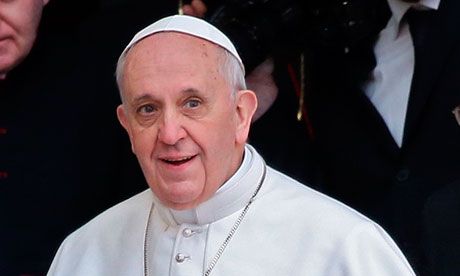
Pope Francis

(via Photograph: Alessandro Bianchi/Reuters)

Excerpts from a Guardian article on the Pope:

“‘A person once asked me, in a provocative manner, if I approved of homosexuality. I replied with another question: ‘Tell me: when God looks at a gay person, does he endorse the existence of this person with love, or reject and condemn this person?'”

We’ve heard that sort of answer somewhere before, I think.  Answering a hostile person’s loaded question with another question, gently and compassionately ridiculing the supposed boundaries of the combative question being asked (Luke 10:25-26; Luke 20:3; John 18:33-34).

Explaining his decision to live in “The Casa” (where he was housed during the discernment and election of the new Pope last spring) at the Vatican instead of the tradition Papal apartments: “I cannot live without people.”

What do the first chapters of Genesis lay out for all humanity to read, but that God himself committed in the beginning to never live without people?  Where people are, God is in their midst; God is present.  This is the story of Scripture, this is the Gospel–because of God, incarnate in Jesus Christ, we are never alone.

On women as part of the church body: “The feminine genius is needed wherever we make important decisions.”

Didn’t someone else speak out by word and action about women’s important place in society and in communities of faith?  This other man spoke to women of impure blood, and allowed a prostitute to touch him (John 4:7).


Pope Francis is a man deeply steeped in prayer and Scripture.  He is not upsetting the whole of the Roman Catholic Church, he is not reversing the tide of Roman Catholic theology, or doctrine, or practice.  By the examples above, he’s sticking just about as close to the classic Christian game book as a person can!  Francis is, for whatever reason, someone that our media and our wounded and our skeptics can hear in a way that we haven’t been able to hear and to listen for many, many years.

Isn’t it a beautiful wonder that simply stealing pages from Jesus’ playbook is still, thousands of years later, considered radical and exciting and irresistable?

What is it, do you think, that makes him someone to whom the world is willing to listen?