Who is my family?

2013-05-13 20.32.03

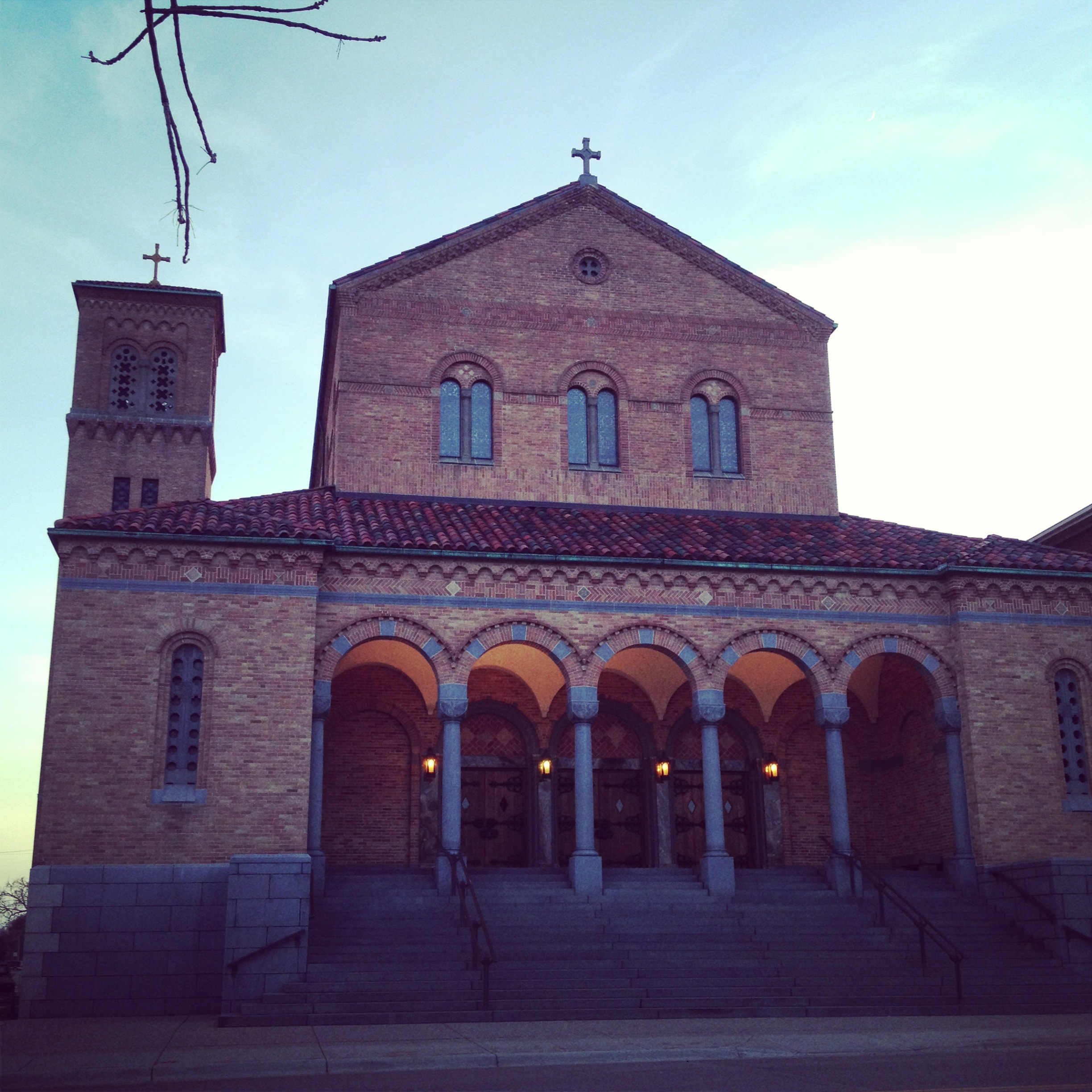
(Cathedral of St. Mary, St. Cloud, Minnesota)

All of my genes come from one county in central Minnesota.  Spending time there as a girl with my father’s family, seeing my paternal family name on gravestones in churchyards, hearing my grandmother’s stories about where the first pioneer of our family settled on “that very hill!”  My mother’s family, from the same area, was the quiet, present, forbidden topic.  I don’t remember a time that my biological parents were together, and rarely visited the area with my mother, so my experience of this county is fragmented, though my relatives may very well have sat next to each other in church.

Last week, I went back there, to St. Cloud, for my great-grandmother’s funeral.  I saw the county and its people through my mother’s eyes again–the dozens of people who came to the wake lived on the same roads I’d traversed numerous times with my father’s family, but hadn’t stopped to introduce myself or say hello.

I remember always being so curious about my mother’s family and her own time in St. Cloud where exactly she practiced throwing pots, where her grandparents had lived and worked, the places that meant something to her and to that ancestral half of me.

Running the St. Cloud State campus the morning of the funeral, I realized that my mother’s family was something like God’s family should be for each of us: my father’s family (while visiting the county) was present, obvious–they sat next to me at the dinner table and drove me around; my mother’s family was there too–in the grocery store, perhaps, or walking along the same street toward a movie–I just didn’t know they were next to me, too.  God’s family is not always easy to identify–we don’t know who is part of our family in God–but we know as surely as they are part of our blood that they surround us and we belong to each other.

Harry Potter Life Lesson #2

The illusion of control.

**(no particular spoilers–if you’ve been not-living-under-a-rock the last decade, you’ll learn nothing new here to spoil the plot of the HP franchise)

As the series develops (now somewhere in the middle of book 5), the characters’ struggle to understand and submit to reality intensifies; it’s clear that Harry Potter’s Muggle (non-magical) relatives are willfully ignorant (or openly hostile) of any supernatural happenings in their lives.  Most other Muggles, too, are accustomed to a particular way of interpreting reality which shields them from any confrontation with magical, supernatural realities.  Put simply: there is nothing more to life than what meets the eye (and if there is, one promptly shuts one’s eyes).  Understandably, to be challenged with inexplicable phenomena is distressing–one hardly knows whether “up” is still “up.”  By the second half of the series, even magical humans are willfully blinding themselves to the growing reality of evil in their midst.  The truth is too disruptive to life as we know it, and the possibility of ignoring that truth is still open to us (so we take it).

We could apply this principle to so many parts of our lives–the Isaiah Women’s Bible Study has done so this year–whence comes our food and clothing, how are our brothers and sisters without jobs or homes treated, what is happening to the earth because of our lifestyle choices?  Today I want to consider a particular aspect of our social formation: our insistence that we’re in control of our lives and our destinies (and that our freedom to control ourselves is a good, desirable thing).

I’ve been noodling a movie I saw a few months ago, “Young Adult.”  In it, Charlize Theron plays a moderately successful author of a teen (young adult) book series, who returns to her hometown for a short visit and tries to reignite a romantic relationship with her high school sweetheart, who has moved on, gotten married, and recently added a baby to his happy family.  He’s bogged down with commitments–a steady job, a wife, a kid, a mortgage…  She’s fancy-free–no domestic relationships, a job that only requires a laptop and internet connection, the single life in the big city (the Mini-Apple, that is)…  Our society would have you believe that the one with all the constraints, all of life controlled for him, stuck in a stable, habitual sort of life, is the unhappy one, but as the film depicts (and as myriad surveys of physical and emotional health underline), it’s the “free” person who finds herself deeply unhappy.  Part of the problem is that she hasn’t been able to move on from being a young adult herself (like the characters in her books), but part of the problem is also that she’s made sure not to make any decisions which would threaten her freedom, tie her down, or require a commitment of her.  When we’re under the impression that everything is within our control, we are miserable, overwhelmed by freedom, and we become unhinged when out-of-control things happen in our lives.

How ever dimly, Harry Potter and other characters realize that the world is not under their control and seek to commit themselves to those people and causes and principles (and stories) which provide the sort of foundation needed to understanding the world in which they find themselves. Harry’s friendships with Ron and Hermione define who he is to those at Hogwarts, his school (just as his relationship to his mother, father, godfather, and teachers also shape what it means to be Harry Potter).  Harry’s actions, fighting evil and falling into an excess of dangerous situations, form the contours of how he is recognized and understood by others.  It is the choices that we make to give up our freedom that make us who we are–Harry is committed to his friends; they continue to eat together and study together when they are in a tiff.  Often due to circumstances beyond his control, Harry is thrust into situations where he confronts evil head-on; ruled by the story he’s been given about his early years (having survived a murder attempt as a tot), he chooses to continue to fight the evil forces of the wizarding world.

One wonders–was he really “free” to choose to fight in the first place?  “Freedom,” as exemplified by Charlize Theron’s character in “Young Adult” is the path which is easiest–the path that requires the least of you, leaves your as unfettered and unaccountable as possible.

Harry’s life has been completely shaped by events beyond his control, events which suggested a course for his life long before he was capable of choosing anything. He did choose to continue on the path that was set out for him by these early, formative events, but what propelled him on this path, what made the path “obvious” was the same thing each of us should seek in discerning our life paths–the one which leads to more life–the path toward the good, the true, and the beautiful.

Music & Worship

“‘Ah, music,’ [Dumbledore] said, wiping his eyes. ‘A magic far beyond all we do here!'”

– Harry Potter and the Sorcerer’s Stone

The Harry Potter binge continues; I’m now on book 4, but #1 still has my heart.  How can you not give a hearty “Amen!” to this sort of one-line-gem?  There’s much to be said about the power of music, studies to cite of the effect of melodious sound on heart rate and personal stories about how hearing a particular song immediately shifts one’s mood or triggers a memory; Emile Durkheim could even chime in, noting music’s power in creating the all-explaining “collective effervescence.”

Having held Dumbledore’s quotation with me this week, turning it over in my mind with special reference to worship, an embodiment of what I’d been trying to understand and articulate was plopped into my lap this morning:

A recent prayer practice in the Hylden household has included the book, Common Prayer: A Liturgy for Ordinary Radicals.  In Anglican Daily Office-like format, this book provides a liturgy for Morning Prayer every day of the year, often building its service around modern saints (today was Septima Poinsette Clark).  In every service, a song is included to be sung about where the Invitatory psalm would be said (or chanted) in the morning office. Though I’ve chanted Morning Prayer before, this book’s services include a variety of 50-some familiar melodies (from the first verses of favorite hymns, like, “Amazing Grace,” “All Creatures of Our God and King,” and “Be Thou My Vision,” to songs like “Solid Rock,” “Servant Song,”), which are more forgiving to froggy morning throats and, at least for me and my family, tap into a bit of that personal-story-memory.  Adding just a bit of music to the morning–joining voices together to sing and worship, nonetheless–has transformed the prayers.

Listening Lately – Edwin McCain

This month, I’ve been on yet another Edwin McCain listening binge.  For ten years, this singer-songwriter has been a soundtrack to my life.  I’ve been playing his latest album, “Mercy Bound” on repeat, but today I share the very, very first song of his with which I fell in love, “The Rhythm of Life” (from 1997’s “Misguided Roses”):

The rhythm of life
Heaven withstanding and smiling we’re all swept away
The rhythm of life
Is not so demanding as some caught in narrows would say

Fragile as ships as we pass through Gibraltar
The sirens have long given way
Dark as the murky graveyard of sailors
Whispering secrets told in the crashing waves

The beating of hearts
Set walls to trembling the power of silence persuades
The stumbling feet
Stagger predestined we all end up wild eyed and crazed

And from the madness most jaded of vision
Reflections of horror invade
Running and falling relinquish your venom
The antidote surely will cause your affliction to fade

How little we know of what we are blessed with
Our shimmering island it turns
How little we look at what we see clearly
Of tragedy’s lessons not learned

Sleeping through classes we’ll make it up later
There’s still so much time left to go
Misguided roses we bloom in October
Emerging triumphant in time for the season’s first snow

Harry Potter Life Lesson

Sometimes life feels like this:

“Harry was now trying hard not to panic. According to the large clock over the arrivals board, he had 10 minutes left to get on the train to Hogwarts and he had no idea how to do it; he was stranded in the middle of the station with the trunk he could hardly lift, a pocket full of wizard money, and a large owl.”
(- Harry Potter and the Sorcerer’s Stone )

You’ve found a wonderful, new life, one that makes sense of those parts of your life that didn’t before, the transition to this new life may be painful, but in a very deep way, it fits. Then, the real test comes–you have to leave your old life behind & do something that seems very strange to the inhabitants of the world from which you came. You suspect the new world and life will be ever so much more fitting and good for you than the old one, but you don’t quite know yet. Then, on the precipice, you’re suddenly left alone between these worlds, holding the strange items (actions, convictions, perspective) that draw you to this new life, laughed at by those in your old life for these strange things to which you now ascribe.

I think someone said once, “Follow me.”