
A Funeral Sermon on Beauty

Mary loved to spend time gardening, I’m told.  Reflecting on what I’ve learned of her life from her family and friends, I’m struck by her commitment to the beautiful things of this world.  Can you think of anything more beautiful than flowers and trees in bloom?  As a pediatric nurse, a mother, and a grandmother, she loved children—can you think of anything that brings more joy and beauty than a baby?  She served as a docent at the Art Museum and helped with the Children’s Bazaar—what is more beautiful than the excellent art of old masters and the works of young creative minds?

In the lives of the people Mary touched, we continue to see hints of her.  She has grandchildren who may remind you of her own character; her friends and loved ones are changed for having been near her.  These characteristics we see in each other that remind us of Mary are a reflection of her beautiful spirit, a sort of family resemblance that permeates those whom Mary loved.

This sort of family resemblance, which means more to us than having similar noses or sharing the same, very-tall physique, might be thought of as a little glimpse that we can see of Mary even after she is gone.  It is far from being the same thing as having her in the room with us again, but it is a taste, or a hint, or a reminder of what we used to experience with her.  The ways that her beautiful spirit rubbed off on others is a testament to her love.  And isn’t love the most beautiful thing of all?

We mourn today that we do not share company with her the way we used to, but just as we remember our time with her,  the scraps of beauty shared with Mary aren’t just tokens of a time gone by; the beauty she shared with us is a promise of much greater beauty to come.  Her garden creations only scratch the surface of the beauty that awaited her and that still awaits us.  The joy she knew and shared with children is a hint of the joy that was in store for her, and is still in store for us.  In the story of Mary’s life—her love of sharing good and beautiful things, and her mission to make others’ lives beautiful—we see reflections and hints of another beautiful story, which is the account of the whole world.

God entered into the world story in the form of a little baby named Jesus, who brought both bewilderment and joy to his parents and family.  As a child he delighted others with his curiosity, as the story of Jesus in the temple tells us.  Then, he grew up into a person who loved spending time in nature, especially in gardens;  and he often went off alone to gardens to pray, because it was there that God had first met humanity.  Further, Jesus loved to spend time with people around the dinner table, enjoying the good things in life done well.  He threw parties himself and he was a great guest at events, keeping the festivities rolling by making more wine in one case, and healing people that they might stand and dance in another.  Perhaps more than parties, this God-man loved to heal people, whether that meant curing their physical pain, or sitting with them while they cried through their loss, as a nurse might.  This beauty-loving God has made our lives beautiful and his time on earth showed us that the greatest beautiful things are yet to come.

In closing, I want to return to the image of a baby—the Gospel lesson we just heard tells us that the Father and the Son both have life in them, and that they offer that eternal life to us.  How is it that nature has set up for a baby to be created, but by the love shared between two people?  Love creates life.  Lovingly tending a garden allows the plants to flourish; holding a newborn close to your chest allows the little one to feel your body heat, and to thrive; gently studying a subject with love enables an artist to capture the essence of the scene she’s experiencing.  We know from our loving relationships, our families, our friends, that love is more than just an evolutionary advantage we all share; it both enables and demands that we do irrational and extraordinary things.  God did something irrational and extraordinary in coming to live among us as Jesus Christ.  God in Christ is the root of love that allows us each to grow into strong plants and trees of the true, the good, and the beautiful.

Amen.
Children & the Kingdom of Heaven

“But Jesus said, ‘Suffer little children, and forbid them not, to come unto me: for of such is the kingdom of heaven.'” (Matthew 19:14, KJV)

2013-01-16 08.40.00

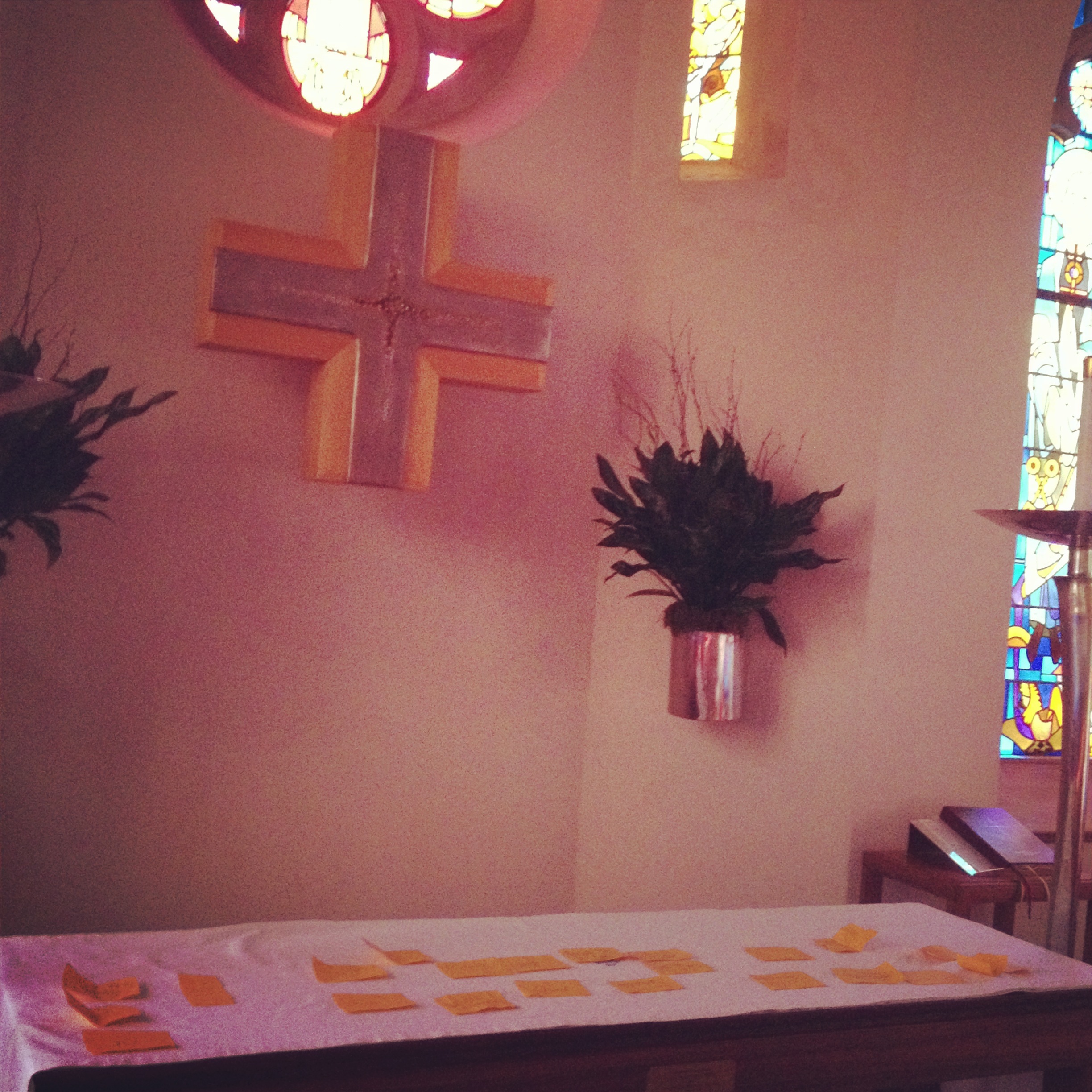
Last Wednesday in Chapel, I read this story out of the Jesus Storybook Bible (JSB) to the 1st-4th graders who gathered (the 5th and 6th graders were out that day, providing an opportunity for time with the little ones who, being suddenly foisted into leadership in the chapel, were blessedly deer-in-headlights quiet).  In the JSB, this story ties together the disciples arguing about who was greatest/most-beloved-of-Jesus among them, and the little children approaching Jesus (this is one of the many reasons i love the JSB–they’ve always thought of connections that I haven’t made).  The disciples are acting the way that one expects children to behave, “I’m best!” “No, I’m more clever!”  “Clearly, it’s ME who’s most important!”  While this niggling is going on in the background, Jesus is left un-guarded, and children start wandering up to him–drawn by his approachability, his gentleness, and his love.  They run into his arms, and he laughs with them (according to the JSB–a colorful, though fair!, description), they talk about what’s going on in their little lives, and sit on Jesus’ lap.  Finally, the disciples realize what’s been going on, and they rush over to shoo away the children who are disturbing the Important Work of Jesus.

Of course, Jesus then sets the disciples straight, showing them–and us!–how much we have to learn from children, from the way that little ones know that there’s more to the world than what we see–the world is magical–that Jesus is the Most Worthy of our love and trust.

At the close of the story, I told the children about the leadership they’d be expected to take in showing the 5th and 6th graders the new habit we were going to start in chapel on Wednesdays (the day I lead).  All year, we’ve been taking prayer requests by voice, imagining that we’re placing those people in our two up-turned hands and then lifting them up to God.  Last Wednesday, we took it a step further.  I encouraged the children to take a slip of paper, to write on it any request they had–people they wanted to remember, or situations that they might want to bring to Jesus–and by rows, I released them to leave the paper on the altar at the front of the chapel.  They brought their hearts up to Jesus and laid their worries down on the altar in front of Him.

Bible Study Notes – Isaiah 43

Unable to withstand more judgment yesterday’s cold January evening, the intrepid Monday Night Women’s Bible Study broke rank and jumped to Isaiah 43, just for the evening.  So, now–more reflections on the same chapter as the last (entry), with much more brainpower behind it!

“Do not fear, for I have redeemed you” (Is. 43:1)

“Do not fear, for I am with you” (Is. 43:5)

What does it mean to “fear” God?  Isn’t this discordant with God being all love and all goodness?  What do we have to fear in him?

If we’re–with God’s help!–seeking the good and have experienced just a taste of the goodness and perfection of God, then we’re growing in virtue, and, knowing what it is like to be in the presence of real good-ness, we really are (or would be) afraid to behave in a way that takes us away or separates us from the good, and true, and beautiful in life.  Our fear is of being separated from God–we are not afraid of anything else that might come upon us, because if God is with us in whatever trial or event or danger we experience, we have nothing to fear.  God is with us.  This promise he makes in verse 5 is described in v.2–see post below–and this God who promises to be with us no matter what we face is someone you really want on your side (see vs. 11-13).

This talk of “fear” led us to reflect on the difference between fear and anxiety: fear is born of an experience–if we’ve touched a hot stove burner, we are afraid when we are pushed from behind toward a stove that’s on.  Anxiety is from anticipating–dreading!–something that we have never experienced; it’s worry.  We’ll always have fear, it’s just a matter of what we choose and habituate ourselves to be afraid of; anxiety is not something we have to have.

God’s promise to be with us is elucidating in another way; one of our number shared how different she felt when she broke up with her college boyfriend of two years compared to when her father ended up in the hospital for a heart attack–in the case of her father’s illness, the extended family showed up quickly and en force, her immediate family was not alone, and though it was a scary time, they were all together in it, and it was beautiful, she said, because of the love that she felt.  On the other hand, when she and her boyfriend broke up, the despair was engulfing–exactly because she was alone, and the cause of the pain was a declaration of alone-ness.

The discussion of fear and of being alone reminded me of Daniel and his friends in the fiery furnace.  They tell the king, “[W]e have no need to present a defense to you in this matter.  If our God whom we serve is able to deliver us from the furnace of blazing fire and out of your hand, O king, let him deliver us.  But if not, be it known to you, O king, that we will not serve your gods and we will not worship the golden statue that you have set up.” (Daniel 3:16-18).  God is God, and he can save us–but even if he doesn’t, he’s still God.  Actually, here’s a sermon that says all of that much more articulately and beautifully. (The Rev. Dr. Sam Wells)

Epiphany – Following the Light

We’ve been living for a few weeks in the in-between times.  In between the half-seasons of television shows, I mean.  Since the beginning of December, most series have taken a hiatus, and this next week, the dramas and comedies return in full force.  Not least—Downton Abbey Season Three starts on this side of the pond tomorrow night/tonight at 9pm.  Our recording devices will return to their usual, almost-full-to-capacity status, and our ache to find out if the hero will return from his coma will, hopefully, be sated.  We are desperate to discover whether the heroine will ever find true love, we despair along with the couple who seek an adoption, but keep falling into heart-breaking loopholes.  Of course, this could be more than just television; we could be facing these sorts of hopes and tensions in our real lives, too.

These stories, great and small, deep and vapid, true and fictional, speak to our need for a narrative of a love so extraordinary as to change everything it touches.

This is, perhaps, something of what the wise men sought as recounted in our Gospel passage today.  Matthew tells us they packed up their camels and trekked across a continent to meet this new baby King.  These wealthy, busy men didn’t send a messenger, or even have Babies ‘R Us ship a gift to Jesus.  These studiers of the heavens had seen something big—this light in the heavens—and whatever it was that caused the light had to be seen in person.  They were desperate understand and to be near the event that had made even the predictable skies look new.

They rushed to Jerusalem to congratulate Herod on this great event that had taken place in his backyard; they were eager to get directions from Herod about where exactly to find this child-king.  Imagine these impressive, imposing men standing on your front porch, knocking on your door.  They’re wild-eyed and overcome—bursting with joy for the adventure they’ve undertaken.  Herod opens the door in his bathrobe, having been roused from the couch watching reruns on TV, and stares at these men blankly.  What are you doing here?  What do you want?

They practically bulldoze him, rushing through the rooms of the house, tearing down the hallways, spouting their research and the prophecy they had found as they hunt desperately for the person they desire.  It quickly becomes clear that Herod hadn’t been paying attention to the lights in the sky and the signs around him.  He pulls his bathrobe around himself a bit tighter, and a cloud forms over his eyebrows.  He narrows his eyes in thought, “it’s not bad enough that I’m living in the Roman Boondocks,” he says to himself, “now there’s a rival that everyone knows about except me.”  As soon as the wise men stumble off to Bethlehem, he returns to the couch to brood and to cook up a scheme to unseat this new king.

The wise men troop down the Jerusalem hill, out into the countryside.  They’re on edge, they know they must be close to the place where the world has been changed, the place the light has been leading them on their long expedition.  They arrive in Bethlehem, on the main street.  The light keeps alluding them, they duck behind buildings and then stretch high on their camels to keep an eye on the light.  As they get closer and closer to the light, they realize they’re in a shady part of town.  There’s the coughing of illness, the stench of poor plumbing, probably a few ladies of the night in some doorways.  The tension is incredible—where are they going to end up?  What’s going on that the light is leading them to this kind of place?

Suddenly, almost imperceptibly, the light halts—they were, perhaps, confused, but as St. Matthew puts it, they were absolutely “overwhelmed with joy.”  They stood on another front porch, much less-grand than the last one, still seeking a king.  I imagine this greeting was very different from the grumpy ruler they’d left in the big city.  Joseph and Mary were still in the throes of sleep-deprived early-parenthood, and to make matters more stressful, they’d both been having dreams and it was becoming clear that their reality—the quiet life they’d envisioned, raising a happy little family in Nazareth—was not the way that things were going to play out.  Now, foreigners showed up on their doorstep, and they begged to see the newborn.

Can you imagine the scene?  Joseph and Mary, bleary-eyed, but trying to be hospitable, the travelers, dusty and exhausted, but rapturous finally to be in the same room as this child of promise.  Each of them were stretched to their absolute limit—emotionally wasted and physically spent.  The light had led each of them to this place—the very edge of survival; and it was here that they found Jesus.

Are you there this morning?  Perhaps the holidays were especially hard this year—so much changed in the last twelve months, and 2013 stretches as far as the eye can see.  A long trip, even a cross-continent, trek on a camel, sounds like a dream-like escape.  Overwhelming joy would be a lovely feeling to experience, but there’s so much evil in the world and so many broken relationships in your life that “joy” doesn’t seem like a state of mind meant for you.  I wonder what it was that made the wise men overwhelmed with joy—if it was their aching feet, or their home-sick hearts, or some other force quite outside themselves.

In Jane Austen’s novel, Emma, the young heroine is satisfied with her unmarried life, contentedly spending her time matchmaking others.  Throughout the novel, she is plagued by her brother-in-law, Mr. Knightly—his much-more-pleasant brother had married her sister.  At the climax, Emma has realized, by his absence, that she is desperately in the love with him and must marry him, and he returns, she thinks, to admit his love for her best friend.  Her despair turns quickly to joy when he says that his trip to his brother’s house in London was no comfort—that her sister reminded him daily of his feelings, and that he returned to the country just to be near her again.  He says, “I rushed back, anxious for your feelings, I came to be near you.  I rode through the rain, but I’d ride through worse than that if I could only hear your voice telling me that I might at least have some chance to win you.”

Jesus went on a very long journey in order to arrive in Bethlehem.  The Son of God was with God from the very beginning—even before time, as the Gospel passage from John told us last week.  And after the creation of the world, after centuries of time passed and after God developed relationships with Abraham and Isaac and Jacob and Moses; he wooed the Hebrew people and showed his love for humanity by telling us how to follow his light and how to thrive in relationship with him.  Finally, the Son of God came to earth, as the most extraordinary act of love ever known.  He ended up in Mary’s womb, where he grew for nine months, he got crowded in there and made the long, dangerous trek that we all do into the big, wide world.  In response to this incredible odyssey Jesus Christ undertook, the wise men thought that the least they could do was to take a trip to see him for themselves.  The light came to them and they responded.  They traversed the wilderness to witness the miracle of the greatest love the world has ever known—God himself coming just to be near us.

God With Us

If you had to–what would you say are the two most-widely-memorized passages of Scripture?  Reading Psalm 23 this week, in preparation for a funeral, I was struck at the similar themes in the psalm and in the Lord’s Prayer…

The Lord’s Prayer asks us to repeat that we hope for God’s will to be done here on earth as it is in heaven, to affirm in faith that God will lead us away from temptation, and to declare that the kingdom–all creation–belongs to God (to, in a way, assert that God is everywhere, as he is witness to everything, all the time, in the universe–the buck stops with him).

Psalm 23 tells us that God is our constant companion–our leader as we pass by verdant fields and flowing water, the one standing next to us in the valley, the one sitting nearby when we face enemies.

If *I* had to choose, I’d say these are the two that “everyone” knows.  If you’ve spent any time around a church, or even in a literature course, you’ve seen these two passages.  They’re the ones that–if anything!–fictional characters are quoting, they’re the ones that–again, if you’ve heard anything!–you’ve heard these two.

So, if these are the two most-easily-found scraps that provide us with clues to God’s identity, and we see in them that God says he will always be near us, he will be our all-time companion, what do we see to corroborate this in Scripture?

Abraham – leaves all he’s ever known, he’s alone in a strange land with his wife—in his travels he’s afraid more than once that he’ll be killed, but he trusts God and God continues to be present and God blesses Abraham’s family.

David – youngest, smallest son, the stinky shepherd, but he trusts God and God is present with him and blesses him.

Jesus  – is God’s ultimate presence with us.  God himself came to live with humanity, because of his love for us.

Marriage is meant to be a symbol of Jesus’ presence with us, his church.  We vow to be present, to be a companion, to one particular person for our entire lives.  We can’t make it easier, or take over someone else’s life, but we promise to be next to them in facing both sorrow and joy.

Children also teach us about God’s presence.  We get a glimpse of the love God has for us in the love we feel for our children, we see how dependent we are on God when we experience the dependence our children have on us.

We cannot protect our children from all sadness and all harm, but we do our best to be present with them, to walk alongside them as they—and we—endure whatever suffering befalls them.

We are God’s children, and through Jesus Christ, his own son who he gave up for our sake, God himself is present to us, today, and forever.  Amen.

(inspired by reflections on a recent funeral)