
Waiting to Breathe – The Feast of the Baptism of Jesus

Father in heaven, who at the baptism of Jesus in the River Jordan proclaimed him your beloved Son and anointed him with the Holy Spirit: Grant that all who are baptized into his Name may keep the covenant they have made, and boldly confess him as Lord and Savior; who with you and the Holy Spirit lives and reigns, one God, in glory everlasting. Amen.

Collect (Prayer) for the First Sunday after the Epiphany (BCP)

If you would, close your eyes with me.  Let’s take one big, deep breath in through our noses together–as much air as your lungs can hold; then let’s all exhale at the same time, with our mouths wide open, a big “ha” sound…  Let’s do it once more, a big, long, deep breath through our noses, and a loud, long breath out through our mouths.

Thank you.  I just thought we could all use a little more oxygen.  Now, on with the sermon!

In a break with many other Protestant churches, our Anglican tradition is to baptize babies.  As you’re probably aware, many churches choose to wait till a person can speak for themselves and decide on their own whether or not they really want to be Christians before they submit to the Christian ritual of baptism.  We side with the Roman Catholics and the Orthodox churches on this count, and in doing so, we’re making a significant statement about who we believe God to be.

During the first centuries of Christianity, before there were so many denominations as such, they were ironing out some of the import sacraments–what it meant for humans to take up common physical items, water, bread, wine, and to ask God to enter those things, so that we could better understand how it is that God enters each of us.  One of the questions that came up was: what if the priest who prayed that God would bless the water for Baptism, or enter the bread and wine for Eucharist later on turned out to be a fraud?  They used a word worse than fraud, but the question they were getting at was how much human effort and righteousness affected God’s potency.  Who was responsible for how things turned out, humans, or God?

As you can probably guess, the answer our ancestors in the faith came to is that what matters is God.  Even if the priest who baptized you, or officiated your wedding, or buried your grandma turns out to be an embezzler, or worse, the Christian church throughout the ages has agreed that we all trust that God takes care of and protects and is the one thing that matters in whether or not a sacrament does the job.

Let me tell you what a relief that is!  So perhaps we should all just go home now.  God’s got it all under control, he can zap us with grace any time he likes–why bother with saying a creed and praying prayers and having this strange meal together?

Did you know that our respiratory system is the only system in our bodies that is both voluntary and involuntary?  We can’t stop our stomachs from digesting just by thinking about it, and if everything’s working right, our limbs don’t fly about on their own.  But at the beginning of the sermon, we all concentrated and made ourselves breathe.  Since then, I’ll bet that no one has kept thinking “breathe in, breathe out” every moment while I’ve been up here preaching.  But none of us has passed out, we’ve all kept breathing just as we always do, without thinking about it.

Whether we’re paying attention or not, God is at work.  When we concentrate on it, when we look for what God’s up to around us and in us, we start to see more clearly how God is active all the time.  Our lungs are passive, in a way; they can’t control how much oxygen is in the air, or how they function in different levels of pressure.  God is like the oxygen in the air–he’s present everywhere, and we breathe him in without noticing sometimes, though the greatest benefit comes when we pay attention to what we’re taking in and what we’re letting back out.

We come to church because this is where we learn to breathe.  We learn how to take God in, and how to let him fill us up.  In our modern society, spending lots of time sitting behind desks and hunched over computers, we are not breathing as well as some of our forebears did who spent their days outside in the fresh air, working the soil and making their own food.  Our lung capacity shrinks when we don’t use the full range of our breath, just like our ability to notice and listen and respond to God shrinks when we don’t make a habit of spending time seeking and noticing him with others as we worship.

We baptize babies because we believe that in the end, it’s about more than any decision or declaration one person makes; it’s about the God made known in Jesus Christ coming to be with us in the Holy Spirit, that we would never be alone, and that the love manifest in the Trinity is stronger than death.  That kind of love takes a community, and it is the Christian community, throughout time and space, that commits for us at our baptism, and with us throughout our lives, to continue to help us learn how to breathe.
“It was God, who is close to the Father’s heart, who has made him known.”

Gospel Lesson: John 1:1-18

Epistle: Galatians 3:23-25; 4:4-7

In the 1950’s, there was a missionary named Jim Elliot who felt called by God to go to Ecuador to minister to native peoples there.  Along with his team, he started to build relationships with a particularly remote tribe—first dropping gifts from their missionary plane, then working toward introducing themselves, continuing to clear the way with more presents to show their goodwill.  Finally delegations from each group met.  On this big day, Jim took a photo from his pocket to show the tribespeople that the missionaries were friends with a member of their tribe.

Having never seen a photograph, they assumed that Jim had eaten brother, since he had taken the likeness of this person out of his body to show them.  They murdered Jim and his companions immediately.

I wonder if we sometimes make the opposite mistake about Jesus.  I wonder if we take Jesus to be just a picture of God—only an image or likeness, but not really God himself.  They say a picture’s worth a thousand words, but if I had my choice I’d take the thousand words every time—there’s so much more to learn from studying a description of someone than reducing a whole person to a single photograph.

Our Gospel passage today is bursting with poetic description of God; it harkens to another description of God elsewhere.

“In the beginning, God created the heavens and the earth.”  That description goes on to reveal that God created humanity “in God’s image”—which means that we ourselves are a sort of photo in some way—and when God created humanity, he furnished a place for his people to live and provided for their every need.  You know this story—here’s where the montage of Adam and Eve frolicking and eating and naming animals fits in—and then something goes wrong.  (you can imagine the sound of  a pin dragging against vinyl) Adam and Eve decide that God may have been lying to them after all, and they test the truth God had told them—whether it really did matter so much how they lived.

Now we really learn something about God: that evening, arriving for their daily walk, God calls out for his companions, his cherished creatures.  They’re hiding—they know they shouldn’t have tested God and shouldn’t have doubted that God was telling the truth, but they really would rather not face up to it.

We’re not that different, are we?  Instead of recognizing our crookedness, we bury it and move on.  I read a story this week of a professor who, when his desk got too full of letters to be answered and tasks to complete, he’d spread out an edition of the New York Times and then start over as if his desk was clean.  We paper over our sins, too, instead of owning up to them before God.

On that evening, God knew exactly what had happened and where his creatures were; he could have come rushing in, screaming, demanding that they leave immediately, as if he was a righteous landlord.  But that’s not the description of God that we’re shown here at the very beginning of Scripture.

Scripture begins with a God that is so full of love that he dreams each of us up out of nothing.  Then, when each of us, as we all do, decides to test out whether God is really telling the truth, he gently asks what it is that we’re doing—giving us a chance to tell him the truth and to own up to our schemes.  We grab a New York Times, or a fig leaf, to try to cover up the mess we’ve made, even though God can already see the mess.  The God who’s described here in the pages of Genesis is the same one described in the first verses of the Gospel of John—the God full of grace and full of truth.

Being full of grace and truth sounds lovely, but I argue this morning that it makes God very off-putting.  That same professor didn’t cover his desk with a newspaper just once, but did it habitually—when he finally died, they dug down many layers of newsprint, finding all sorts of unpaid invoices, unanswered inquiries, and unfinished assignments.  Can you imagine the horror he might have felt if this practice had been discovered and challenged while he was alive?  God knows all the layers of newsprint we’ve used to paper up our lives.  Even when I’ve lost count of the path and number of lies I’ve used to cover up various deeds—done and left undone—God knows each and every one.  God is full of truth, and that sounds kind of terrible.

Thomas Keating, a 20th century monk, says that when it starts to dawn on us just how many layers of deception we’ve built our lives on, we think we’re getting worse, but truly, we’re just realizing how bad off we always were, and that, he says, is an enormous grace.

We look up at God from the bottom of our crumpled-paper and sticky-sin lives, and he reaches down and scoops us up in his hand, brushing away the debris.  This is grace.  While truth is hard, I think grace might be harder.  The law, our epistle says, was our disciplinarian before Christ came.  The law, or rule-following, lets me continually hit myself against a wall when I do something wrong.  I punish myself and pay for the wrong I’ve committed.  All the time, I’m trying to be dependent only on myself.

This isn’t how we were made to be, though.  We were made to be in the midst of God’s grace and truth.  God’s grace is the hand that comes down to the cave of our sin and scoops us up and out of it—we don’t have to run ourselves against a wall, we don’t have to sit in the dog house for months on end; we’re forgiven.  The hard part is to accept God’s grace, to live as if we are truly forgiven, not punishing ourselves any more, but acknowledging honestly the shortcomings we suffer.

I’ll close with a bit of a poem by W.H. Auden:

Well, so that is that.  Now we must dismantle the tree,

Putting the decorations back into their cardboard boxes —

Some have got broken — and carrying them up to the attic.

The holly and the mistletoe must be taken down and burnt,

And the children got ready for school.  There are enough

Left-overs to do, warmed-up, for the rest of the week —

Not that we have much appetite, having drunk such a lot,

Stayed up so late, attempted — quite unsuccessfully —

To love all of our relatives, and in general

Grossly overestimated our powers.  Once again

As in previous years we have seen the actual Vision and failed

To do more than entertain it as an agreeable

Possibility, once again we have sent Him away,

Begging though to remain His disobedient servant,

The promising child who cannot keep His word for long.

The Christmas Feast is already a fading memory,

And already the mind begins to be vaguely aware

Of an unpleasant whiff of apprehension at the thought

Of Lent and Good Friday which cannot, after all, now

Be very far off.


God is full of truth—he knows what’s under your newspaper.  God is full of grace—he brushes away all the debris by his death on the cross and resurrection.

Will you accept his hand?

Resurrection

“Take away the stories of Jesus’s birth, and you lose only two chapters of Matthew and two of Luke. Take away the resurrection, and you lose the entire New Testament and most of the second-century fathers as well.”

Wisdom on the centrality of Jesus’s resurrection to Christianity by N.T. Wright (Surprised by Hope, pg. 43).

What is Your Name? – All Saints’ Sunday – Trinity Cathedral

20131102-211325.jpg

“22 ‘Blessed are you when people… cast out your name as evil because of the Son of Man… 26‘Woe to you when all men speak well of you.” (Luke 6:22, 26; NKJV)

Today, the celebration of All Saints’ Day, is a moment to consider our baptism.  In some of the services today, babies will come to be baptized, and when they are, their families will be told, “Name this child!”  My own middle name is for my great-grandmother, who died in May of this year; I think of her especially on this celebration of All Saints’ Day, as many of us remember people who have died in the last year who were holy beacons of Jesus’ love.  I’ve noticed since moving to the South that down here, many more people name their children after family members.  I even know a family who boasts something like seven generations straight of women with the same name.  Names still mean something down here, and that makes the name that God gives us all the more sweet.  The most important name that any of us could be called is “Christian.”  “Christian” means “little Christ,” or perhaps more colloquially, “imitator of Jesus.”

God is fond of giving people new names.  In the Old Testament, God changes people’s names at profoundly significant moments in their lives.  Just a few weeks ago, we heard the moment when Jacob’s name was changed to Israel.  Do you remember?  The reading from Genesis told us, “‘Your name shall no longer be called Jacob, but Israel; for you have struggled with God and with men, and have prevailed.'” (Gen. 32:28; NKJV) God changed Jacob’s name to Israel the night before Jacob was to meet his brother again for the first time in decades.  But to understand what’s significant about this name change, we should understand what the names mean: “Jacob” means “trickster,” and stories about tricksters are common throughout ancient literature.  Think about the wolf in Little Red Riding Hood, or the Hare in the parable about racing with the tortoise.  These characters don’t make friends, they are scrappy, and they have to stick to themselves because their only way of getting ahead in the world is at another person’s expense.  Jacob did that to his brother Esau, cheating his older sibling out of the blessing and riches which were meant for him; later, Jacob did it again to his uncle, stacking the deck so to speak, to make sure the sheep in his herd were the most hardy.  But here in Genesis 32, Jacob’s name changes–God comes near to Jacob and transforms him.  God changes Jacob so completely into a new person that his name can’t even be “trickster” anymore.  It’s changed to Israel, which means, “God fights.”  You might think of it as something like, “God fights for you”–I imagine that’s what Israel hears any time his name is said after it changes that fateful night.  God loves Jacob just as he is, trickster and all, but God loves Jacob too much to leave him that way.  God transforms Jacob, and gives him a new name with a new identity.  He’s no longer a “trickster,” but a person for whom “God fights.”

This happened to Paul, too, in the New Testament–the writer of those letters starts out with the name “Saul,” but when he meets Jesus on the road to Damascus, Jesus tells Saul that he’s got a new job to do now and it’s such a change that he needs a new name to go with it.  That’s how Saul becomes Paul.  We could think about it this way: Saul starts out with a sensible life–he’s a Pharisee, well-respected, super smart, the jock, the popular kid, the A+ student–he’s the top of everything, the wonderkid.  God comes along and stands in his path one day, and the great reputation that Saul has, his trophies he’s won and collected–this life Saul’s built–it comes undone and is remade by God into something that doesn’t make sense at all to Paul’s old friends.  Being transformed by the God we meet in the person of Jesus Christ means that we do strange things, like giving someone who’s cold our new, fresh, warm coat, not the old, smelly, ratty one.  We relentlessly forgive the person who continues to stand us up when we’ve made a date, or keeps hanging up on us when we call on the phone.  No matter how many times someone asks for a coat or a blanket, and no matter how many times someone hangs up on us, we give and we forgive one more time, every time.  These actions make no sense unless Jesus Christ is Lord; unless he is God incarnate.

No one is naturally generous or forgiving; developing holy habits takes lots of hard work, and it’s a hopeless pursuit unless the person is utterly devoted to the God revealed in the person of Jesus.  Every saint we celebrate today recognized God in the life, death, and resurrection of Jesus and committed their lives to that truth.  I heard someone say once, “People who are saints don’t know it until God himself tells them.”  Saints’ lives are transformed by the truth of Jesus; their first name is “Christian.”  God has re-named them.

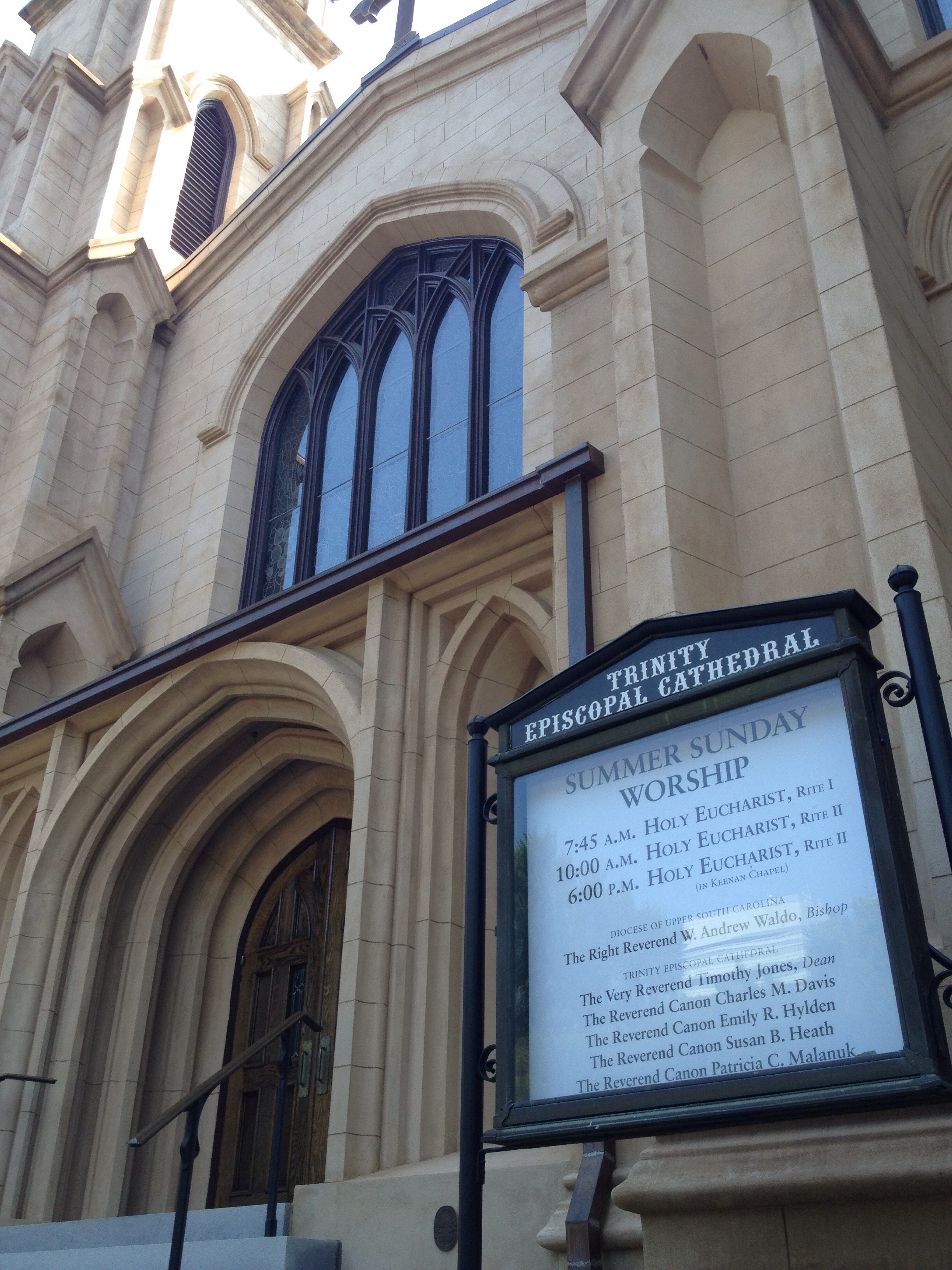
Today we celebrate All Saints.  There are hundreds of faithful Christians who have passed through these doors, many we remember as living hard, holy lives devoted to Jesus.  There are thousands more, through the last 200 years at Trinity, and millions throughout the world, who has been called saints by God because of their holy lives, oriented completely toward Jesus.  We do not remember, nor could we ever know, all their names.  But God has recognized them, and that is the only lasting remembrance.

After these buildings crumble and the plaques are tarnished, after the communion kneelers disintegrate and the endowment runs out, though our names and the names these parents give their children as they are baptized today will disappear and be forgotten by future generations, may we so fight to live lives that only make sense in the sight of Jesus’ resurrection; that our reward may be God remembering our name when we see him face to face one day.

Despair & Dashing Babies Against the Rocks

Two of the most infamous psalms in Scripture are 88 and 137, so it seemed like an especially brilliant idea to tackle them both in one go during the 35 minutes alloted for Sunday School (usually it’s more like 45 minutes, but the preacher went long…).  Here are a few notes from our class’ wonderings and wanderings:

Though these two prayers have no particular relation to each other, put together, they have something specific to teach; Psalms 88 & 137 take God seriously in a way that we are often unwilling to consider.  When a child is clearly upset but says, “No, nothing’s wrong!!” she’s distancing herself from you.  She won’t allow herself to be made well or to be changed.  Prayer, real talking to God in despair and in anger requires that you be ready for God to act, to transform you and the situation.  To share your sadness and anger with God, you must admit that you are sad and angry, and to admit that you aren’t in control and aren’t able to help yourself means you are humbling yourself.  It’s significant that in this depression and anger, these composers turn to God; they’re hurt and broken by the world, but they cling to God by continuing to offer prayers.

One woman said, “Whenever I want to pray about something that makes me angry or hurt or sad, I say to myself, ‘well, I should trust more.  I should not let this get me down–then I can pray about it.’  But the truth is that these psalms show us that we should approach God just where we are.”

Psalm 137

1 By the rivers of Babylon—
there we sat down and there we wept
when we remembered Zion.
2 On the willows there
we hung up our harps.
3 For there our captors
asked us for songs,
and our tormentors asked for mirth, saying,
‘Sing us one of the songs of Zion!’

4 How could we sing the Lord’s song
in a foreign land?
5 If I forget you, O Jerusalem,
let my right hand wither!
6 Let my tongue cling to the roof of my mouth,
if I do not remember you,
if I do not set Jerusalem
above my highest joy.

7 Remember, O Lord, against the Edomites
the day of Jerusalem’s fall,
how they said, ‘Tear it down! Tear it down!
Down to its foundations!’
8 O daughter Babylon, you devastator!
Happy shall they be who pay you back
what you have done to us!
9 Happy shall they be who take your little ones
and dash them against the rock!

 This shocking ending is both negative (rare in the psalms) and gruesome.  It’s been composed after the fall of Jerusalem, during the Babylonian exile (v.1); the composer is ridiculed by his captors for his hope of restoration.  The first section (vs.1-3) narrates the scene, the second bit (vs. 4-6) pledges loyalty to Jerusalem, and in the last section (vs. 7-9) the psalmist details to God exactly what he thinks is an appropriate payback.  In the ancient world, it was a practical military policy (albeit an especially cruel and not-always-enforced one) to kill the babies and children of a people group in order to wipe out that nation’s existence and legacy.  Pharoah did it to the Hebrew people in Egypt, which is why Moses was hidden as a baby and sent to sail down the Nile.  The writer desires for all of the Babylonian culture, all its legacy and mark on the earth, to be wiped out.

Well, there’s no country called Babylon anymore, so maybe the psalmist got his wish.  I think there’s more to be mined here than that: looking at the psalm again and thinking about it from a perspective of “good guys” and “bad guys” or perhaps even “God’s people” and “the Evil one,” what is the Scripture saying to us?  We live now in the midst of evil, strangers in a strange land; this place is not our home.  We endure violence and struggle against our sin.  But someday, we will struggle no more, and we will endure no more evil; happy shall be the one who roots out the progeny of evil, killing off all hints of evil, burning away all darkness–rooting out its very babies, that it has no future.

Psalm 88

 A Song. A Psalm of the Korahites. To the leader: according to Mahalath Leannoth. A Maskil of Heman the Ezrahite.

1 O Lord, God of my salvation,
when, at night, I cry out in your presence,
2 let my prayer come before you;
incline your ear to my cry.

3 For my soul is full of troubles,
and my life draws near to Sheol.
4 I am counted among those who go down to the Pit;
I am like those who have no help,
5 like those forsaken among the dead,
like the slain that lie in the grave,
like those whom you remember no more,
for they are cut off from your hand.
6 You have put me in the depths of the Pit,
in the regions dark and deep.
7 Your wrath lies heavy upon me,
and you overwhelm me with all your waves.
Selah

8 You have caused my companions to shun me;
you have made me a thing of horror to them.
I am shut in so that I cannot escape;
9   my eye grows dim through sorrow.
Every day I call on you, O Lord;
I spread out my hands to you.
10 Do you work wonders for the dead?
Do the shades rise up to praise you?
Selah
11 Is your steadfast love declared in the grave,
or your faithfulness in Abaddon?
12 Are your wonders known in the darkness,
or your saving help in the land of forgetfulness?

13 But I, O Lord, cry out to you;
in the morning my prayer comes before you.
14 O Lord, why do you cast me off?
Why do you hide your face from me?
15 Wretched and close to death from my youth up,
I suffer your terrors; I am desperate.
16 Your wrath has swept over me;
your dread assaults destroy me.
17 They surround me like a flood all day long;
from all sides they close in on me.
18 You have caused friend and neighbour to shun me;
my companions are in darkness.

A pscyhologist was in the class and she observed, “This sounds like clinical depression.  The words that are used, the way it’s described–it’s practically textbook.”  She is exactly right; the psalmist wants to have hope, but can’t muster it.  There is nothing but darkness.  We have friends and loved ones who suffer depression, some of us have lost people to the illness.  Here in Scripture is preserved one experience of depression, perhaps to let us know that this may be a part of life on earth.  This sort of brokenness may not be solved on this side of Heaven.  We must admit that not all will be made well in advance of the end.  The psalmist reminds us of something very important in verses 10-12: “Do you work wonders for the dead?” he asks; “Is your steadfast love declared in the grave?” he challenges.  In Jesus Christ, and in the salvation God offers us through him, yes–God does work wonders for the dead; indeed, his steadfast love is declared exactly in the grave.  This does not provide a cure for depression, but we are given hope of healing, whether in this life, or the life to come.