Happiness List

a banner week.

1. spending the better part with the dear choristers of Trinity Cathedral, noticing and calling out God’s work in their lives (it didn’t hurt that we were all in the NC mountains).2013-10-01 19.21.02

We had hardly all arrived, but I was re-dubbed “Momma Hylden” (from “Mother Hylden”–the former was ‘more southern,’ they told me) and a daily hang-out in the outdoor chapel, christened “Moments with Momma Hylden” was born.  Those were truly my favorite moments of the week; witnessing the connections young minds and hearts made amongst music, worship, vocation, offering, community, and Scripture.  A few of the light-bulb moments are captured in Quotations of the Day from earlier this week.

2. (1a.) Playing in rain, mud, and pudding with chaperones & youths alike.  Nothing like summer camp for reminding one that laughter is not only good medicine, but a window into God’s heart.

2014-08-04 15.12.21 HDR

3. And last, but by no means least–tomorrow, one of my dearest friends gets married (it doesn’t hurt that it’s in Durham!).  2012-11-29 08.06.37
We found each other during transitional moments in both our lives–wondering where we belonged, suspecting we each were called to a life that didn’t look a lot like what we’d known our lives to be in the past.  We were confirmed in the Episcopal Church together, together we’ve wondered about what to do with our lives, and as she stood up with me and my beau when we tied the knot more than three years ago, I’m so eager and full of joy to do the same with her.I’m working on a quilt (you may have seen bits on instagram) as a wedding present; I’m especially grateful for that old “you’ve got a year after the wedding to send a gift” rule!

Godspeed this weekend, y’all.

writing in the walls

While in France, more than just my cell phone taught me to look up and look out.

IMG_2174

Sainte-Chappelle’s windows pointed my eyes heavenward, illustrating stories from Scripture (the very stones which line the windows are arranged in such a way as to make arrows–do you see?)

IMG_2319

Mont Saint Michel–a monastery which itself points upward, perched on a rock at the Atlantic shore–boasts a Gothic church, encouraging the pilgrim to continually remember the source of life and strength.

IMG_2420

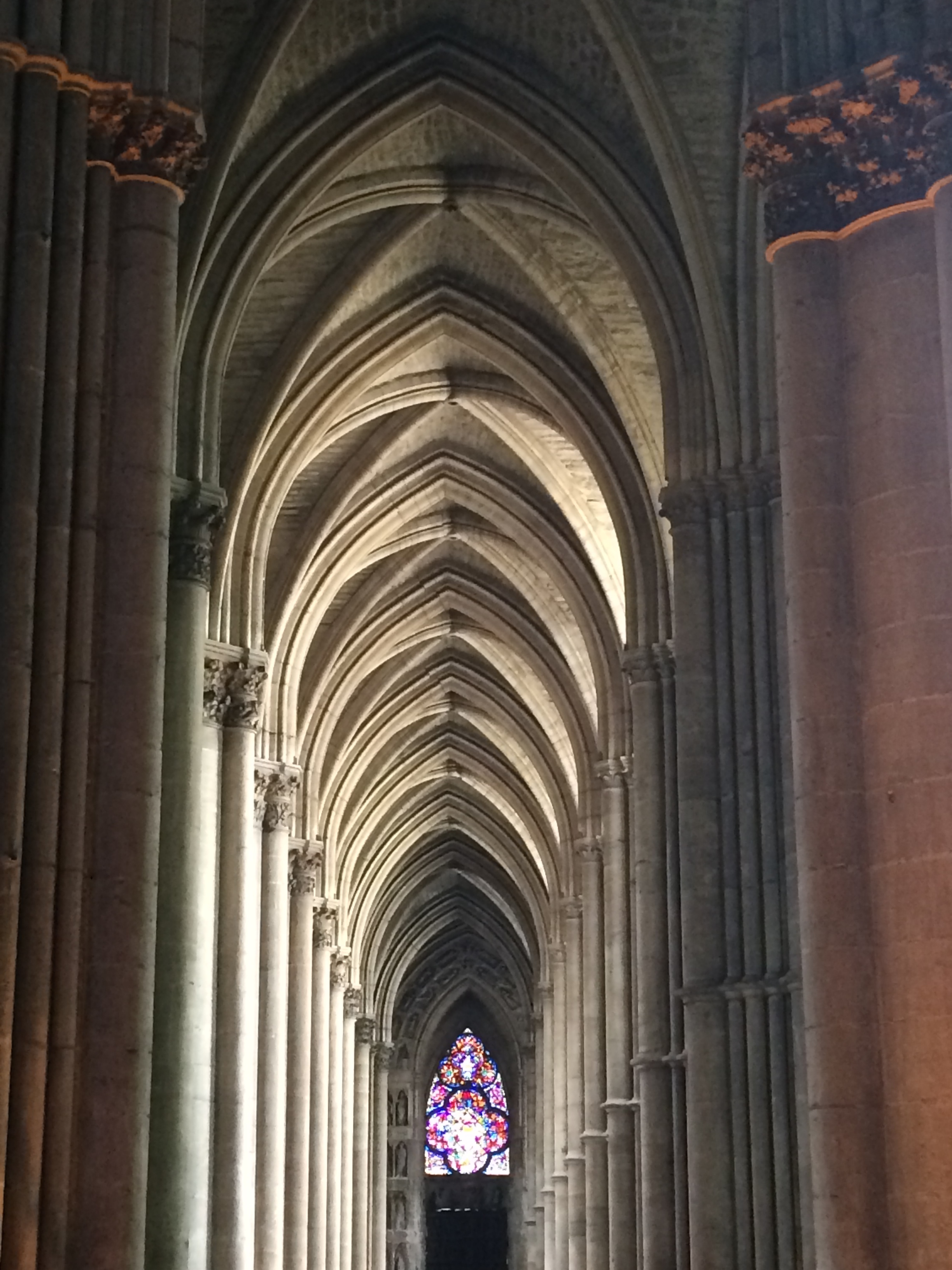
Arrows abound in the aisle at Reims.

IMG_2466

All is oriented upward on the West facade in Strasbourg.

Our necks hurt the first few days that we spent in cathedrals, but soon we got used to paying more attention to what was above and around us than what was below us or what was associated with our own individual experiences (I cannot recall which cathedrals were most-busy, or most-noisy, or too cold, or too warm, or too expensive).

I wonder if our lives should be a bit more about paying attention to who God reveals himself to be (those things, “above”), to God’s work in others’ lives and in the world (what’s around us).

This message is finding its way into all kinds of outlets recently–here are a few I’ve noticed:

Relevant Magazine

Huffington Post

What do you think?  How have sacred spaces challenged you to look differently at life?

What are we good for?

At St. Sulpice this morning, enjoying one of the most impressive organs in the world, it was the altar there and reminded me anew: worshiping God in church on Sunday is the most important thing we do all week.
The beautifully and carefully formed gold candlesticks on the altar are impossibly ornate. It’s not my favorite look or style, but even a commoner like me, not at all first in metalworks can see they are excellently executed, carefully formed, beautiful.

20140622-230440-83080271.jpg

Churches in the past weren’t built as “seconds,” metalworkers didn’t donate their mistakes or castoffs or hurriedly constructed pieces to their church, they gave their best. If any, seconds went to their customers, because the only one who could ever offer payment with eternal consequence is God.
In the Eucharistic prayer (said together, with the priests voice, over the bread and wine every Sunday), “we offer ourselves, our souls and bodies” – we are saying that our bodies, our lives, our very selves, aren’t things that we’ll cling to, grasp, spend for our own enjoyment, glory, but pour out for God. We are committing to give our very best efforts to God, just like 17th-century metalworkers.
Our call as disciples of Jesus, then, is to give our best, and to exhort and help our fellow disciples give their best, most sincere, most excellent offering they can.
We are to spur each other on to learning, training, practice, sincerity, and devotion in everything we take on.
Half prepared, or hurriedly completed, or insincerely devoted efforts are not things God wants.
God does not want unstudied worship, distracted bodies, lazy or hardened or impenitent hearts. One way to understand Cain’s unacceptable offering is that God knew Cain’s heart, and it was not sincere, prepared, devoted to true, full worship.
We practice, learn, test, and assess our worship as we do other parts of our lives because we believe our offerings of our souls and bodies, their condition and sincerity, makes a difference to God.
God cares whether we’ve truly, sincerely committed our work and effort fully to his glory–whether we really mean it and live what we pray, that “we offer ourselves, our souls and bodies to be a reasonable, holy, and living sacrifice” to God.
God seeks to work through us as Christ’s body, the Church; all parts working together, working the most intently and sincerely possible, is the only way to fully serve our Lord.

more pomp & circumstance–why process for the Gospel…

As we gather for worship this morning, I’m going to paint you a picture of our life together; something that might—or might not—help us understand and imagine how we work together as one body, how we are God’s hands and feet in the world.

Somewhere near the middle of our Eucharist service, we read from Matthew, Mark, Luke, or John together.  When this happens, have you noticed that a lot of people move?  The deacon, or the celebrant, in the Keenan Chapel services, walks into the middle of the nave, right into the heart of the congregation, if you think of us all gathered here as a “body.”  Once the deacon is there, she proclaims the Gospel to us all.  She’s not just reading what’s written on the page; just like there’s something special about singing together and praying together, as we do when we gather here, there’s something special about listening together—most of us learned about that in kindergarten: we learned how important and transformative it is when we all listen to the same words and instructions at the same time.  Not least, it’s easier for our teachers and leaders to help do their jobs if we’re all paying attention to the same place at the same time.

Many of us turn to face the deacon as she or he shares the Gospel with us from the middle of our gathering.  This is a great and beautiful symbol—someone who has been appointed by God to spend all their time taking the Good News of Jesus’ resurrection into peoples’ everyday lives does that on Sunday mornings, too, in order to remind us that God belongs in the middle of our lives, in the middle of our relationships, as the focus of our attention and our bodies—God is the one toward which we turn and orient ourselves.

Holy, holy, holy is the Lord God Almighty, who was, and is, and is to come!

Jesus stays, Jesus stays.

“Crucify him!  Crucify him!”

Last Sunday, we played our part, joining in the dramatic reading of the events leading up to Jesus’ death.  We yelled “Let him be crucified!” along with the jealous crowd (Matthew 27).  Someone told me afterward that she always waffles about whether or not to say those words out loud with the rest of the congregation; it makes her uncomfortable, and it just sounds so horrible.  I knew what she meant–I closed my eyes this year when I joined in the shout; I just couldn’t bear seeing the angry crowd in front of me, it felt so real.

The horror is that it is real.  In dozens of ways, we shout “Crucify him!” every day.  When we respond in anger, when we deceive and rationalize, choosing the easy way out instead of the truth, we turn our backs on the reality that God offers us.  It’s like throwing God’s playbook into the trash and letting the door slam as we walk away.  We insist on our own way and our own wisdom, just like Adam and Eve in the garden, just like Jesus’ disciples who were scattered in Gethsemane’s garden–just like every human throughout time; except for Jesus himself.

What a strange God we worship.  What kind of God leaves his abode to come down to this broken place called earth?  Once arrived, what kind of God takes on the limitations and stresses of human life, living inside the confines of a human being?  As a human, what kind of God endures a fraudulent trial leading to trumped-up death charges and a humiliating spectacle of an execution? What kind of life is that? What is he revealing to us about the truth of love?

As Jesus hangs on the cross (as he did at this very hour), people mock him; someone asks, “If you saved others, why can’t you save yourself?”  Another says, “If you’re really God, the way you say you are, why don’t you come down?  If you did, we’d surely believe you then!”  Can you imagine the temptation Jesus might have faced?  Indeed, in the garden with his disciples the night before, he has already laid his cards out with his Father, begging that he not actually have to go through with the whole thing, desperate to find another way out.

Abandoned and hanging on a cross, Jesus, the Son of God, stayed.  While he was spit on, ridiculed, beaten, and nailed, he refused to turn his back on the people who were torturing him.  Jesus never pulled the release valve, Jesus never left us.  He was committed to showing humanity what love means by never turning his back on us even if that meant that he would have to die.  There was finally nothing else left for Evil to try except to force God’s hand by threatening him with death if he didn’t give up on people.  Jesus stayed.

The same crowds who had shouted a few days earlier that he was their hero turned quickly into the angry, jealous crowds who pushed at him to crack and then turned their backs to let him die. How often do we experience the same swift change in our lives?  Our best friend suddenly becomes our most effective attacker; our well-ordered life is shaken into a disaster; the most reliable part of our day is ripped out from under us, leaving a gaping hole.  We all suffer abandonment that leaves us wondering which way is up.

Though we may not know which way is up, or how to keep moving through the mess of life, or how to withstand the attacks of someone we love, Jesus has shown that God will stay right next to us.  Staying meant death, but Jesus chose not to use his power as God to get him out of the mess humanity had made around him; he only ever called upon the power of God to help others, never himself.

Jesus still calls upon the power of God to help us, even though we’re just as fickle and cowardly and arrogant and skeptical as the crowds who surrounded him at his death.  Jesus never left them alone, even when the price to stay was death.  Even though we turn our backs on God, he will never leave us alone. Jesus stays, Jesus stays.