I have fallen in love with Henry Purcell

Our choir has been singin’ Purcell’s “I was glad” like it’s their job (ahem, “vocation”–and indeed, it is!).  His setting of Psalm 122 has been crawling around the corners of my mind and heart since I first heard it a few weeks ago at choir camp.

(via)

Check out a recording here (listen to the young ladies of Trinity–and men–at the 11:15am service’s Anthem, and to the adult choir’s Anthem at Evensong from this past Sunday, the 18th).

And the psalm itself, as a meditation this cloudy Tuesday morning:

1 I was glad when they said unto me: We will go into the house of the Lord.

2 Our feet shall stand in thy gates: O Jerusalem.

3 Jerusalem is built as a city: that is at unity in itself.

4 For thither the tribes go up, even the tribes of the Lord: to testify unto Israel, to give thanks
unto the Name of the Lord.

5 For there is the seat of judgement: even the seat of the house of David.

6 O pray for the peace of Jerusalem: they shall prosper that love thee.

7 Peace be within thy walls: and plenteousness within thy palaces.

8 For my brethren and companions’ sakes: I will wish thee prosperity.

9 Yea, because of the house of the Lord our God: I will seek to do thee good.

(via)

into the cloud. on transfiguration

2013-01-29 08.18.42

“…a cloud came and overshadowed them; and they were terrified as they entered the cloud.  Then from the cloud came a voice that said, “This is my Son, my Chosen; listen to him!” (Matthew 9:34b-35)

20130210-183737.jpg

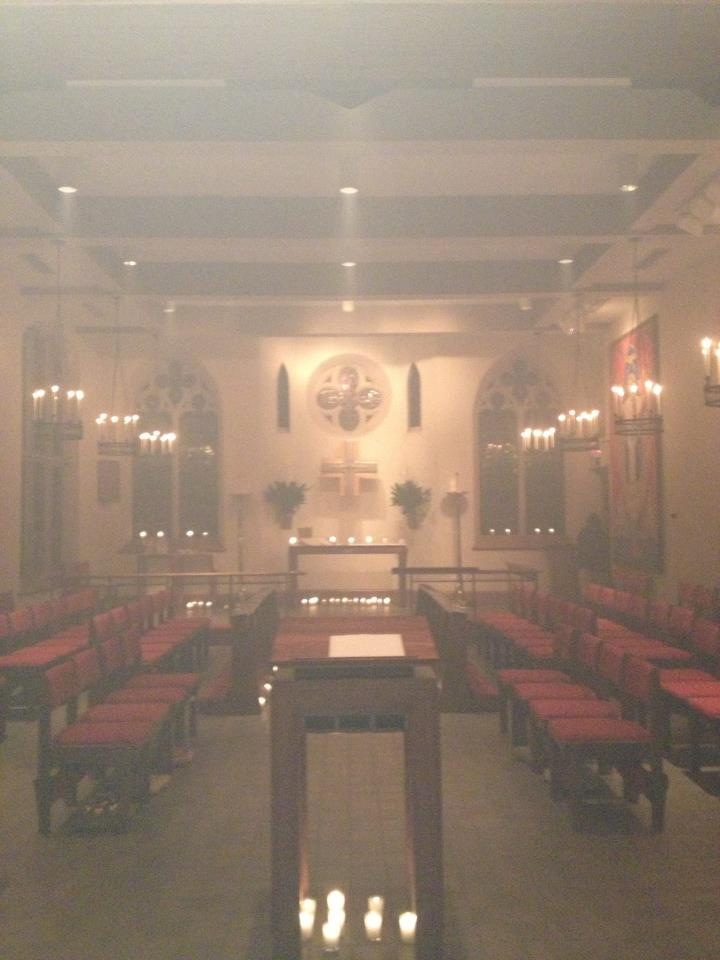
When the Gospel passage of the Transfiguration was read last Saturday evening during our Vigil service, another one of the imports of incense dawned on me.  I happened to be thurifer last week, making me the cloud-maker for the evening; throughout the service, as the incense swirled around us, we quite literally entered a cloud.  The smelly (in a good way, to my nose) incense enveloped us and we dwelt in the closest thing to a blanket of mist that people can easily create themselves.  That’s why we use incense (among many other reasons).  It moves us into the cloud.

It’s not just any cloud.  As we read in our Isaiah Bible study this week (ch. 19), God’s communication with humanity is often through a cloud (this was a big-deal connection to the Church Fathers–see Cyril of Alexandria, Gregory of Nyssa, John Chrysostom)–like the pillar of cloud that led the Israelites through the wilderness, God speaking out of a cloud at Jesus’ baptism, and God and Moses communicating through a cloud on Mount Sinai.  Clouds are often used in Scripture to remind us that God is near and so we use cloud, in incense, to remind us that God is in our midst when we worship together.

Join us at the corner of Wydown & Ellenwood on Saturday nights at 5 p.m. to worship in the cloud…

why we should dress up to go to church.

In August, I drove to Ohio to visit my family for a weekend and to collect the dishes my grandmother had designated for me 12 years before, when she died.  After more than a decade, I had a stable enough (read: not-a-dorm-room!) home in which to keep and use these family heirlooms.  Though we have sturdy and colorful Fiestaware, I looked forward to using this set on weekends, on days I felt extra low, special occasions, and any time I longed to feel close to my grandmother and my family again.  Especially in a time when many kids move away from ancestral homes and lands, objects like these taken on extra meaning and reverence.

I remember Thanksgiving with these dishes (I’m talking specifically about the dinner plates/serving bowl in the photo above); just seeing them immediately makes me think of my grandmother, her home, how I felt when I was there, and by extension, the rest of my family.  In a way, when eating on these dishes, I’m eating with my family–we’ve shared meals on these plates and pieces.

This is the same thing that’s going on in church–this is why Episcopalians and Roman Catholics and other churches of “high” liturgy use silver-plated goblets and plates, and why they use fine linen napkins and tablecloths.  First, the meal that we join together to eat each Sunday (or whenever you go to church and enjoy a Eucharist) is an important meal, it is a meaningful meal–like Thanksgiving, or someone’s birthday, or the night the boss comes to dinner.  Second, just like the special dishes that remind me of my family and ancestors, our special silver chalice & paten (cup & plate) are reminders of the Christians who have worshiped God for generations before us, in that very church–they were bought or given by them and passed down through the generations of Christians called to be Christ’s church in a particular place; they’re heirlooms (metal lasts longer than clay or porcelain, let alone gold’s anti-bacterial properties–spurious or not, this comforts me).  Third, we believe that somehow, this bread and this wine is different than the stuff you pick up at the grocery store, and if it is different, if it is in some way Christ’s Body and Blood, then we ought to treat it with some care, and putting it on sturdy, beautiful, set-aside-for-that-use serving-ware seems like a good way to denote its importance.

Therefore, we dress up.  What I mean is that if we notice the importance of particular meals in our daily lives (Thanksgiving, birthdays, anniversaries, Christmas (!!)), ought we not remember the Last Supper in the same way?  A way for each of us to respond to God’s call to us is to present our best to him–our best clothes, for one thing.  Of course, God doesn’t love us less if we show up unshowered and with jeans on, nor does he talk about us behind our back with the Son and Holy Spirit; however, dressing up for church is a way of putting some of our own skin into the game, so to speak.  God does not require it!–but God does desire a contrite heart (and since we are not just hearts, but bodies, our clothing and how we use our bodies can be an offering and symbol of our contrition and honor and love for God).

Perspectives on the Eucharist

oh, there are dozens and hundreds of theological explanations of the Eucharist–what *exactly* is “happening,” and how and why…  this is not one of those.  this is a reflection on how Jesus can specifically meet a person in the bread & wine of Holy Communion.

this morning, i learned that dear, dear friends of mine are moving about a six-hour plane ride away.  both husband and wife have been so vital to the discernment of my call to ordained ministry that i honestly don’t know where i would be without them (well, without Jesus, of course, but without their willingness to be conduits!).  thinking of their exit makes me tear up; i hope i get over that part at least by the time i see them…

as such, it’s been an emotional day.  i looked forward to going to the week-day Eucharist that the church i’m working at this year hosts every Thursday.  the familiarity of the service is so, so calming.  this particular service is small, usually less than 10 attendees, and held in a chapel that’s covered in carpet, wood and a bit of hewn-stone accent–it feels like a cozy cave (with lovely triangle windows at the top that let you see only the tops of the trees outside).  Not only was the homily about Advent and waiting (someone here is searching for a job post-grad), but Communion was something special today.

as i knelt down and the wafer was placed in my hand with the usual words, it dawned on me that this was exactly the same thing they would do and experience when they went back to England.  they, too, would receive the cup with the same, old proclamation.  we’d be taking and eating and living in Christ, still together, somehow, though we would not live down the street (in walking distance!) from each other anymore.  we would still be tightly knit as God’s children, washed by Jesus’ blood–we will still be one body, because we share one bread and one cup.

this is exactly (one of) the thing(s) that the Eucharist is to remind us of–that we aren’t individuals, and we aren’t divided and we aren’t alone.  we are joined to all Christians throughout space (the whole earth) and throughout time (all of history) in the sacrament of Eucharist.  we all serve the same Lord, and so we are never so far away from each other as we may feel, because we are all part of the same mission.