
“And people from the whole Judean countryside and all the people of Jerusalem were going out to him, and were baptized by him in the river Jordan, confessing their sins.” (Mark 1)

Can you imagine being eager to repent of your sins? Are you one who would have rushed into the wilderness, hopped in your car and high-tailed it to Cameron Parish, if you’d heard that some prophet had showed up there and was baptizing people? 

That sounds nice for other people. Maybe somebody else needs to go unburden themselves, but I’m okay right here. God can change a heart from anywhere, he doesn’t need me to go to Cameron parish or West Texas or Honduras to find salvation and listen to some fire and brimstone preacher. I can repent just fine right here in the quiet of my pew, without any histrionics or wailing or embarrassing outbursts. We have order – we are Episcopalians, for goodness’ sake.

But it’s not really about being Episcopalian or avoiding uncomfortable shows of emotion. It’s about fear, isn’t it? I wonder if we might be afraid of what God requires of us in judgment. 

Last week at the 8:30am service, Fr. Jake preached to open the Advent season, and he relayed a striking image from a C.S. Lewis novel that opened to us the way it might look when Jesus comes to judge and cleanse us. I think it might have looked different than we expected. 

So maybe that’s a good question to ask: what do we expect the exposing and purging of our sins to look like? 

Did any of you see the Anne of Green Gables with Megan Follows from the 1980s? (Who didn’t?!) There’s a scene where she’s a teacher trying to inspire her drama students to really get into playing Mary Queen of Scots, and she throws herself across the stage to cling to the skirts of whoever the other character is, maybe Queen Elizabeth the First, and yells, “Save me, sweet lady!” That’s one of the first images that bursts to my mind about begging for forgiveness. The debasing oneself, the physical and figurative lowering toward the dust. T

And we can easily imagine, too, the way that we might have experienced confession and punishment growing up – a stern voice saying, “well, tell me what you did wrong.” That hot, prickly feeling on your neck and back, maybe even bowing your head in shame and sadness in this expectant silence. Perhaps there were physical consequences too, privileges removed, or pain inflicted to help teach us a lesson.

Our world judges wrong in courtrooms, with testimonies and standing up alone in the truth or in sin. We are not so far removed, only a few hundred years, from pillories and the cutting off of ears or hands. 

Gosh, who would want to invite that kind of awful pain, and to be exacted from the Lord of Lords – the almighty one of ultimate power. What excruciating destruction he could bring to our lives! Surely it’s more than we could even imagine.

Yes, I would be one of those who would demur the invitation to go and be cleansed in the wilderness. I am not eager to have my sins nailed up next to me, or to have a scarlet letter sewn to my shirt, or to serve a sentence in a dank dungeon. Nobody really does, right? 

So I wonder if the exposing and purging of our sins for Jesus’ sake might look different than what we expect. I wonder if Jesus’s redemption and facing of our faults might be surprising in view of what the world teaches us that restitution looks like. 

Consider: back in the garden, when Adam and Eve had disobeyed, God sought them in the cool of the day. He didn’t come immediately the moment he knew they’d sinned. He didn’t stomp over and throw lightning bolts, he didn’t nail them up to a cross literally or figuratively, he didn’t even slap their behinds or waggle his fingers at them. With compassion and regret, he laid out the consequences of their actions; I get the sense that if it had been possible to ignore the price of their actions, he would have, but you see, they’d made a choice to not-trust God, and from that point, God still wanted to protect them as much as he could, and so the consequences provided a sort of boundary line to do what he could to keep them safe while being in the wide world. 

Later, we see in the Gospels how Jesus interacts with those who come to him with humility, knowing their sins. Often these are the people who society reminds of their shortcomings all the day long. But Jesus doesn’t pile on with the cultural expectations of shunning tax collectors and ignoring prostitutes. Those who recognize their imperfections, those who are humble about their sins, those who come to Jesus holding their sins out in front of them, are received how?

Jesus looks with compassion, Jesus takes time to sit with these people. Jesus gently wipes their tears and listens to their burdens and pronounces them forgiven. 

This isn’t the shunning or shaming we might expect. This isn’t the hot anger and lightning bolts that we often assume power will wield. This God revealed in Jesus Christ deals gently with those who recognize their darkness and who seek to heal from evil. And that’s the difference, isn’t it? I wonder whether the people who went out from Judea and all the surrounding countryside and who poured out from Jerusalem were the ones who knew they were already in darkness and already mired in the wilderness of sin. 

I wonder whether these people who sought John the Baptist and his cleansing in the river Jordan recognized that the trip to the wilderness was really not so much geographical as it was spiritual. And that they were, in truth, already there. 

Already in the wilderness. Already lost and parched. Already feeling heavy and burdened by the weight of their lives. Already wandering in guilt and regret. I wonder whether any of this feels familiar to you.

What we find in Scripture, not least in the prophecy from Isaiah this morning, is that this God, unlike rulers in the world or idols of ancient times, uses his great power when he’s doing good, not when he’s meting out consequences. The God revealed in Jesus Christ is a God of mercy, the prophet Hosea tells us, and when “he comes with might, and his arm rules for him, his reward is with him… he will feed his flock like a shepherd; he will gather the lambs in his arms.” This God is abundant in his power for mercy, for gentleness and nourishment, for forgiveness, for light and health and thriving and hope. 

The powers of this world are harsh and dark and full of punishment. The consequences are dire – the wages of sin is death – but the gift of God is eternal life. God’s kingdom, the ruling order that Jesus ushers in through the incarnation, is founded on the power of God’s love, not the power of pain or punishment or shame or evil. So as we approach God’s throne of grace, our confession of sin need not be fearful or defensive. We may rest knowing that the purging of our sins will hurt only in so far as it is hard to extricate ourselves from darkness, and that the love of God is a cleansing, healing salve to our sin-sick souls. 
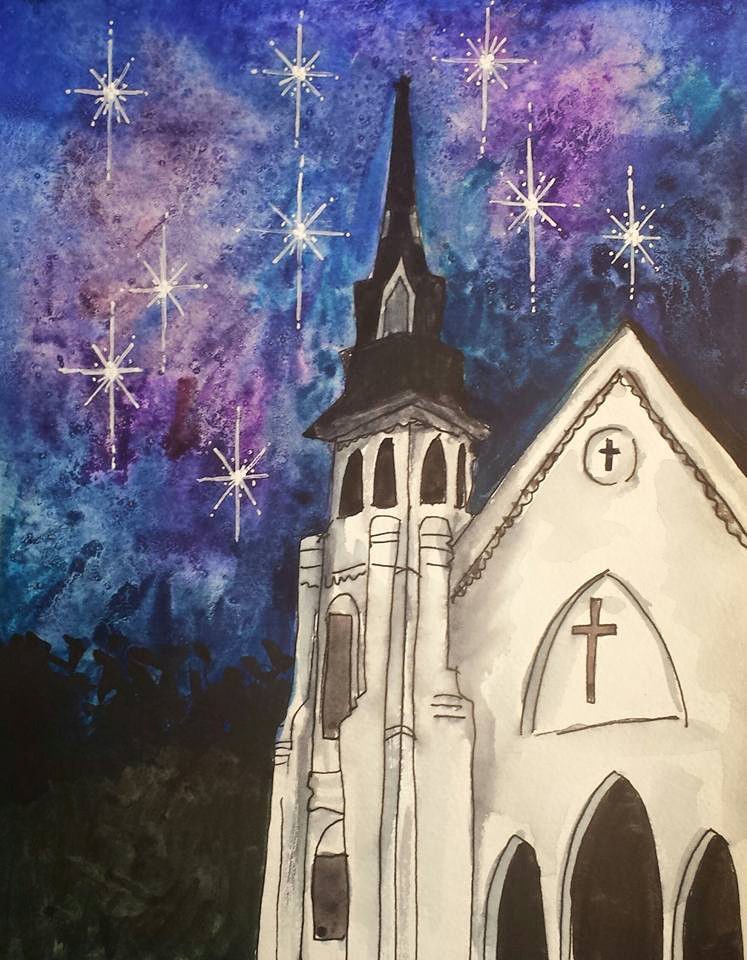
what to say about the Charleston martyrs

11402816_1009715492374949_8168622302111602227_n

artwork via

three sermons that are worth chewing on this week:

“That your Gospel is more powerful than our hate, more powerful than our despair, more powerful than our pride, and more powerful than our delusions, we give you thanks O God.”  Confession (1)

In the face of Emmanuel AME Church, Naming Goliath (2)

“Last week in Charleston, however, was different. To be sure, it’s important not to romanticize or idealize the black church, or any church. All Christian groups are riven by Sin just like all other groups. But the black churches have suffered so extremely, and so unjustly, for so long, that they have achieved a maturity that seems almost superhuman.” “What’s in those lamps?” (3)

God With Us

If you had to–what would you say are the two most-widely-memorized passages of Scripture?  Reading Psalm 23 this week, in preparation for a funeral, I was struck at the similar themes in the psalm and in the Lord’s Prayer…

The Lord’s Prayer asks us to repeat that we hope for God’s will to be done here on earth as it is in heaven, to affirm in faith that God will lead us away from temptation, and to declare that the kingdom–all creation–belongs to God (to, in a way, assert that God is everywhere, as he is witness to everything, all the time, in the universe–the buck stops with him).

Psalm 23 tells us that God is our constant companion–our leader as we pass by verdant fields and flowing water, the one standing next to us in the valley, the one sitting nearby when we face enemies.

If *I* had to choose, I’d say these are the two that “everyone” knows.  If you’ve spent any time around a church, or even in a literature course, you’ve seen these two passages.  They’re the ones that–if anything!–fictional characters are quoting, they’re the ones that–again, if you’ve heard anything!–you’ve heard these two.

So, if these are the two most-easily-found scraps that provide us with clues to God’s identity, and we see in them that God says he will always be near us, he will be our all-time companion, what do we see to corroborate this in Scripture?

Abraham – leaves all he’s ever known, he’s alone in a strange land with his wife—in his travels he’s afraid more than once that he’ll be killed, but he trusts God and God continues to be present and God blesses Abraham’s family.

David – youngest, smallest son, the stinky shepherd, but he trusts God and God is present with him and blesses him.

Jesus  – is God’s ultimate presence with us.  God himself came to live with humanity, because of his love for us.

Marriage is meant to be a symbol of Jesus’ presence with us, his church.  We vow to be present, to be a companion, to one particular person for our entire lives.  We can’t make it easier, or take over someone else’s life, but we promise to be next to them in facing both sorrow and joy.

Children also teach us about God’s presence.  We get a glimpse of the love God has for us in the love we feel for our children, we see how dependent we are on God when we experience the dependence our children have on us.

We cannot protect our children from all sadness and all harm, but we do our best to be present with them, to walk alongside them as they—and we—endure whatever suffering befalls them.

We are God’s children, and through Jesus Christ, his own son who he gave up for our sake, God himself is present to us, today, and forever.  Amen.

(inspired by reflections on a recent funeral)

First Sunday of Advent – Waiting – Church of St. Michael and St. George

In the name of the Father, and of the Son, and of the Holy Spirit.  Amen.

(silence/staring right back at the congregation for 10 seconds)

Ten seconds of silence.  But how long did the wait seem to you?  And how did it feel to sit through it?  Did you start to wonder if something was wrong?  Perhaps I realized that my notes weren’t on the pulpit, or maybe I suddenly felt ill, or got stage fright after doing this without too much trouble the last few months.  After a few seconds—how quickly our minds move from one line of thought to the next!—you lost interest in this strange, quiet woman standing in front of you and moved on to planning your grocery list or trying to recall which doctors’ appointments were this week, or whether you’d written that Christmas card already.

Last week, picking up a friend from the airport, I wondered, as I often do in that situation, what we did before we had cell phones.  I have never picked someone up from the airport without a cell phone to aid me in timing my car’s arrival.  I vaguely recall being with my mother, driving around and around in circles, searching for our guest, or even further back in my memory, being allowed to idle in our car by the baggage claim curb.  Our technology has eliminated our need to really sit and wait for someone—three-year-olds who are being potty-trained, excepted.  Even in such a situation when we happen to be sitting in a restaurant, waiting for our lunch companion, or standing outside a theater, waiting for our date to park the car, we pull out our phones and check to see whether we might be more interested in what’s happening somewhere else—a sports game or a war in the East or, until a few weeks ago, the newest political gaff.

At a party a few weeks ago, six or ten of us sat around a coffee table, waiting for the guest of honor to arrive.  Almost instinctively, many of us pulled out our phones and then glanced down to occupy us while we waited.  Immediately, Rob Lehman roared at us—I don’t know if you’ve ever had a red-haired man over six feet tall roar at you, but it’s something fearsome to behold, and let me tell you, it makes you listen!  He said, “What are you doing?!  Be here!  Be present!  Put those things away!”

This (evening/morning), Jeremiah doesn’t have to say that to the people he’s addressing.  They’ve got nothing to put away, they’ve got nothing to occupy their minds or mouths—many of the people Jeremiah’s talking to have lost their homes and their land and their livelihoods.  They’ve been carried off into exile—and I imagine they’re remembering, with a lump in their throats, the stories their ancestors had told them about another exile, centuries spent in Egypt.  Perhaps they had that feeling of foreboding that they had pushed the envelope (?) just a little too far.  They’d meant only to get to the brink of disaster, and then pull themselves back before the real consequences set in.  Then they lost their balance, and mighty Babylon came in and erased their lives from the face of the earth, sweeping the people along back to Babylon.

These people sat in their shantytowns, figuratively listening to Jeremiah on the radio.  He told them that God hadn’t forgotten them, and far from being abandoned, God would still fulfill his promise to them, saving them from their distress and bringing them to a safe and secure existence again.  What a relief!  Imagine the pit in their stomachs shriveling up, their breath coming a little easier, their shoulders drooping a little as the stress of the unknown left their bodies.

But then, they looked around, and remembered that they were still stuck in Babylon for God-knows-how-long.  The severity of the situation caused them to redouble their resolve, knowing that it probably would not be within their own lifetime that God’s promise would be fulfilled.  Still, God had promised to deliver them, and again—just like in Egypt, he had made good on his promises before.

What were their options, anyway?  There was no food in the storehouse to fall back on; there were few family or communal networks intact to provide support.  God was their only fallback, God was their only support.  They had no personal property to distract them from the waiting, nor had they prosperous, rewarding occupations, as they may have had in Israel.  All possible diversions had been stripped away—it was just the people, sitting in a foreign land with few comforts, staring into the heavens, waiting for God.

How strange they must have seemed in the midst of this thriving, bustling world capital, those rural Israelites who thought that their God was more powerful than Babylon.  Didn’t they know that they Babylonians’ ancestors had almost built a tower to Heaven?  These people they now lived with were truly the most impressive people on earth.

Believing in and waiting on God’s promises looks strange, especially in lands which boast much of the world’s power.  It’s weird to get up at 5 a.m. on Sunday mornings and drive to a shady part of town to make toast and drink coffee with people who don’t look like you do.  It’s puzzling why kids would fill shoeboxes with gifts they’d really love to see under their own Christmas tree and ship them off to other continents.  It’s strange for busy moms to leave their families on a school night and make a Christmas meal together to give to another set of moms who happen to be in their teens.

This first Sunday of Advent marks a change in time for us Christians.  It the Church’s new year, and it’s no coincidence that our first season in it is a season of waiting.  Like the Season after Pentecost, which we just left, and like Christmas and Epiphany, which are coming up, Advent encourages us to focus on a particular aspect of our lives as Jesus’ disciples.

Waiting on Jesus looks strange in our culture, but it’s absolutely necessary for us if we want to grow as disciples.  We take advantage of the story that God gave us of Mary and Joseph and the Israelites waiting for Jesus to model our own waiting on him.  For myself, I struggle with waiting—not only the kind we’ve been talking about this morning, distracting ourselves so that we forget that we’re waiting at all, but the kind when you jump the gun.  Fr. Jed is a great bread maker—he’s got his monastery cookbook, and he churns out artisan loaves with flair.  Your Mtr. Emily is not a great bread baker.  I can never tell when I’ve waited long enough on the yeast, and for some reason, there are always phantom drafts in my kitchen that do not make it a friendly environment for the growth of yeast.  My breads end up low, and often tough—I am not at all gifted in judging the readiness of yeast, and I go on strike against yeast every few months, and the jar of it languishes in my fridge.  I think we’re often like this about Advent.  We’re not good at waiting, so we give up and give into the busyness and the distraction.  But Jesus, and Advent, are always there waiting for us—they haven’t given up on us, so why don’t we give the waiting another try?

Amen.