“And people from the whole Judean countryside and all the people of Jerusalem were going out to him, and were baptized by him in the river Jordan, confessing their sins.” (Mark 1)

Can you imagine being eager to repent of your sins? Are you one who would have rushed into the wilderness, hopped in your car and high-tailed it to Cameron Parish, if you’d heard that some prophet had showed up there and was baptizing people? 

That sounds nice for other people. Maybe somebody else needs to go unburden themselves, but I’m okay right here. God can change a heart from anywhere, he doesn’t need me to go to Cameron parish or West Texas or Honduras to find salvation and listen to some fire and brimstone preacher. I can repent just fine right here in the quiet of my pew, without any histrionics or wailing or embarrassing outbursts. We have order – we are Episcopalians, for goodness’ sake.

But it’s not really about being Episcopalian or avoiding uncomfortable shows of emotion. It’s about fear, isn’t it? I wonder if we might be afraid of what God requires of us in judgment. 

Last week at the 8:30am service, Fr. Jake preached to open the Advent season, and he relayed a striking image from a C.S. Lewis novel that opened to us the way it might look when Jesus comes to judge and cleanse us. I think it might have looked different than we expected. 

So maybe that’s a good question to ask: what do we expect the exposing and purging of our sins to look like? 

Did any of you see the Anne of Green Gables with Megan Follows from the 1980s? (Who didn’t?!) There’s a scene where she’s a teacher trying to inspire her drama students to really get into playing Mary Queen of Scots, and she throws herself across the stage to cling to the skirts of whoever the other character is, maybe Queen Elizabeth the First, and yells, “Save me, sweet lady!” That’s one of the first images that bursts to my mind about begging for forgiveness. The debasing oneself, the physical and figurative lowering toward the dust. T

And we can easily imagine, too, the way that we might have experienced confession and punishment growing up – a stern voice saying, “well, tell me what you did wrong.” That hot, prickly feeling on your neck and back, maybe even bowing your head in shame and sadness in this expectant silence. Perhaps there were physical consequences too, privileges removed, or pain inflicted to help teach us a lesson.

Our world judges wrong in courtrooms, with testimonies and standing up alone in the truth or in sin. We are not so far removed, only a few hundred years, from pillories and the cutting off of ears or hands. 

Gosh, who would want to invite that kind of awful pain, and to be exacted from the Lord of Lords – the almighty one of ultimate power. What excruciating destruction he could bring to our lives! Surely it’s more than we could even imagine.

Yes, I would be one of those who would demur the invitation to go and be cleansed in the wilderness. I am not eager to have my sins nailed up next to me, or to have a scarlet letter sewn to my shirt, or to serve a sentence in a dank dungeon. Nobody really does, right? 

So I wonder if the exposing and purging of our sins for Jesus’ sake might look different than what we expect. I wonder if Jesus’s redemption and facing of our faults might be surprising in view of what the world teaches us that restitution looks like. 

Consider: back in the garden, when Adam and Eve had disobeyed, God sought them in the cool of the day. He didn’t come immediately the moment he knew they’d sinned. He didn’t stomp over and throw lightning bolts, he didn’t nail them up to a cross literally or figuratively, he didn’t even slap their behinds or waggle his fingers at them. With compassion and regret, he laid out the consequences of their actions; I get the sense that if it had been possible to ignore the price of their actions, he would have, but you see, they’d made a choice to not-trust God, and from that point, God still wanted to protect them as much as he could, and so the consequences provided a sort of boundary line to do what he could to keep them safe while being in the wide world. 

Later, we see in the Gospels how Jesus interacts with those who come to him with humility, knowing their sins. Often these are the people who society reminds of their shortcomings all the day long. But Jesus doesn’t pile on with the cultural expectations of shunning tax collectors and ignoring prostitutes. Those who recognize their imperfections, those who are humble about their sins, those who come to Jesus holding their sins out in front of them, are received how?

Jesus looks with compassion, Jesus takes time to sit with these people. Jesus gently wipes their tears and listens to their burdens and pronounces them forgiven. 

This isn’t the shunning or shaming we might expect. This isn’t the hot anger and lightning bolts that we often assume power will wield. This God revealed in Jesus Christ deals gently with those who recognize their darkness and who seek to heal from evil. And that’s the difference, isn’t it? I wonder whether the people who went out from Judea and all the surrounding countryside and who poured out from Jerusalem were the ones who knew they were already in darkness and already mired in the wilderness of sin. 

I wonder whether these people who sought John the Baptist and his cleansing in the river Jordan recognized that the trip to the wilderness was really not so much geographical as it was spiritual. And that they were, in truth, already there. 

Already in the wilderness. Already lost and parched. Already feeling heavy and burdened by the weight of their lives. Already wandering in guilt and regret. I wonder whether any of this feels familiar to you.

What we find in Scripture, not least in the prophecy from Isaiah this morning, is that this God, unlike rulers in the world or idols of ancient times, uses his great power when he’s doing good, not when he’s meting out consequences. The God revealed in Jesus Christ is a God of mercy, the prophet Hosea tells us, and when “he comes with might, and his arm rules for him, his reward is with him… he will feed his flock like a shepherd; he will gather the lambs in his arms.” This God is abundant in his power for mercy, for gentleness and nourishment, for forgiveness, for light and health and thriving and hope. 

The powers of this world are harsh and dark and full of punishment. The consequences are dire – the wages of sin is death – but the gift of God is eternal life. God’s kingdom, the ruling order that Jesus ushers in through the incarnation, is founded on the power of God’s love, not the power of pain or punishment or shame or evil. So as we approach God’s throne of grace, our confession of sin need not be fearful or defensive. We may rest knowing that the purging of our sins will hurt only in so far as it is hard to extricate ourselves from darkness, and that the love of God is a cleansing, healing salve to our sin-sick souls. 

The Kingdom of Heaven

Last week, I saw the Kingdom of Heaven on Rosemont Avenue.

That’s the name of the street where I live up in North Oak Cliff, and I want to offer a witness here this morning. The Kingdom of Heaven broke into the 600 block of North Rosemont Avenue, for a moment I glimpsed heaven there. Sure, it gave me a warm, fuzzy feeling, I smiled, and I nodded at how light and joyful a place the world could be. But it just as easily couldn’t have happened. It was just as possible, and maybe even easier, for nothing exceptional to have happened at all, for the Kingdom of Heaven to stay hidden and quiet and unseen, but there were two things that happened to enable this witness I’m giving you this morning.

First, somebody invited the Kingdom of Heaven to be part of their own daily life, and then second, somebody else saw and talked about what happened.

I heard the story from that witness, and now I share it with you. This neighbor had just gotten home from a long trip last Sunday night, and she found a note on her front door when she arrived: Continue reading

A Tale of Two Brothers

nicoles-picture“There was a man who had two sons.”

Jesus was preaching to sinners and tax collectors—the societal scum of the earth—but the pharisees and scribes were listening in too—the acceptable, impressive, and righteous of social standing.

Now when these men who were accounted as righteous—the socially-impressive Pharisees and et cetera—heard Jesus say those magic words, “there was a man who had two sons,” in their minds, these learned Jewish men immediately put their money down on the younger son. This was because in the Old Testament, all the stories they’d ever heard about who their God is and how this God interacts with humanity, the younger son always wins. It may be something about cheering for the underdog, though I suspect it tells us more about who this God is than who he likes to cheer for—this is a God of surprises. Way back in the beginning, the first set of brothers on earth, Cain and Abel; they both make offerings to God, and God is pleased with Abel’s offering (we’re not exactly told why). Then, last week we heard about Abram. Amos alluded to the two sons that he had—it won’t surprise you, the younger one is the one God chose to use for his great promise of progeny. Perhaps one of the most significant brother pairs is Jacob and Esau, Jacob steals Esau’s birth-blessing which he’s owed as the oldest son, and Jacob ends up being named Israel, a name we know and use to this very day in connection with the Jewish people.

So back to the sons in our parable: the Jews who were listening knew exactly who to root for.

And Jesus continues: The younger son, when he was adult-enough, asked his father to split up all the family assets and to give him the piece he had coming to him.

Can you imagine what it would be like if your child came to you and said, “Hey, someday you’re gonna die, and in your will, I know you’re gonna be pretty generous; so, why not just give it to me now, and I can enjoy your generosity while I’m still young?” “Over my dead body!” you might say—the son is treating his father as if he’s already dead. But for whatever reason, the father listened and did just as the young son asked. A few days later, the boy took all that cash in a duffel bag, and he left home.

Cut to the montage in Vegas, the private planes, the champagne running free, and whatever else you want to imagine is tied up in “dissolute living.” Last weekend I saw a show called “House of Lies,” and I suspect that one of those characters is this son.

Then the stock market crashes. It’s 2008, or, the proverbial 2008. The son loses all his money, and he’s dying on the street. He’s thinking about his life, and he realizes what a fool he’s been. All the stuff didn’t give him peace and security, it didn’t really make him happy. He’s bet on the wrong life, he’s gone far down the path of seeking stuff and security, and it all left him for dead.

So he turns around and goes back home. He’s not expecting a ticker-tape parade, or even to be let in the front door. Imagine it’s Downtown Abbey: he’s shuffling up the drive, trying to get his words right, wanting to ask if he could be a field hand, or maybe an assistant to the gardener, or the livestock manager. Just something that will give him a roof over his head and some food in his belly.

But his father is sitting in the library, and sees that familiar gait coming up the gravel drive. Before the son is able to make to the back door, his father intercepts him and crushes him in a enormous hug. A party is quickly organized and the best wines are pulled out of the cellar, surely to Carson’s dismay. And echoing the butler’s disapproval, the older son arrives from a hard day of agenting and wonders what all the fuss is about. This respectable, dutiful older son catches sight of his lost young brother, and rolls his eyes with a sigh. “Oh, of course you’ve come sniveling back. Father, you can’t be serious—how can you celebrate this kind of behavior? I won’t have it. I’m going up to my room.” And even though he sounds much like Lady Mary, he’s a man, I assure you.

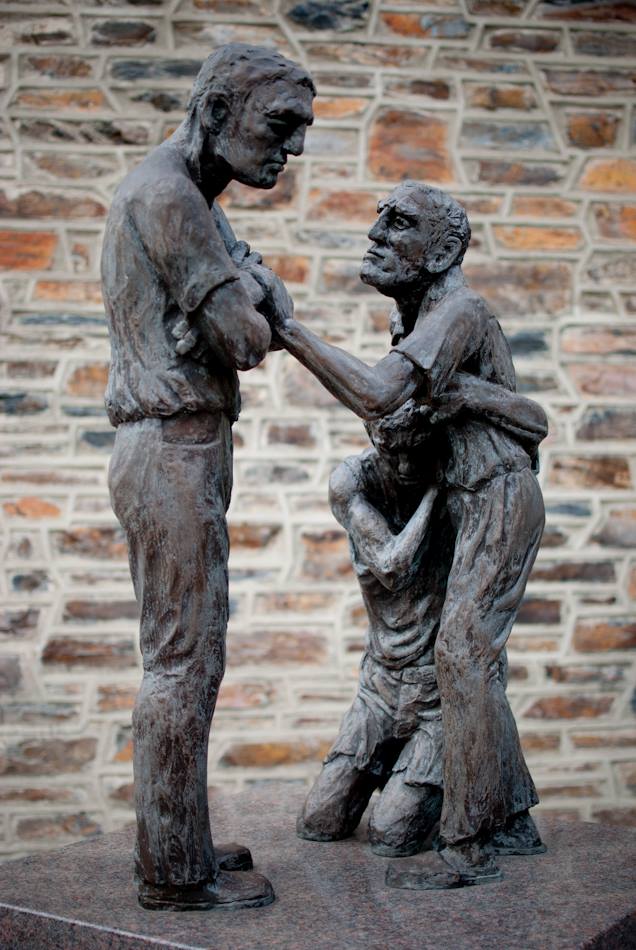
There’s a sculpture at Duke Divinity School of this moment in the story, the younger son is kneeling at his father’s side, Dad has an arm around him. The older son stands hardly within reach, with his arms folded across his chest. the father reaches out a hand to hold on to the older son, a sort of lifeline, desperate for reconciliation and wholeness, now that the family unit is back within reach.  And what happens next?  We don’t know.

That’s where Jesus ends the parable. 

fractured families – breaking societal rules – holding a grudge – count someone (friend, brother, parent) as “lost” – beyond the pale, beyond help. UNFORGIVABLE

So the respectable Jewish listeners, having put their money on the younger son, sit there scratching their heads. The son who messed up—to put it mildly—the one that they had been primed to support, he ended up breaking all the rules, sluffing off his family, and then, even though he had disobeyed every law that the Jews were so careful and fastidious to keep, this son was accepted again into the family, he was even celebrated. What could Jesus mean by that?

Do any of you have family members who are “lost”? Are there friends or people in your life who have abandoned you, or done something unforgivable? Is holding a grudge against them your wall of protection? Maybe they just stopped calling or they’ve gone off with some kind of substance to try to find peace there. Do they know that they can come home? What would happen if they did?

As for the tax collectors and sinners who were listening to this parable, they’d received no such training in Jewish lore, and they probably thought, “Ah ha! The older son! Surely he’s the one to bet on.” Usually the oldest son would receive the extra blessing, an extra share of the family fortune, fortune smiled on him—why wouldn’t you cheer for this character?

These social pariahs might aspire to be this brother, to be the upstanding, responsible, well-cared-for, safe brother. He’s hard-working and respected, invited to all the right clubs and social engagements. But the danger of that kind of life, or the danger of wanting it for its own sake, for the sake of being respected and rich and secure, is that you’re looking for the trappings of the lifestyle and not the life itself. The older brother had the shell of this full life, but not the heart of it.  His smallness of heart when his brother returns betrays him; it’s almost as if he is jealous that his brother enjoyed such freedom and adventure. The older brother isn’t pursuing hard work and respectability out of his own desire for good, honest work, or for love of his family and the position they hold, but because he thinks he should do it, because it’s what he thinks is expected of him.  Likewise, those listening who are desperate for respectability and wealth are shown that in themselves, they are just trappings, not the real stuff of a life that is whole and happy.

It’s really the tale of two lost sons.

One leaves home physically, takes a bunch of possessions and fills himself up with food and booze and all kinds of things that numb the deep hunger he has to be known. The other son stays home, seems to do all the right things, follows all the protocols for blessing and accomplishment, seeming to have no sin or darkness to hide at all. But as the tax collectors and sinners find by the end of the parable, this son, too, has sin he needs to acknowledge. He’s hidden it well, and he’s distracted himself with lots of good deeds and sacrifices for the sake of the family. But he’s run away from home too. He’s run away in his heart and is just as lost as his brother.

There is nothing so fickle and wayward as the human heart. And there is nothing which has more worth to God than each of our hearts, than winning the affection of each and every human heart.

I think that’s why Jesus ends the parable where he does: he leaves the question with hearers of every stripe and sort: will you repent and come home?

God our Father says, “Please come back, in both heart and soul; it’s just not home without you.”

The way back home is to say out loud that we have run away, to admit we’ve tried to cover ourselves up and pass ourselves off as just fine, doing okay, not in need of anything. It’s hard to admit that we’re lost and need to be found. That we’re cold and we’ve spent all our inheritance and we just want to belong again.

We’re encouraged during Lent to do some of that soul-searching, to admit that we’ve run away, and then to find our way back home.

The message that both sides needed to hear, both the ritually-righteous and the socially-sinful, is that God the Father, the God who Jesus reveals to us, is more interested in mercy than in sacrifice.

Younger son’s repentance leads him to be ready to sacrifice, to be a slave in his own home. He desires no claim of his birth or title or name, he expects no mercy.

The older son has given all the right sacrifices, he’s fulfilled all the obligations and expects to be judged on his sacrifices, he hopes that his right action—no matter his motivation—will show him worthy. In the end he is expected to have mercy, and to display forgiveness; all the sacrifice doesn’t matter if his heart is not merciful toward his brother.

It’s not that there is no grief or consequence or price to be paid for the sin and destruction wrought on the family—indeed, the estate is diminished at least by half, but in the midst of that price, what matters even more than sacrifice and than respectability is restoring wholeness, restoring relationship, bringing back unity.

This is what God does when Jesus dies on the cross. Jesus doesn’t go to the cross, unjustly condemned, because it is the sacrifice that ought to be made, that’s part of it and theologians rightly argue that Jesus’ sacrifice for our sin is part of the story, but another part is that God in Jesus shows love and mercy on the cross. Jesus is jeered by the onlookers: “Come down from there, save yourself, prove that you are full of all power and that you are God.” Jesus decides instead to show that he is God by living and dying in love and mercy, by enduring what a human would have to endure if you or I had been unjustly condemned. This is how God chooses to bring us home, God in Jesus forgives our wickedness, loves us completely and steadfastly.

So now it is up to you and up to me: do you have the courage to say “Father, I have sinned against heaven and before you”? Do you have the humility to respond with honest repentance and to come back home, in heart and soul?

image via 

Merry Christmas!

c4a8b45a-b2f9-467a-afb1-f1dcff83b803

A meditation I wrote for today sent out via the Living Church Daily Devotional: CLICK HERE.

(Subscribing is FREE, just click the link in the upper left corner of the new window; you’ll get a sweet short devotional in your mailbox every morning!)

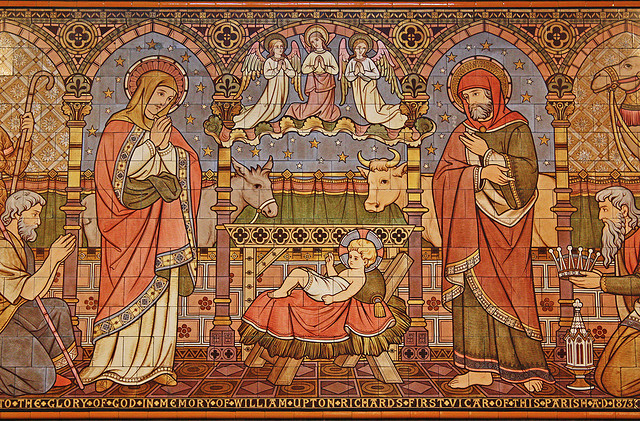
Detail of tiled wall, All Saints Church, Margaret Street, via Fr. Lawrence Lew, O.P./Flickr

Praise God

If you’re here this morning feeling triumphant and joyous and free because of the Supreme Court’s decisions this past week, praise God.

If you’re here this morning feeling queasy and uncertain because of the Supreme Court’s decisions, or because of hate that’s been manifested in our state and even across the street in the last few weeks, praise God.

If you feel like finally, finally, God is answering your prayers, praise God.

If you feel like, in light of this week, God must be taking a nap, praise God.

I do truly pray that there are people in these pews today of all those convictions, because there is merit in all those convictions, and familial love and diversity is a hallmark of the Kingdom of God.

God doesn’t look the way that any of us think he does. God doesn’t act the way any of us suppose he should. God doesn’t look like you. God doesn’t look like me.

God looks like Jesus Christ.

God is Jesus Christ.

Praise God, our Lord Jesus Christ.

And you know what today is? Continue reading