Driving back from hospital visits today, I was listening to our country music station. How often does a popular song articulate the call of ministry?
“Never let your prayin’ knees get lazy, and love like crazy.”
Lee Brice

Driving back from hospital visits today, I was listening to our country music station. How often does a popular song articulate the call of ministry?
“Never let your prayin’ knees get lazy, and love like crazy.”
Lee Brice
“That which we have heard and known, and what our forefathers have told us, we will not hide from their children.” (Ps. 78:3, BCP 694)
A few years ago, while in seminary, a friend of mine and his wife welcomed their first child. In a facebook status post soon after the birth, he said something to the effect of, “God has entrusted this child to us–he is God’s child, not ours.” It’s stuck with me, and the sentiment in the psalm appointed for Morning Prayer today echoes my friend’s wisdom.
The speaker in this verse sounds like the generation caught in the middle, the generation of parents is very much keeping the children they bear in trust for their own elders. Children belong not to their individual parents, but to the tribe in which they were born. It’s not even up to the parents whether they pass along the faith and truth with which they’ve been entrusted–to teach the young about God is simply what parents owe to their own parents and forebears.
Have you ever thought of your children (or siblings, or kids at your church, or elsewhere in your life) as simply being entrusted to you by God or by your whole lineage of ancestors? The world feels a lot more like a family when we think about our children collectively.

A number of months ago, a seminarian here at CSMSG preached about “thin spots,” moments and events when the distance or space between us and God or us and heaven seems to be inconsequential–the space seems “thin.”
I think of the way that light peeks through well-worn fabric; the way that the “fabric” of our lives can get to be gauze-like in places, and that wearing away reveals the light–the glory, the God-ness–behind/underneath it. The more I focus on these spots, the more I see them. I don’t think they’re increasing in frequency by any means–I’m not becoming holier by the minute, let’s be real!–but I do think that in training myself to see them, I’m getting better at seeing more of them.
 Another contributing factor: really, truly working to see trials as opportunities to grow. I’m borrowing another blogger’s great, great wisdom here. When we help to create thin spots*, we’re more attuned to God’s work in our own lives, and we’re more willing to receive/notice the gift of those moments that remind us of God’s presence and of the joy of life itself.
*choosing to think of trials as opportunities to grow–loving others well with no attention or regard for their behavior toward us. This is helping others, especially in physical ways–bringing dinner to a person’s home, inviting someone to coffee, visiting with someone in the check out/coffeeshop/DMV line; this is going ahead and being honest (lovingly!) with others, especially in positive ways–sending that note to the acquaintance who just gave birth and you want to congratulate, telling your spouse out loud that you’re so grateful for him/her, calling that dear old friend you haven’t spoken with in a year (not letting the shame of how long it’s been/how strange you think it might sound/how stalkerish it might seem get in the way of expressing gratitude!); this is washing your mind out when storm clouds gather and when the person in line/in the car in front of you/in the upstairs apartment happens to be very, very rude. I have to constantly remind myself that there’s surely something that is bothering her/him, and it’s not really about me, but about trying to work through the anger and hurt, and I happen to be caught in the crossfire (this is one of my biggest challenges).
In my own life, paying more attention to thin spots recently, I’ve found they most often happen when I’m with other people–not alone–and when I’m praying. Now, I must have the courage to be with people and to pray all the more!

This week, the Daily Office Lectionary (the schedule that takes pray-ers and read-ers through most of the Bible in the course of two years, found in the back of any Book of Common Prayer, and online in various locations, like this) has been taking us through Isaiah. This prophet’s words are major faves for Messianic imagery and promise–Isaiah’s are the words ones Jesus quotes most during his ministry as recorded in the Gospels. They’ve been fertilizing my heart the last few weeks (and months–in our women’s Bible Study); here are a few thoughts on two verses from Isaiah 43, part of the Lectionary’s reading in the last week.
“When you pass through the water, I will be with you; and through the rivers, they shall not overwhelm you; when you walk through fire you shall not be burned, and the flame shall not consume you.” Isaiah 43:2
We have, we do, we will face rivers and fires–storms of relationships and financial stability and physical/mental health–there is no promise God ever makes that we will be shielded or that we can avoid trials and pain in our lives. The promise made to us here is that when we face pain and trials, because we will, we won’t be drowned or choked or suffocated or burned or consumed–we won’t be killed. When we face pain, we have an opportunity to grow and learn and to become stronger through the trouble we’re encountering. If we stick stubbornly to God, like a burr on a dog’s coat, our trials become moments that we can learn trust, and we can come out the other side stronger and happier and closer to God than before.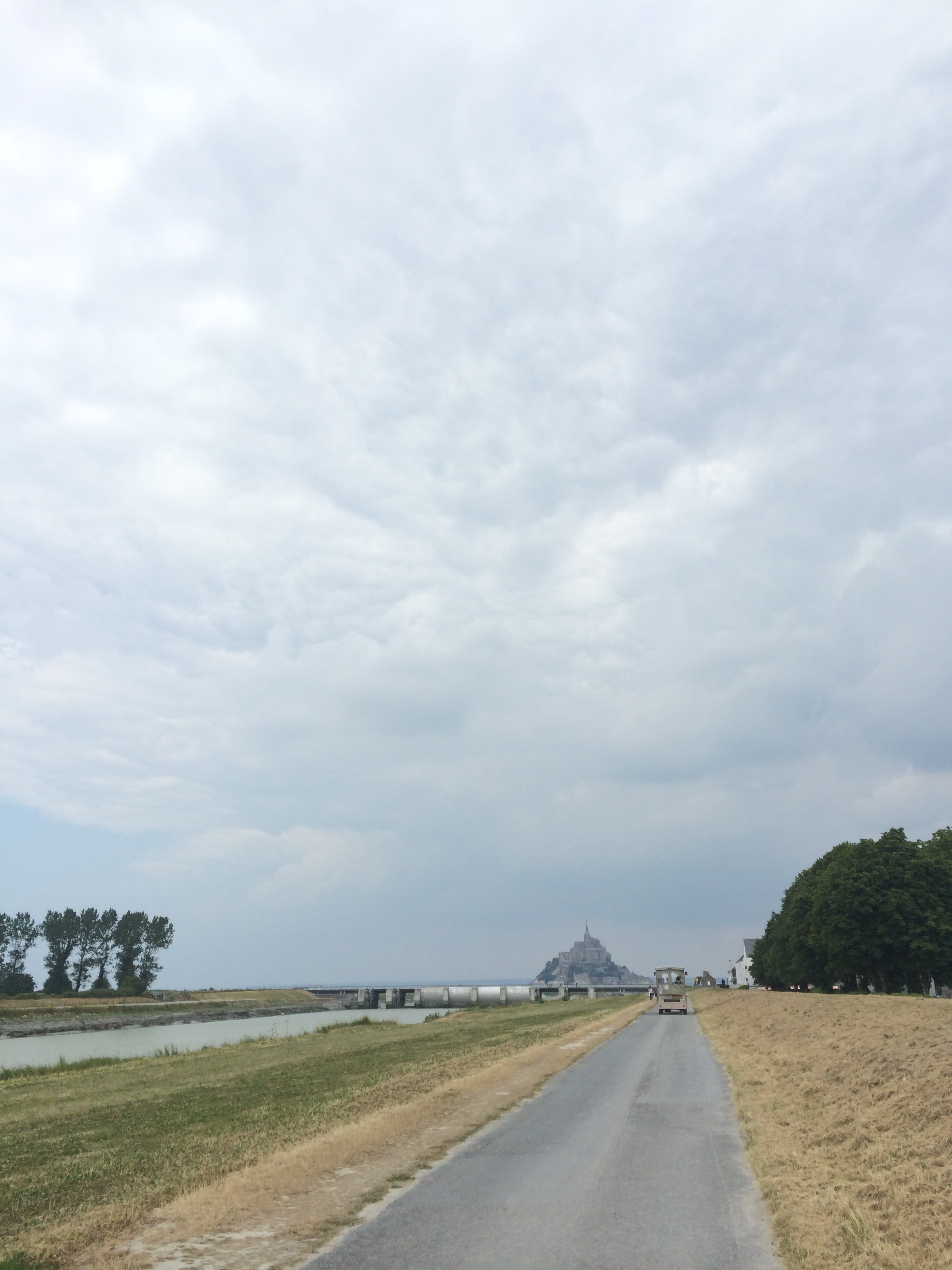
“I am about to do a new thing; now it springs forth, do you not perceive it? I will make a way in the wilderness and rivers in the desert.” Isaiah 43:19
We don’t experience much physical wilderness in our day & age–there aren’t any places on the earth that haven’t at least been mapped, if not overrun with people and paths and conveniences (especially in the US)–but perhaps you can imagine what it might be like to stand on the edge of a desert, or at the end of the road leading into the nature preserve (if that’s the closest we can imagine to “wilderness”!), and try to conceive a way through the uncharted space to wherever it is we’re supposed to go. Even if it’s like a park, and there are paths running through this “wilderness,” such ready-made paths never seem to go quite the right direction. Though we face areas of wilderness in our lives–relationships that are stuck and have no clear direction out of the mud, medical or financial or other problems that have only walls and uncertainty–God will guide your path (the one for just you–not a pre-made, well-worn path, perhaps).

Proper 17 – Year B
One of the things a person faces when they move somewhere new—not speaking from personal experience, of course—is that she knows that her influences will change. For example, in North Carolina, I used to get up at 6 a.m. a few times a week to run with my dog, Ben, before heading to Morning Prayer and school. I loved the quiet time in the morning, it felt like I was alone with my university—no one was around when I would pound down Chapel Drive and I could enjoy the gothic towers by myself. I’d been living under the shadow of Duke for almost a decade and I could hardly imagine life without them. Knowing that I’d graduate soon and move somewhere—who knew it would be a move to other Gothic towers—the lonely runs were all the sweeter.
The first Saturday that we lived in our apartment, I hoped that keeping to my early running schedule would provide some familiarity and make the jarring transition a bit smoother. I eagerly woke up at 6 a.m. and laced my running shoes. I grabbed the leash and we were off. Except, as you well know, a 6 a.m. run on Wydown, even on a Saturday, is not a quiet, lonely, soulful experience. There are myriad other dogs, runners, bikers, and walkers—I wondered if I’d read the time-change wrong.
If you’ll allow me a bit of a stereotype, I think you’ll see my point: around the southern-cuisine-soaked North Carolina paths, I was a standout, I was bucking the norm. Around active Missourians, I was at most, the norm, and more likely, I was trailing the crowd. In the last months, my influences have changed.
In the same way, our relationships influence how we think, and how we talk, and how we behave. We not only pick up other peoples’ way of talking, but we pick up their habits, good and bad, and we pick up their perspective on life and belief. Some of it is peer pressure, and some of it is just how we humans work—we mimic those whom we like and with whom we spend a lot of time.
Jesus longs to spend a lot of time with us, he longs for us to be changed in our speaking and habits, and in our belief by spending time with him. He says, “Arise, my love, my fair one, and come away.” Song of Solomon is a curious book in the Old Testament, and its original purpose was probably as love poems between two human lovers. It is still instructive to us in that meaning, but our God, author of all good things, provides more than one level of meaning in his Word to us, and today, he says to you in the words of this poem, get up from where you’re seated, stagnant, and move with me. Follow where I am leading you, hold my hand and let me be your companion—spend your life’s journey walking with me, and let me be the most significant influence in your life.
What God invites us to do in the Scripture reading this morning is the same exact thing that we prayed for in our opening collect this morning. We said, “graft in our hearts the love of thy name, increase in us true religion, nourish us with all goodness, and bring forth in us the fruit of good works.” We’re echoing what God has already said to us; we are praying that our desires would be aligned with what God desires for us.
This prayer acknowledges that we need God’s grace even to accept the offer he gives us to arise and come away with him. We need God to develop in our hearts a love for him, we need God to plant and grow the seed of true religion, we need God to nurture goodness in us, and we need God to bring these changes to bear in a transformed life, evidenced in new God-centered perspectives and behavior and language.
So what does it look like when God is doing all this work on us? The collect calls it “true religion.” By implication, we’re only capable of false religion on our own—which might be another name for what the Pharisees were up to in the Gospel lesson, fastidiously washing their hands and their kettles, careful to not allow anyone, especially Jesus, to influence or change their well-defined religious practice.
“Religion” has become a touchy word in our culture, it carries baggage of intolerance and carries the whiff of meaningless but complicated rules and regulations. But if we think about the way that we use the word “religion” in our daily lives, another meaning, perhaps a more faithful one, emerges. Consider: “she religiously packs her lunch.” “He gets up at 5 a.m. religiously in order to run.” “That family does yard work every Saturday religiously.” These more everyday uses of the word refer to habits, and most often, to good ones, at that. Religion, then, must be about our habits and the things that we do that hold our lives together. So what makes our practices, our habits in our relationship with God, “true”?
Throughout the Bible, God reminds us that he desires obedience, not burnt offerings, and he wants us to be of the right mind and heart, not of the right clothing and mannerism. We humans continue to worship in ways that Christians and Jews have for centuries because we know that it is not all about what we think is trendy in 2012, but what Christians throughout all of history have discerned about how to be faithful through their own lives of prayer and habit. We are joining in the habits of the Church by worshipping this way on Sundays and throughout the week. Part of how we know what true religion is is from looking back at what faithful people who spent at least as much time, if not more than we do, in God’s presence, allowing themselves to be transformed by him. We know that there is wisdom in old generations, and we should listen, both to the voices in the Bible, and the voices of saints throughout the centuries. The Church is so much larger than just St. Michael and St. George, and larger than the Anglican Communion, and larger than all the Christians living in the world today. Our history tells us some of what true religion looks like.
As we’ve been considering passages throughout Scripture this morning, we’ve found that we can also see some of the shape of true religion through Scripture. The Pharisees are a cautionary tale, for example, and the disciples are sometimes shining examples and sometimes illustrations of mistakes we ought not make. The Old Testament shows us through the Hebrews how God communicates to his people, of whom we’ve become a part, and how we can best respond to God’s call. Scripture also details God’s ultimate call to us—Jesus’ life, death, and resurrection. We are shown by example exactly how it is we can grow in true religion by mimicking and habitualizing Jesus’ words, attitudes, and behavior. We are invited into true religion by our Baptism following in the footsteps he trod to the river Jordan. We encourage and submit ourselves to God for growth as we seek the Eucharist every Sunday, just as Fr. Andrew & Fr. Jed have explicated in the past weeks.
Finally, God inspires our minds and pricks our consciences as he draws us to himself and continually makes his invitation. It is a lifestyle of habits that can be painful and difficult at times, and is almost always inconvenient to our lifestyles in this culture, but deep down, we know that it is the way of everlasting life—it is the true religion.
Perhaps a way of rephrasing God’s invitation to you this morning can be found in a modern-day love poem:
Baby, why don’t we just turn that TV off?
Three hundred fifteen channels
Of nothing but bad news on
Well, it might be me, but the way I see it
The whole wide world has gone crazy
So baby, why don’t we just dance?
 hope of things not seen