Selective Memory

More and more, I’m realizing that the things I remember and the things I forget aren’t just coincidences.

A few weeks ago, Psalm 23 was one of the readings assigned by the Revised Common Lectionary–the schedule of Old Testament, Psalm, New Testament, and Gospel readings that most all Lutheran, Anglican, and Roman Catholic churches use to plan their Sunday services.  The 23rd psalm was one of the first bits of Scripture I memorized; it’s long-since become so familiar to me as to sometimes feel calloused–overused.  I no longer turn to it for comfort or for inspiration, I’ve let it grow cold and unfamiliar in my mind and heart the last decade.

Saying it with a hospital patient this week, I stumbled in the middle, suddenly unable to recall the next verse; I skipped on to the next bit I could recall, and we finished strong, but I wondered what the little phrase was that I’d forgotten.  I looked it up.

It was verse 3: “He restoreth my soul: he leadeth me in the paths of righteousness for his name’s sake.” (KJV)

More than believing that I’m not alone in the valley of the shadow of death, or that goodness and mercy shall follow me, I wonder that God binds up and brings back our souls to health.  God promises to restore our souls, to upright the fallen, spilled, perhaps broken, vase of our lives, and to put it back where it belongs (we may not even know or remember where it belongs, exactly, but I suspect that if we ever get there–“restored”–we’ll know).

Why I am Episcopalian, Part 3; or Quotation of the Day

Ian Cron puts so many things so well; here, exactly why I wandered into a Roman Catholic Church seven years ago:

“Much of the liturgy for the mass, filled with its formularies, prayers, and creeds, is well over a thousand years old. I was moved that people were offering up the same words, giving expression to the same truths in different languages and time zones all around the globe that very day. Some were singing the liturgy in grand cathedrals in Europe, and some under a lush canopy of trees in Africa. Some were performing the liturgy in secret house churches in China, and others in prison chapels. Where or how it was said it didn’t matter. Solidarity mattered.

As I pondered the faces of saints captured in stained glass, the frescoes that adorned the walls and ceilings of the nave and apse, it dawned on me that the liturgy was connecting me to a long and ancient line of believers.  Time had become irrelevant.  We were one chorus, one communion of saints.  I was but one soul in the long procession of the faithful that wound its way down and along the hilly landscape of history.  I was appropriately small.”
Chasing Francis, pg 90

oh peas, no!

20140509-172930.jpg(actually, they’re tiger beans, but this priest couldn’t resist the bad AWESOME joke)

This morning I had coffee with a fellow writer friend.  I confided in her that I’ve felt challenged the last few weeks, lots of honesty roiling inside of me, eager to get free.  But I haven’t found a gentle, gracious, sufficiently-shrouded way to say these things yet, so I keep quiet–and very little comes out of the faucet at all (case in point: this dear space over the last six weeks).

Looking at my dear little bean plants in the garden this afternoon, I noticed something very disconcerting: their hard, protective shells were shriveled on the dirt.  Discarded.  Dried up.  Spent.  Returning to the dust.

The sort of click that you hear just-cracked safes make in the movies sounded in my head.

It’s only in taking off the outer barrier–the nice, cozy, practically indestructible casing–that allows the plant to grow, to feel the sunshine, to blossom, and then to bear fruit.  Growing does each of us good in and of ourselves, and to a much lesser extent, does good for those around us, watching our growth, encouraging their own growth, we hope.  The bearing fruit, though, that’s when we can really thrive, because that’s what we’re made and meant to do–to share the beautiful, hard-won, unique gifts that God places inside each of us.

But ugh–we’ve got to shed that outer shell, making ourselves open to attack, criticism, weather, ugliness.

Another wise friend of mine said recently, “With the immense support I have, how could I let my fear get in the way?”  With the immense support we have in our great triune God, how could we let our little limiting casings get in the way?


growing in the dark

20140507-182446.jpg
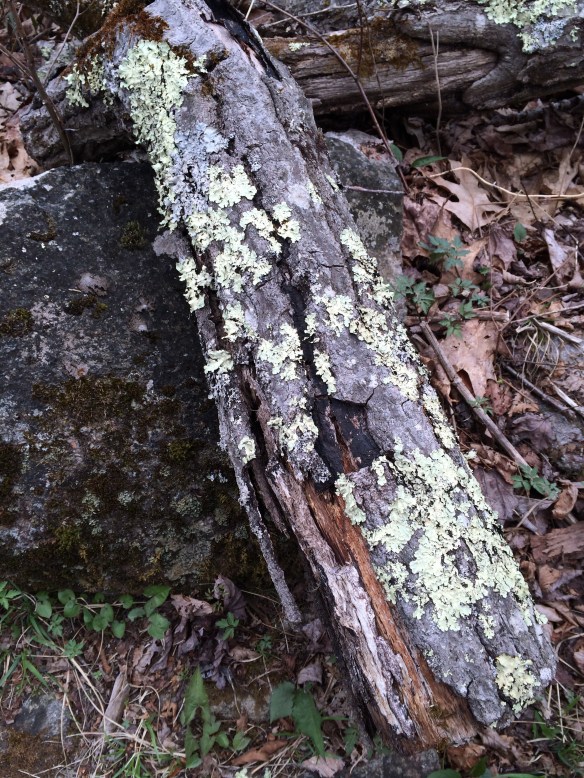
Since early this year, moss has captivated me.
In February, I went to Kanuga with the diocesan youth, and the cold ground boasted plenty of soggy, fallen branches covered in moss and lichen.

A few weeks ago, back in the mountains of Western North Carolina, I found more, and couldn’t stop taking photos.20140507-182505.jpg

I wondered why these funny little organisms had such an effect on me; it made me think about their make up.

Moss grows in the shade–when I was little, my dad taught me that if you couldn’t quite tell which way was which (cardinally-speaking), you could tell north by what side of a tree had moss growing on it.  Lots of plants and growing things prefer sun, the more the better!  But moss, with its soft, fragile, hardy growth needs some shade to thrive.  If we acknowledge and honor even the shady moments of our lives, we can grow and thrive in and through them.

20140507-182456.jpgSpeaking of hardy, there’s no better word to describe lichen.  It grows in the most inhospitable places–on rocks, in deserts, even in the arctic!  Lichen also grows in rainforests, on soil, and in more temperate areas; no matter where it finds itself, lichen hangs on and determinedly grows.  This fierce fungus not only survives, but boasts a frilly natural beauty.  What an example of how to live our own lives.

All around us are resolute, haunting, quiet witnesses to the brutality of this world and to the strength of living things.  Whether you believe in a God or not, it’s clear we’re not really alone (thank goodness!!).