
Our Deepest Gratitude

Around many tables this afternoon, probably at the table where you’ll be sitting, a moment will come when each person will be asked to reflect and recount the things for which she or he is thankful.

Some people do this all year round, a friend of mine thinks of three specific things he’s grateful for before he lets his feet hit the floor in the morning.  I know a few people who keep gratitude journals, jotting down events, or people, or moments during the day.  The journals let them look back and remember these treasured moments in the following weeks and months, which makes them feel grateful again–because they’ve probably forgotten those little fleeting gifts in the interim.

It seems that for us humans, it’s often much easier to remember negative things than positive things.  Look at the ancient Hebrews–I don’t mean to pick on them as exemplary in this area, because they certainly aren’t–the Bible is made up of common life examples, situations in which any person would do the exact same thing.  As God’s people are wandering around in the desert, they complain to Moses–do you remember those stories?  They’ve just seen God’s protection of them at the Red Sea, cutting off the Egyptians from pursuing them, and with the image of the great waves crashing over the heads of their enemies still burned into the backs of their minds, they turn to Moses and say, “Are we there yet?!  We’re going to DIE out here!!  This is absolutely HOPELESS.  We should go back to Egypt.  Let’s take a poll–who wants to go back to Egypt??”  It sounds a little like the back of my mom’s minivan on the way to summer vacation.

Do you remember what happens next?  Our Gospel lesson alludes to it; God provides food for them in the wilderness by raining down manna on them.  The manna is something that can be baked into bread which the Hebrews gather up every morning when they wake up–it falls and rests on the ground overnight, like dew, the Bible says; maybe something like the frost we experienced on our lawns this morning.  The word “manna” in Hebrew translates as, “What is it?”  Its substance is mysterious, we don’t know exactly what it is, even today.  But in another way, we, as well as the Hebrew people, know exactly what it is–it’s a blessing, it’s a witness to God’s love and care.  So the Hebrew people gather up these little scraps that remind them how much God loves them and cares for them.

What is our gratitude except Manna?  The journals my friends keep are proverbial baskets full of manna, pages and pages of reminders of God’s goodness and love toward us.  Our greatest gift which God sends from heaven as a symbol and reminder of his love is Jesus Christ, his only Son, God incarnate.  In today’s Gospel lesson, some people ask Jesus, “What sign are you going to give us then, so that we may see it and believe you?  What work are you performing?” (v.30)  Do you recognize the skepticism?  Maybe first-century people aren’t so different from people today.  “How can you prove that God exists?”  “How do you know that Jesus is God?”

Jesus responds to his interlocutors that it was God who was behind the manna their ancestors ate, as they well know; and besides, God has provided for them the true bread which is standing right in front of them.  They’ve already seen signs–their ancestors witness to them about the manna provided in the wilderness.  The actual eyes beholding Jesus in first-century Capernum didn’t see the manna falling, or ingest it into their own bodies, but their very existence was evidence that their ancestors hadn’t starved in the wilderness, but that they’d been sustained by something–by manna, the children and grandchildren and great-grandchildren were told.  And so, these children generations later knew and trusted that the manna had fallen and had been a tangible testament to God’s care for His people.

It’s the same for us.  We haven’t seen Jesus in the way that the people in our Gospel lesson today did; we haven’t seen Jesus the way that Paul did on the way to Damascus or Jesus’ disciples did after his resurrection.  But we know Jesus came, and lived, and died, and rose again because we have our ancestors’ witness to those events.  We stand on the shoulders of our great-grandparents in the faith, trusting their testimony about the God made human in Jesus Christ.  Further, because we exist as Christians and children of God, we ourselves are witnesses, we are a testament to God’s love and power.

Our great-grandfather-in-the-Faith, G.K. Chesterton said, “The test of all happiness is gratitude; and I felt grateful, though I hardly knew to whom.  Children are grateful when Santa Claus puts in their stockings gifts or toys or sweets.  Could I not be grateful to Santa Claus when he put in my stockings the gift of two miraculous legs?  We thank people for birthday presents of cigars and slippers.  Can I thank no one for the birthday present of birth?” (Orthodoxy)

Sitting Still: Waiting with the Prophets

rock at ConnemaraTuesday morning began The Simple Way Women’s Bible Study at Trinity Cathedral (come and join–7:30am, Tuesdays in Columbia, SC!).  Through 2013, we’re studying Micah, one of the minor prophets, contemporary of Isaiah, Amos, and Hosea.
The church’s season of Advent, the four weeks before Christmas, happens to coincide with one of the busiest times of the secular calendar–holiday parties, family gatherings, workplace gift exchanges, grabbing up last vacation days, spending out the flexible spending account, pushing through year-end evaluations, enduring exams and final papers (the list never ends).  Advent is meant to be a time focused on waiting; waiting for Jesus to come as a baby on Christmas, waiting for Jesus to come again in the clouds, waiting for Jesus to heal us and make us whole.  Usually, when we’re really focused on waiting for something, we are the opposite of busy.  Waiting for a baby, waiting for a bus, waiting for a medical report, waiting for the phone to ring, waiting for water to boil, waiting for Dad to come home–waiting is full of attention, expectation, hyper-awareness.  These are not characteristics we usually associate with ourselves during the month of December.

The opposite-ness of this way of like that God calls us to in Advent makes its practice all the more important.  Christians are supposed to things differently and look strange to people who do not claim Jesus as Lord.  So we sit with the prophets, with Micah, and wait for Jesus to come, just like Micah waited for Jesus thousands of years ago.  While we’re sitting together, us and Micah, we might as well read some of what God revealed to him; perhaps we’ll learn a bit more about this strange God and how it is we can practice being still enough to listen to him.

In the study Tuesday morning, I gave some facts about Micah: from the 8th century, called a “minor prophet” because his book is short, prophesied mostly about Jerusalem and Judah.  He’s referred to in Jeremiah, and perhaps in 1 Kings, too.  Jeremiah 26:18-19 gives a window into how we might interpret and understand the prophecies of the Old Testament, especially the woeful ones.  Jeremiah presents one of Micah’s prophecies, that Zion and Jerusalem would be razed if the people of Judah did not turn to God, and then Jeremiah points out that under Hezekiah, a righteous king, Zion and Jerusalem stood strong–it’s not that Micah was wrong, but that the smallest turn toward God changed the course of history.

Though Micah is one of the “minor” prophets, his words are widely used and remembered.  Do you recognize this one, “they shall beat their swords into ploughshares, and their spears into pruning-hooks; nation shall not lift up sword against nation, neither shall they learn war any more.” (4:3b)  The same words are found in Isaiah 2:4; the vivid phrase has inspired many artists over the centuries.  Another well-known verse, 6:8, exhorts: “what does the Lord require of you but to do justice, and to love kindness, and to walk humbly with your God?”  Finally, perhaps Micah’s most famous prophecy, “But you, O Bethlehem of Ephrathah, who are one of the little clans of Judah, from you shall come forth for me one who is to rule in Israel, whose origin is from of old, from ancient days.” (5:2) This prophecy is quoted by Matthew (2:6), as well as being inspiration for “O Little Town of Bethlehem,” the beloved Christmas carol.

The central message of Micah, which we’ll be studying for the next four weeks, preparing for Christmas, is stated in chapter one, verse three: “the Lord is coming.”  Echoed in I Corinthians 16:22 (“Our Lord, come!”) and Revelation 22:20 (Come, Lord Jesus!”), this is our Advent prayer–“Our Master, come to us, help us to receive you.”  This is the human challenge, to receive the God revealed in Jesus Christ, to be turned toward him and to submit ourselves to his call.

Micah speaks often of the coming judgment which will accompany the Messiah; judgment can stir up anxious images of law courts and accusations, but this isn’t what Jesus brings.  “God never accuses, he convicts” (via a very wise friend last week), reminding me that thoughts I have that sounds like accusations are the sort I ought to banish immediately–accusations and shame are not of God, they are not part of God’s judgment.  “God’s justice is forgiveness” (another very wise friend)–holding on to grudges, counting costs, and eating up our resentment brings judgment onto ourselves, our sin is our own punishment.  As God continuing seeks relationship with each of us, may we undertake habits during Advent which help us to be turned toward God.

Resurrection

“Take away the stories of Jesus’s birth, and you lose only two chapters of Matthew and two of Luke. Take away the resurrection, and you lose the entire New Testament and most of the second-century fathers as well.”

Wisdom on the centrality of Jesus’s resurrection to Christianity by N.T. Wright (Surprised by Hope, pg. 43).

What is Your Name? – All Saints’ Sunday – Trinity Cathedral

20131102-211325.jpg

“22 ‘Blessed are you when people… cast out your name as evil because of the Son of Man… 26‘Woe to you when all men speak well of you.” (Luke 6:22, 26; NKJV)

Today, the celebration of All Saints’ Day, is a moment to consider our baptism.  In some of the services today, babies will come to be baptized, and when they are, their families will be told, “Name this child!”  My own middle name is for my great-grandmother, who died in May of this year; I think of her especially on this celebration of All Saints’ Day, as many of us remember people who have died in the last year who were holy beacons of Jesus’ love.  I’ve noticed since moving to the South that down here, many more people name their children after family members.  I even know a family who boasts something like seven generations straight of women with the same name.  Names still mean something down here, and that makes the name that God gives us all the more sweet.  The most important name that any of us could be called is “Christian.”  “Christian” means “little Christ,” or perhaps more colloquially, “imitator of Jesus.”

God is fond of giving people new names.  In the Old Testament, God changes people’s names at profoundly significant moments in their lives.  Just a few weeks ago, we heard the moment when Jacob’s name was changed to Israel.  Do you remember?  The reading from Genesis told us, “‘Your name shall no longer be called Jacob, but Israel; for you have struggled with God and with men, and have prevailed.'” (Gen. 32:28; NKJV) God changed Jacob’s name to Israel the night before Jacob was to meet his brother again for the first time in decades.  But to understand what’s significant about this name change, we should understand what the names mean: “Jacob” means “trickster,” and stories about tricksters are common throughout ancient literature.  Think about the wolf in Little Red Riding Hood, or the Hare in the parable about racing with the tortoise.  These characters don’t make friends, they are scrappy, and they have to stick to themselves because their only way of getting ahead in the world is at another person’s expense.  Jacob did that to his brother Esau, cheating his older sibling out of the blessing and riches which were meant for him; later, Jacob did it again to his uncle, stacking the deck so to speak, to make sure the sheep in his herd were the most hardy.  But here in Genesis 32, Jacob’s name changes–God comes near to Jacob and transforms him.  God changes Jacob so completely into a new person that his name can’t even be “trickster” anymore.  It’s changed to Israel, which means, “God fights.”  You might think of it as something like, “God fights for you”–I imagine that’s what Israel hears any time his name is said after it changes that fateful night.  God loves Jacob just as he is, trickster and all, but God loves Jacob too much to leave him that way.  God transforms Jacob, and gives him a new name with a new identity.  He’s no longer a “trickster,” but a person for whom “God fights.”

This happened to Paul, too, in the New Testament–the writer of those letters starts out with the name “Saul,” but when he meets Jesus on the road to Damascus, Jesus tells Saul that he’s got a new job to do now and it’s such a change that he needs a new name to go with it.  That’s how Saul becomes Paul.  We could think about it this way: Saul starts out with a sensible life–he’s a Pharisee, well-respected, super smart, the jock, the popular kid, the A+ student–he’s the top of everything, the wonderkid.  God comes along and stands in his path one day, and the great reputation that Saul has, his trophies he’s won and collected–this life Saul’s built–it comes undone and is remade by God into something that doesn’t make sense at all to Paul’s old friends.  Being transformed by the God we meet in the person of Jesus Christ means that we do strange things, like giving someone who’s cold our new, fresh, warm coat, not the old, smelly, ratty one.  We relentlessly forgive the person who continues to stand us up when we’ve made a date, or keeps hanging up on us when we call on the phone.  No matter how many times someone asks for a coat or a blanket, and no matter how many times someone hangs up on us, we give and we forgive one more time, every time.  These actions make no sense unless Jesus Christ is Lord; unless he is God incarnate.

No one is naturally generous or forgiving; developing holy habits takes lots of hard work, and it’s a hopeless pursuit unless the person is utterly devoted to the God revealed in the person of Jesus.  Every saint we celebrate today recognized God in the life, death, and resurrection of Jesus and committed their lives to that truth.  I heard someone say once, “People who are saints don’t know it until God himself tells them.”  Saints’ lives are transformed by the truth of Jesus; their first name is “Christian.”  God has re-named them.

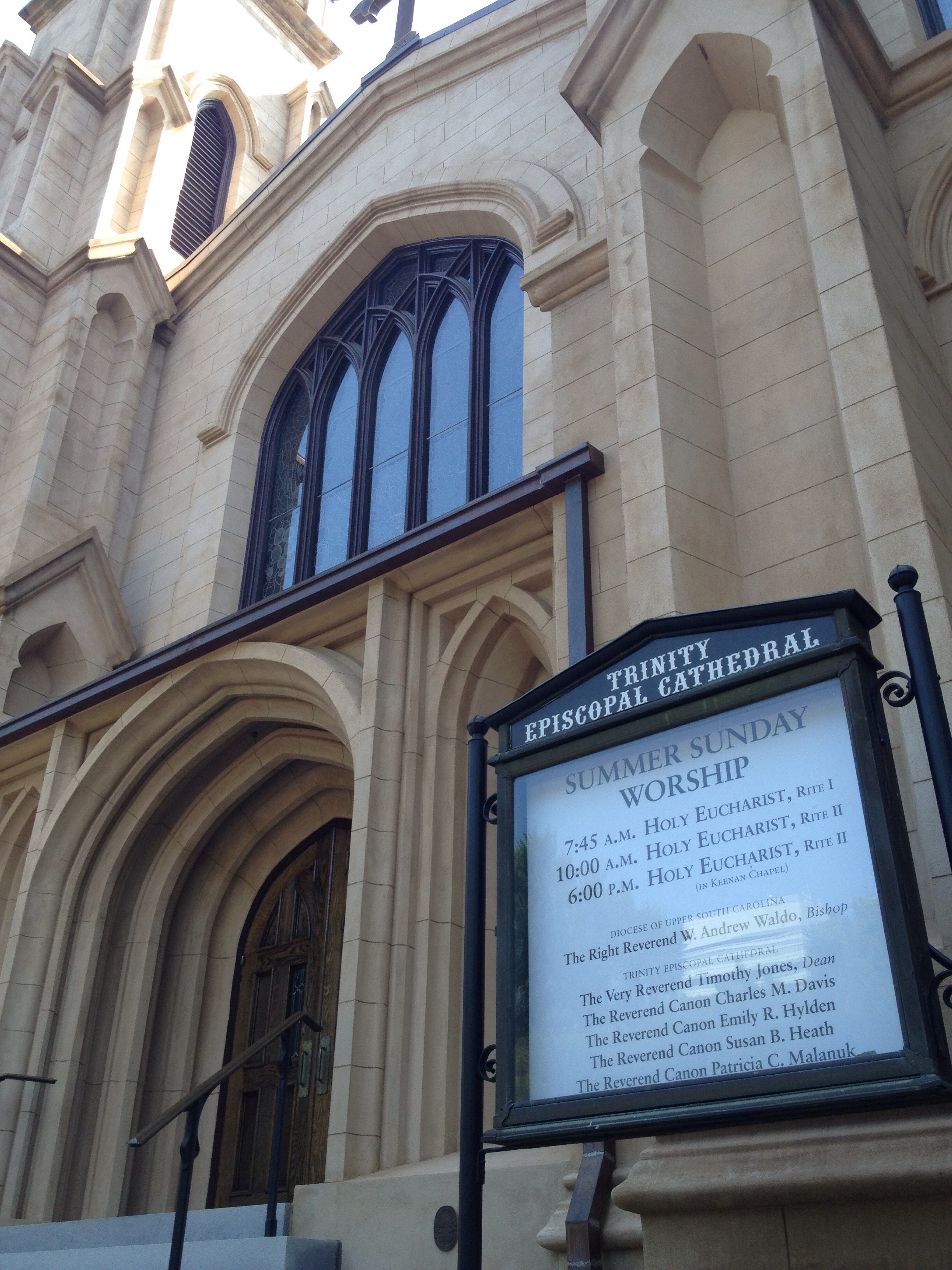
Today we celebrate All Saints.  There are hundreds of faithful Christians who have passed through these doors, many we remember as living hard, holy lives devoted to Jesus.  There are thousands more, through the last 200 years at Trinity, and millions throughout the world, who has been called saints by God because of their holy lives, oriented completely toward Jesus.  We do not remember, nor could we ever know, all their names.  But God has recognized them, and that is the only lasting remembrance.

After these buildings crumble and the plaques are tarnished, after the communion kneelers disintegrate and the endowment runs out, though our names and the names these parents give their children as they are baptized today will disappear and be forgotten by future generations, may we so fight to live lives that only make sense in the sight of Jesus’ resurrection; that our reward may be God remembering our name when we see him face to face one day.

The Blood of the Innocent

“34 Your clothing is stained with the blood of the innocent and the poor,
though you didn’t catch them breaking into your houses!
35 And yet you say,
‘I have done nothing wrong.
Surely God isn’t angry with me!’
But now I will punish you severely
because you claim you have not sinned.”

(Jeremiah 2:34-35)

Where were your clothes made?  Who died to provide you with fashions to cover your body?  Whose blood is on the everyday comforts with which you surround yourself?

In the Psalms class this semester, we’ve been struggling with the sometimes-judgmental and sometimes-angry God we seem to be facing in those poem-prayers.  It’s been hard to face up to the fact that the living God is more than a comforting Teddy Bear.  Let us not try to castrate our God, the Almighty Father, Son, and Holy Spirit.

The first chapters of Jeremiah make clear that God’s wrath is on those who are unrepentant and who lie to themselves, saying they are righteous and faithful when they are full of rotting sin.  2:22, “Though you wash yourself with lye, and use much soap, the stain of your guilt is still before me, says the Lord God.”  (RSV)  We live without intent and without reflection, we trample those who cannot pick themselves up, and we are culpable for our transgression.  It’s not pretty, but is it true.  Would we really even want to worship a God who wasn’t livid at this sort of treatment of the poor and downtrodden?