
The Mistake of the Mustard Seed – Trinity Cathedral

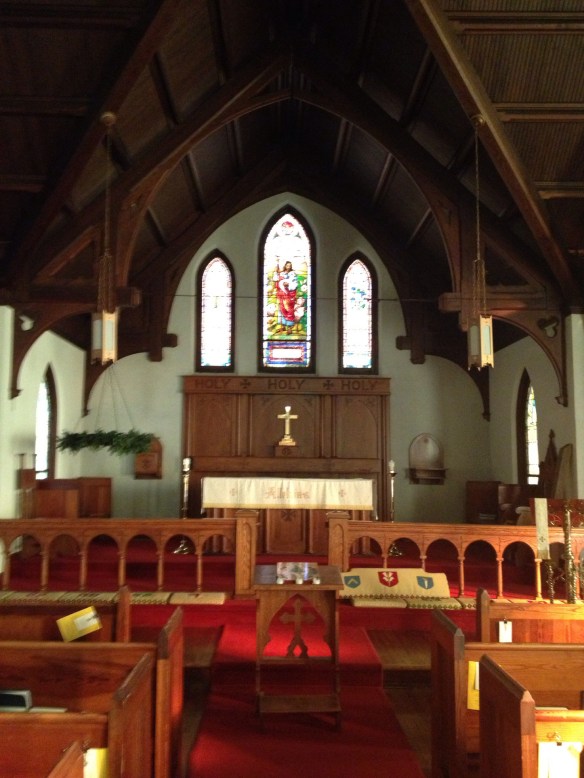
20131005-220716.jpgIn the Gospel lesson today, Jesus says, “‘If you had faith the size of a mustard seed, you could say to this mulberry tree, ‘Be uprooted and planted in the sea,’ and it would obey you.'” (Luke 17:6)

The mistake is to think that it’s about us.  It’s not about our lack of faith, or the struggles the disciples were facing, asking the Lord, “Increase our faith[!]” (Luke 17:5); it’s not that our hope in the living God measures up to less-than-a-mustard-seed’s worth in the scheme of things.  This passage is one time of many throughout all Scripture in which God explains how things work in his kingdom–in the place he wants our hearts to dwell.

Prophets throughout the Old Testament say again and again, “repent!  turn back!”  And they tell the people to whom they preach that it takes only a little shift to bring God rushing in.  God is waiting at the gates, calling out for us, waiting for us to throw him just a mustard-seed’s-worth of trust, and he will burst open the gates and make things change which seem impossible–even things like moving trees and mountains.

There’s another piece to this Gospel lesson today, and it has to do with the way that God’s kingdom works, too.  The reality that we see with our eyes every day isn’t the whole story of the world.  We learn in Scripture, and often through our experience, that there’s a lot more going on than what we can pick up just by looking around.  Living in this broken, mysterious world, we are used to thinking that power means big chairs and high buildings and offices with lots of windows.  Jesus tells us in our Gospel lesson today that power in God’s kingdom looks nothing like that at all.  By his difficult words about the obedient slave, he shows us the example that he himself will live out when he washes the disciples’ feet.  The least among us will be the greatest.  Those who humble themselves will be exalted.  Grabbing for power is helpful for this life, but giving up power is helpful for eternal life.  We’ve been hearing this message again and again through the last months’ readings, last week we heard about the Rich Man and Lazarus, recently, the Epistle to the Hebrews was exhorting us to hang on to those invisible things that are eternal.  This is the Christian faith.  Giving up our grabby attitude toward power, and turning, even just a little bit, toward our Lord.

Timothy, who is a Christian sort of like you and me–he never met Jesus, and wasn’t one of the “12 disciples”–he was just a normal Christian leader, trying to figure out how to be faithful. He is encouraged  in our Epistle lesson (2 Timothy 1:1-14) this morning, to claim the gift of God he was given through the laying on of hands.

Each confirmed Episcopalian in this room has had the hands of a bishop on his or her head (and you can trace the hands that were laid on our Bp. Waldo, or any bishop, back to who laid their hands on him, and back all the way to Jesus and the disciples!).  You have received this gift of faith; you have turned, even if just a little, toward God, and God has rushed at you!  Of course, you don’t have to go through Confirmation for God to know that you’ve turned toward him; just telling God so, asking him to fill you with his Holy Spirit and his power is all you need.

I know I’m sounding a little Evangelical here, but that’s how I was raised, and anyway, we’re in the South, revivals still go on here every autumn.  Though Confirmation and some versions of “getting saved” are one-shot deals, stepping into a lifestyle that acknowledges and even assumes God’s kingdom is not a one-time faith door-buster.

We turn away from God again and again, and must turn back toward Him just as many times.  We so easily forget that in the world that God rules, in His kingdom, success isn’t measured by where we live, or the sorts of vacations we can afford.  In God’s kingdom, which exists right alongside and tangled up with the parts of the world that have turned away from God, we are encouraged to rely on the power of God, to preach always to everyone the Good News that Jesus Christ is risen, that we need not suffer eternal death.

We are to live with the awareness that the Holy Spirit wants to always work in and through us to help others realize and understand the truth and power of our living God.  We strive to discern God’s voice, and to obey it.

St. Francis Day Sermon – Trinity Cathedral

20131004-110147.jpgA St. Francis situation has developed at my house recently.  For three years, I’ve owned an imposing and sweet German Shepherd named Benedict (yes, after the last pope–but the joke doesn’t end there).  About two weeks ago, an adolescent kitten, black with a white belly and feet, started showing up on our front porch; the dear thing was rather malnourished, and suddenly our old neighbor’s words rang in my head: before he moved a month ago, he told us about a black outdoor kitten he’d just had neutered, who he hadn’t seen for a few days.  This hungry little animal must be the same one.

20131004-103840.jpg

We started feeding the dear cat, I named him Francis, after the current pope, and we embarked on a journey of tending two pets who couldn’t be trusted together.  I’m not sure what it means for the future of the Roman Catholic Church that the two most recent popes namesakes’ cannot exist in the same space together in our home, but my allegation that we Hyldens have a St. Francis situation on our hands isn’t about animals so much as it is about living together.

You see, St. Francis is famous for his devotion to animals.  He’s almost always depicted with a bird or other critter, and many of the apocryphal stories about his life and miracles include animals as main characters and beneficiaries of his witness.  Indeed, in our courtyard here, just outside the doors of the chapel, we have a St. Francis statue, surrounded by cement fauna.  This obsession with St. Francis and animals misses the point, though.  Francis started a holy order for men, the Franciscans, as well as a companion order for women, called the Poor Clares; he was a great preacher, teacher, and missionary; it is even said that he received the stigmata, that is, the marks of Christ’s suffering on his own body, during a vision near the end of his life.  Francis’ association with animals is less about the animals themselves, though he clearly cared deeply for all of creation, and more about what his devotion communicated about God.

My dog, Ben, has white-and-black Shepherd markings, not the black-and-tan you most often see on that breed.  This coloring makes lots of people who see him joke, “and what percentage of wolf does he have in him?”  To those who don’t really know him, he looks frightening–and that’s why I got him in the first place–but we have hope that he and Francis can grow to be friends because we know that he is a sweet, soft-hearted dog.

In a similar-but-opposite way, St. Francis looks docile and perhaps even ineffective in his sweet pastoral scenes surrounded by animals, but in reality, he is revered by many as the most Christ-like of any saint in our church’s history.  To associate him only with animals is to ignore the heart of who Francis was and what his example offers to us.  He was converted by a sermon he heard on Matthew 10:7-10, which states, “‘And as you go, preach, saying ‘The kingdom of heaven is at hand.’  Heal the sick, cleanse the lepers, raise the dead, cast out demons. Freely you have received, freely give.  Provide neither gold nor silver no copper in your money belts, nor bag for your journey, nor two tunics, nor sandals, nor staffs; for a worker is worthy of his food.'”  He understood Jesus’ charge to his disciples as aimed at all Jesus’ disciples throughout time and space, even to Francis himself, even, perhaps, to us today.  Francis took this command to heart, and traveled, preaching and teaching his whole life by both word and example.  He told anyone who would listen about the way that God had taken charge and changed his own life, he preached to people who didn’t listen.  Francis preached to everyone, all the time.  Francis even preached to animals.  He was rabid in his proclamation of the gospel to every person and thing that crossed his path.

Francis and his animals aren’t so much about animals needing God’s blessing, but about the charge which we receive, which Francis also received and responded to, which is to preach the Gospel all the time, to everyone, everywhere.  God, in Jesus Christ, came to live with humans so that we might know God’s love in the most personal way; we are witnesses to this love.  Dear friends of mine started the Community of the Franciscan Way in Durham, North Carolina; those with jobs who live in the house provide food, shelter, and companionship to people who have no other place to stay.  Those with no other place to stay are not required to live by the rule of life followed by the others living in the community, nor are they compelled to stay any longer than they wish.  The point is to live in complicated relationships, not trying to change others (but perhaps praying that you yourself would be changed).  May we follow the example of Francis, becoming so famous for our incessant preaching of the living God, that we, too, are forever remembered for talking so much that we talked to animals.

Morning Prayer & I-85 Exits

Back in June, when I made my first voyage back to my hometown* (Durham), about ten minutes out from my best friend’s home, I realized that we NEEDED cheese for our Sunday night repast. Flipping my brain quickly into cheese-emergency mode, I thought, “Must get to Whole Foods (only cheesey place open on Sunday nights). Where am I now? How to get there fast?” And my brain then did a very funny thing. It shut off. I exited the interstate, and my arms felt like they were moving themselves, turning the wheel; my foot had a mind of its own, pressing the brake and the gas. And then, I turned up in the Whole Foods parking lot–presto! What a strange thing to happen, I thought, that my brain wouldn’t do the think-through-the-map-you-keep-stashed-in-your-mind, calculating distances and times and the length of stoplights…

It dawned on me: my brain had done that exact thing so many times on those exact streets that it didn’t need to think anymore. Living in St. Louis, and now in Columbia, I can get around very well, but my mind is constantly calculating and reorienting itself to remember where things are located and how the streets line up. My mind didn’t have to think through routes from here to there because it’d been making that route in my brain so long, through so many seasons of road construction and rain, that my body–in a way–just knew how to get where I wanted to go.

It wasn’t like that in the beginning, back in 2004. I knew one way to get from point A to point B, and though it may have been super-inefficient, I wasn’t going to abandon that route for anything. Gradually, I added more mental map and I colored in the way traffic affected roads at various times of day–eventually, I knew the roads so well, they were just part of me, my arms and legs could take over.

Back in 2008, I prayed Morning Prayer for the first time. I was in one of the hard, straight-backed wooden pews at St. Joseph’s Episcopal Church in Durham. I didn’t know which page we started on, I didn’t know how to choose readings or canticles or collects (or exactly what “collects” were) or when to stand or kneel. It was uncomfortable and foreign and not very enjoyable, but it was required for Confirmation, which I’d decided to undergo for some reason, and so I mouthed the words and listened.

20130925-173749.jpgI was committed to leading one of the Daily Offices (Morning, Noonday, Evening Prayer, and Compline) every week of the academic year, which roughly lined up to our time as catechumens, preparing for Confirmation in the Episcopal Church. Further, we were to pray this set of Offices every day by ourselves, if we didn’t show up at church for it. I was overwhelmed and a little bit rebellious. I didn’t stick with it well at all over winter break that year. By the next summer, a newly minted Episcopalian for just over a year, my field education supervisor expected me to pray Morning Prayer with him every day in our parish’s chapel, and though I felt a bit rebellious here too (when I led, I used contemporary language), I think that is when I fell in love with the Daily Office. Those weeks cemented something in me; some mornings I almost cried through the prayers, I was so tired, so humiliated, so lonely. But every morning, those words were there again, and in a way, that time and place–8 a.m. in St. Agnes’ Chapel–became sacred and became home.

I returned to Durham and to St. Joe’s that autumn, to the people and place that had already been with me through plenty of change and confusion. Morning Prayer was no longer a burden, a commitment that I’d made and felt imprisoned to keep, but a joy and delight–a place and time where I kept meeting God in the words I said and heard.

A little more than a year ago, I arrived late to a service of Morning Prayer in the parish I was serving in Missouri; I jumped right into the canticle being recited, and then I just forgot to pick up a prayer book. The rest of the service had hidden itself in my memory and in my heart. My brain turned off and the words easily came out of my mouth. Just like my body knew exactly how to drive my car to the grocery store, my heart practiced and found its way to God in Morning Prayer.

Years ago, when I started eating breakfast at St. Joe’s with who ever showed up for eggs and grits, they gave me a key, for the mornings that I’d be the first one there to start the coffee.  I still keep that key on my key chain to remember the place and people who re-introduced me to Jesus.

Last week, a dear friend of mine said, “Sometimes big things are the easy things to be courageous about; the little things are hard.” Why can we commit to things like marriage and jobs, but find it so difficult to commit to something like daily prayer, Scripture memorization, or keeping up with pen pals?

(postscript: this is the community now)

Psalm 131 Mash Up

20130925-095507.jpgHebrews 12:1-2 “Therefore, since we are surrounded by so great a cloud of witnesses, let us also lay aside every weight and the sin that clings so closely, and let us run with perseverance the race that is set before us, looking to Jesus the pioneer and perfecter of our faith, who for the sake of the joy that was set before him endured the cross, disregarding its shame, and has taken his seat at the right hand of the throne of God.” (NRSV)

Psalm 131 is a prayer, describing the thing we’re urged to do in this passage from Hebrews, “lay aside every weight.”  This psalm ought to be read, I think, as a plea to God for the truth of the words being uttered–it’s more prophecy than observation of present circumstances.

(1) O Lord, I am not proud, I have no haughty looks.

(2) I do not occupy myself with great matters, or with things that are too hard for me.

(3) But I still my soul and make it quiet, like a child upon its mother’s breast; my soul is quieted within me.

(4) O Israel, wait upon the Lord, from this time forth for evermore.

(via the Book of Common Prayer)

Jesus came because our sin is too heavy for us, because He can and does carry it himself.  Our propensity to turn away from God is too great to overcome ourselves, we must, in humility, lay aside the weight of making our own salvation happen again and again.  All to Jesus I surrender.

Through that laying down, through truly letting go of trying to control or to work ourselves into righteousness, our souls become quiet, our souls and our selves thereby inhabit the place we’re made for–we’re rightly out of the driver’s seat, listening, and being quiet.  We’re being, or practicing being, the humans that we are.

We Gentile Christians are grafted into Israel because of Jesus’ sacrifice, and just as people have waited on God for centuries–thousands of years, even–our occupation is to wait upon the Lord.

A Psalm 131 Rewrite:

Lord, keep us from being proud, and from looking down our noses.

Help us to remember that You are God, You are almighty, and we only need to be servants.

Quiet our hearts before You, drown out voices of worry and despair; relax our frazzled minds into trust in You, let us feel your hands holding us up.

Throughout all time, O Master, your servants have listened to your directions.  We now join with your witnesses from all time, waiting for Your coming again.

In the name of Your Son, our Savior Jesus Christ we pray, Amen.