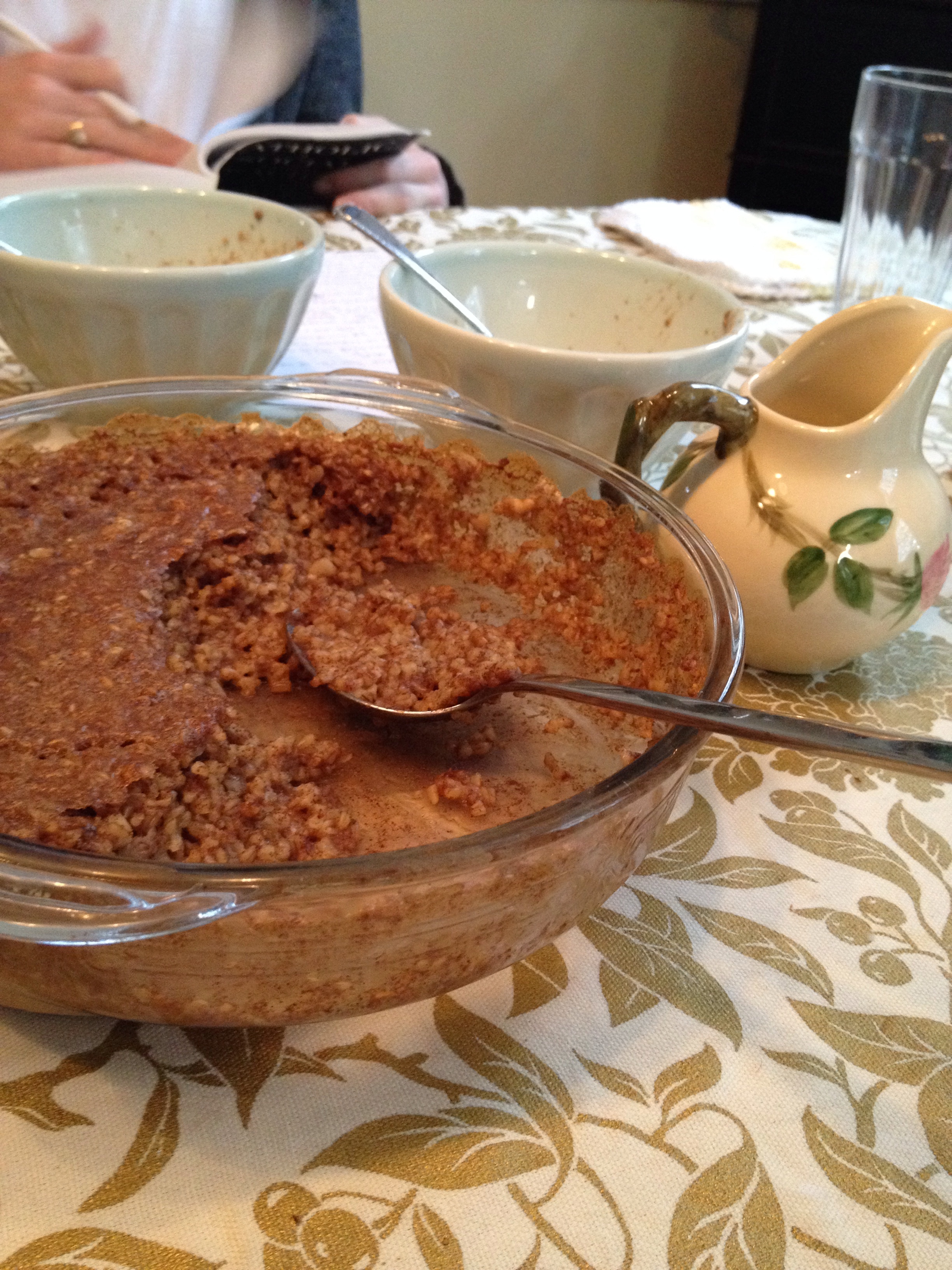
The Definitive Refectory Baked Oatmeal Recipe

20140129-122128.jpg

Isn’t this how problems are usually solved?  You study the problem, consider the issue from all angles, perhaps even try a few solutions, but you never quite get it right till you walk away and then come back to the problem again later (okay, not always, but sometimes that’s true, and it was definitely true with respect to this long-sought-after recipe).

Six years after graduating, I have finally cracked the Baked Oatmeal code of the (now-defunct) Refectory recipe.  The secret, as released last week on Facebook, is steel-cut oats.  In hindsight, I should have tried swapping them out for the oft-called-for old fashioned rolled oats years ago; the texture of my attempts were never quite chewy enough, and you never could really differentiate the classic rolled-oat-shape in the Refectory original.  Without further ado, with two methods:

Ingredients:

1 1/2 cups steel-cut oats

1 1/2 cups water

1 cup milk (extra for serving)

1 egg

1 teaspoon baking powder

pinch of salt

1/4 cup sugar (extra for serving)

1 teaspoon – 1 Tablespoon cinnamon (extra for serving)

Methods:

Overnight method – combine oats with water, egg, sugar, salt, and cinnamon in a large bowl, cover and refrigerate overnight.  In the morning, preheat oven to 350 degrees, add milk and baking powder to the oats, and pour into an 8×8, 9×9, or pie pan.  Bake for 25 minutes, till brown on top.

Morning method – combine oats with water and boil till water is absorbed.  Pour oats into a large bowl, add milk, sugar, salt, and cinnamon.  When oat mixture has cooled somewhat from mixing the other ingredients, add the beaten egg and the baking powder.  Pour into baking dish and bake at 350 degrees for about 25 minutes.

Relive college.

Making Bread: A Magical Recipe for Cinnamon Swirl

20131217-092242.jpg

(photo including said-bread.  shot from yesterday’s breakfast-in-bed, thanks to sweet husband)

Today, I’m doing a lot of bread-sharing, so while I’m celebrating with many dear people on this feast of St. Lucy, here’s a recipe I made last night for cinnamon swirl bread.

As any devoted American Girl knows, the Scandanavian way to celebrate December 13th is to don a wreath of lit candles and to serve one’s family delicious baked goods (or at least, that’s what Kirsten taught us…).

Having just recently finished a book in my favorite genre (memoir-and-recipes), and having the charge of reviewing it (therefore being totally required to make at least one recipe in it), I present Milton Brasher-Cunningham‘s “Refrigerator Rolls”-dough-with-Emily-tweaks-into-Cinnamon-Swirl-Loaf!  Viva Lucia!

Cinnamon Swirl Loaf (makes 2 generous 9×5″ loaves)

In a huge bowl combine: 4 cups warm milk, 1 cup sugar, 1 stick of butter, 1/2 cup vegetable oil and 1/2 cup water.  Once the butter is incorporated (but mixture isn’t hot), sprinkle 4 1/2 teaspoons (or 2 packages) yeast onto the liquid and let the mixture sit and foam.

Once you see the yeast working, add 8 cups of flour–a mixture of white and whole wheat gives some texture (I used 3 cups white whole-wheat and 5 white; Milton uses 7 white and 1 whole wheat).  Add the flour gradually to incorporate it well.  Cover the dough and let the it rest (I put mine on top of my warm oven) and grow till doubled–make sure you use a very large bowl!

After it has doubled in size (it always takes longer than it seems like it should–I try to forget about it rising, because there’s no such thing as leaving it to rise for too long the first time), mix in another cup of flour, 3 teaspoons salt, 2 teaspoons baking powder, and 1 teaspoon baking soda.  Cover the dough and let it rise again (at this point, I put the dough in the refrigerator–it will keep rising in there, just at a much, much slower rate).

If you’ve put the dough in the refrigerator to rise, take the dough out to warm up a few hours (even in the morning, if you’re making the bread in the afternoon or evening) before you plan to bake.  At this point, Milton makes dinner rolls or sweet rolls; I divided the dough into 2 portions, covering my counter with a generous helping of flour (this is very loose, sticky dough) and folding it just enough to make sure it wouldn’t fall apart.  Stretch out one portion into a rectangle about 9 inches by 14 inches.  Cover the face of the dough with 1/3 cup sugar, 3 tablespoons cinnamon, 2 teaspoons ground ginger, and any other spices that appeal (I also used Penzey’s Chinese Five Spice Powder), drizzle with 2 tablespoons real maple syrup.  If you would like, sprinkle the sweet filling with 3/4 cup chopped walnuts, and then carefully roll the dough, using a short end as your starting point.  Once you have rolled the dough up, drop it into a sprayed 9×5″ baking pan with the seam down.  Repeat with the other portion.

Let the bread rise while the oven heats up to 425 degrees, about an hour, and then bake the loaves for 40-55 minutes, until brown and hollow-sounding.  Let cool and enjoy!

Our Deepest Gratitude

Around many tables this afternoon, probably at the table where you’ll be sitting, a moment will come when each person will be asked to reflect and recount the things for which she or he is thankful.

Some people do this all year round, a friend of mine thinks of three specific things he’s grateful for before he lets his feet hit the floor in the morning.  I know a few people who keep gratitude journals, jotting down events, or people, or moments during the day.  The journals let them look back and remember these treasured moments in the following weeks and months, which makes them feel grateful again–because they’ve probably forgotten those little fleeting gifts in the interim.

It seems that for us humans, it’s often much easier to remember negative things than positive things.  Look at the ancient Hebrews–I don’t mean to pick on them as exemplary in this area, because they certainly aren’t–the Bible is made up of common life examples, situations in which any person would do the exact same thing.  As God’s people are wandering around in the desert, they complain to Moses–do you remember those stories?  They’ve just seen God’s protection of them at the Red Sea, cutting off the Egyptians from pursuing them, and with the image of the great waves crashing over the heads of their enemies still burned into the backs of their minds, they turn to Moses and say, “Are we there yet?!  We’re going to DIE out here!!  This is absolutely HOPELESS.  We should go back to Egypt.  Let’s take a poll–who wants to go back to Egypt??”  It sounds a little like the back of my mom’s minivan on the way to summer vacation.

Do you remember what happens next?  Our Gospel lesson alludes to it; God provides food for them in the wilderness by raining down manna on them.  The manna is something that can be baked into bread which the Hebrews gather up every morning when they wake up–it falls and rests on the ground overnight, like dew, the Bible says; maybe something like the frost we experienced on our lawns this morning.  The word “manna” in Hebrew translates as, “What is it?”  Its substance is mysterious, we don’t know exactly what it is, even today.  But in another way, we, as well as the Hebrew people, know exactly what it is–it’s a blessing, it’s a witness to God’s love and care.  So the Hebrew people gather up these little scraps that remind them how much God loves them and cares for them.

What is our gratitude except Manna?  The journals my friends keep are proverbial baskets full of manna, pages and pages of reminders of God’s goodness and love toward us.  Our greatest gift which God sends from heaven as a symbol and reminder of his love is Jesus Christ, his only Son, God incarnate.  In today’s Gospel lesson, some people ask Jesus, “What sign are you going to give us then, so that we may see it and believe you?  What work are you performing?” (v.30)  Do you recognize the skepticism?  Maybe first-century people aren’t so different from people today.  “How can you prove that God exists?”  “How do you know that Jesus is God?”

Jesus responds to his interlocutors that it was God who was behind the manna their ancestors ate, as they well know; and besides, God has provided for them the true bread which is standing right in front of them.  They’ve already seen signs–their ancestors witness to them about the manna provided in the wilderness.  The actual eyes beholding Jesus in first-century Capernum didn’t see the manna falling, or ingest it into their own bodies, but their very existence was evidence that their ancestors hadn’t starved in the wilderness, but that they’d been sustained by something–by manna, the children and grandchildren and great-grandchildren were told.  And so, these children generations later knew and trusted that the manna had fallen and had been a tangible testament to God’s care for His people.

It’s the same for us.  We haven’t seen Jesus in the way that the people in our Gospel lesson today did; we haven’t seen Jesus the way that Paul did on the way to Damascus or Jesus’ disciples did after his resurrection.  But we know Jesus came, and lived, and died, and rose again because we have our ancestors’ witness to those events.  We stand on the shoulders of our great-grandparents in the faith, trusting their testimony about the God made human in Jesus Christ.  Further, because we exist as Christians and children of God, we ourselves are witnesses, we are a testament to God’s love and power.

Our great-grandfather-in-the-Faith, G.K. Chesterton said, “The test of all happiness is gratitude; and I felt grateful, though I hardly knew to whom.  Children are grateful when Santa Claus puts in their stockings gifts or toys or sweets.  Could I not be grateful to Santa Claus when he put in my stockings the gift of two miraculous legs?  We thank people for birthday presents of cigars and slippers.  Can I thank no one for the birthday present of birth?” (Orthodoxy)

Chocolate Coconut Macaroons

Entertaining a dairy-free friend a few weeks ago (and knowing that Smart Balance, though awesome, doesn’t melt into pastry very well), I took the deep plunge into gluten-free/dairy-free baking.  What better than chocolate and coconut to soften the no-butter, no-flour blow?

They were so delicious, there aren’t even any photos.

(super adapted from Martha Stewart Cookies)

Chocolate Coconut Macaroons

Combine 2 1/2 cups shredded coconut (unsweetened, if possible), 1/3 cup cocoa powder, 1/4 cup sugar, and 2 egg whites (egg-white-beaters–in the carton–are great).  Best to mix with hands, as it’s a sticky, strange batter given to clumping.  When thoroughly combined, wash hands, line a cookie sheet with parchment, and preheat oven to 325 degrees.

Wet fingers (perhaps fill a small bowl with water to facilitate a little finger dip while shaping the macaroons) so that the batter doesn’t stick (as much…) and mold 1-tablespoon servings into balls, pyramids, or whatever inspires you.  Place on cookie sheet at least 1 inch apart (you can pack them in pretty well–usually all on one sheet), and then bake for 16-18 minutes, rotating the pan halfway through.

Let cool–at least a little bit–and enjoy!  Next batch, I’ll try to snap a photo before devouring them…

Harry Potter Life Lesson #3

Wizards know how to party.  Did you notice that in the Harry Potter series?  A favorite cafe of mine in St. Louis boasts from its bakery case, “Treacle Tart: A Favourite of Harry Potter’s.”  Each of the seven books provided a sort of liturgy–that is to say, as reader, you knew what to expect at the outset of each new volume: we’d open with Harry away from school, then he’d go to school, then everyone would attend a feast.  Adventures abound, and then would come winter finals, and a Christmas feast.  More adventures, some stress, mounting tension over the great quest of the year, and then an Easter week feast.  A climax, a resolution, the end of the school year…

Why bother with these feasts, or with including meals at all?  On a more detailed level, where do our heroes meet before (almost) every Quidditch (a wizard sport) match?  They meet early in the Great Hall to eat.  Where do our heroes trudge before classes and between exams?  To the Great Hall.  To eat.  (TOGETHER).

For aficionados of the Harry Potter series, one of the most vivid sites at Hogwarts is that of the Great Hall, the gathering place for the community, the place where everyone eats together.  During Ron & Hermoine’s months-long fight, they still sit together and eat (in silence) at the Gryffindor table in the Great Hall.  As a sort of reset button and a moment that can be counted on, the feasts of Hogwarts (and at times, the characters’ homes and camp sites) provide a figurative space set apart.  Worries are forgotten during meals, people are most able to keep their mental demons at bay–those eating together pull each other into the present, allowing moments of enjoyment and peace in the midst of the battles against evil which creep ever closer throughout the series.

Something happens to relationships when humans eat together.  The wizards celebrated, mourned, and counted time by their meeting to eat.  We do the same thing, sometimes (not as often as we did, perhaps, in times past), but I wonder what would happen if we did it more of the time–if we recognized the power of sitting down in uncomfortable places and eating together.

It’s not a coincidence that JK Rowling included big, important meals in her series; I think she was reminding us of the power of sitting together at the same table and eating in spite of broken friendships, tragedy, or danger.  Continuing to show up at the table at the appointed time, even when you aren’t sure if your eating partners will, is a way we can be present for each other the way that God has been present to us already.

The wizards’ parties were a way to show their love and commitment to each other–it’s a celebration of their relationships–as well as a place that can offer a familiarity and safety in the midst of upsetting circumstances.  Whether you are with your loved ones at a glorious spread on fine china in a well-appointed dining room, at a diner late at night hunched over pie and coffee, or huddled around a fire outside eating something that the campfire burnt, it’s what happens in the moments you share, more than the food itself, that you remember and that encourages you–feeds you.