
Our Deepest Gratitude

Around many tables this afternoon, probably at the table where you’ll be sitting, a moment will come when each person will be asked to reflect and recount the things for which she or he is thankful.

Some people do this all year round, a friend of mine thinks of three specific things he’s grateful for before he lets his feet hit the floor in the morning.  I know a few people who keep gratitude journals, jotting down events, or people, or moments during the day.  The journals let them look back and remember these treasured moments in the following weeks and months, which makes them feel grateful again–because they’ve probably forgotten those little fleeting gifts in the interim.

It seems that for us humans, it’s often much easier to remember negative things than positive things.  Look at the ancient Hebrews–I don’t mean to pick on them as exemplary in this area, because they certainly aren’t–the Bible is made up of common life examples, situations in which any person would do the exact same thing.  As God’s people are wandering around in the desert, they complain to Moses–do you remember those stories?  They’ve just seen God’s protection of them at the Red Sea, cutting off the Egyptians from pursuing them, and with the image of the great waves crashing over the heads of their enemies still burned into the backs of their minds, they turn to Moses and say, “Are we there yet?!  We’re going to DIE out here!!  This is absolutely HOPELESS.  We should go back to Egypt.  Let’s take a poll–who wants to go back to Egypt??”  It sounds a little like the back of my mom’s minivan on the way to summer vacation.

Do you remember what happens next?  Our Gospel lesson alludes to it; God provides food for them in the wilderness by raining down manna on them.  The manna is something that can be baked into bread which the Hebrews gather up every morning when they wake up–it falls and rests on the ground overnight, like dew, the Bible says; maybe something like the frost we experienced on our lawns this morning.  The word “manna” in Hebrew translates as, “What is it?”  Its substance is mysterious, we don’t know exactly what it is, even today.  But in another way, we, as well as the Hebrew people, know exactly what it is–it’s a blessing, it’s a witness to God’s love and care.  So the Hebrew people gather up these little scraps that remind them how much God loves them and cares for them.

What is our gratitude except Manna?  The journals my friends keep are proverbial baskets full of manna, pages and pages of reminders of God’s goodness and love toward us.  Our greatest gift which God sends from heaven as a symbol and reminder of his love is Jesus Christ, his only Son, God incarnate.  In today’s Gospel lesson, some people ask Jesus, “What sign are you going to give us then, so that we may see it and believe you?  What work are you performing?” (v.30)  Do you recognize the skepticism?  Maybe first-century people aren’t so different from people today.  “How can you prove that God exists?”  “How do you know that Jesus is God?”

Jesus responds to his interlocutors that it was God who was behind the manna their ancestors ate, as they well know; and besides, God has provided for them the true bread which is standing right in front of them.  They’ve already seen signs–their ancestors witness to them about the manna provided in the wilderness.  The actual eyes beholding Jesus in first-century Capernum didn’t see the manna falling, or ingest it into their own bodies, but their very existence was evidence that their ancestors hadn’t starved in the wilderness, but that they’d been sustained by something–by manna, the children and grandchildren and great-grandchildren were told.  And so, these children generations later knew and trusted that the manna had fallen and had been a tangible testament to God’s care for His people.

It’s the same for us.  We haven’t seen Jesus in the way that the people in our Gospel lesson today did; we haven’t seen Jesus the way that Paul did on the way to Damascus or Jesus’ disciples did after his resurrection.  But we know Jesus came, and lived, and died, and rose again because we have our ancestors’ witness to those events.  We stand on the shoulders of our great-grandparents in the faith, trusting their testimony about the God made human in Jesus Christ.  Further, because we exist as Christians and children of God, we ourselves are witnesses, we are a testament to God’s love and power.

Our great-grandfather-in-the-Faith, G.K. Chesterton said, “The test of all happiness is gratitude; and I felt grateful, though I hardly knew to whom.  Children are grateful when Santa Claus puts in their stockings gifts or toys or sweets.  Could I not be grateful to Santa Claus when he put in my stockings the gift of two miraculous legs?  We thank people for birthday presents of cigars and slippers.  Can I thank no one for the birthday present of birth?” (Orthodoxy)
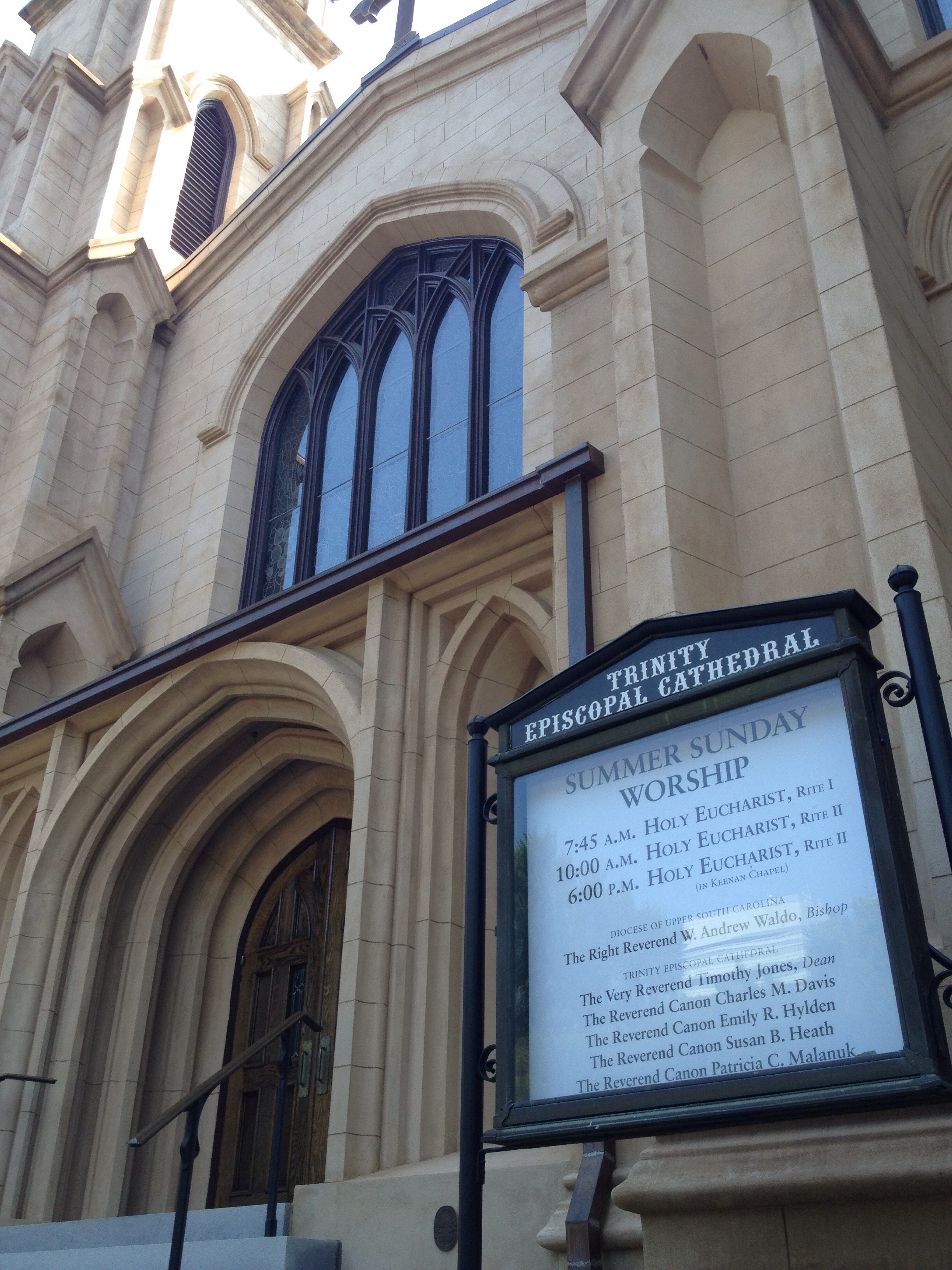
What is Your Name? – All Saints’ Sunday – Trinity Cathedral

20131102-211325.jpg

“22 ‘Blessed are you when people… cast out your name as evil because of the Son of Man… 26‘Woe to you when all men speak well of you.” (Luke 6:22, 26; NKJV)

Today, the celebration of All Saints’ Day, is a moment to consider our baptism.  In some of the services today, babies will come to be baptized, and when they are, their families will be told, “Name this child!”  My own middle name is for my great-grandmother, who died in May of this year; I think of her especially on this celebration of All Saints’ Day, as many of us remember people who have died in the last year who were holy beacons of Jesus’ love.  I’ve noticed since moving to the South that down here, many more people name their children after family members.  I even know a family who boasts something like seven generations straight of women with the same name.  Names still mean something down here, and that makes the name that God gives us all the more sweet.  The most important name that any of us could be called is “Christian.”  “Christian” means “little Christ,” or perhaps more colloquially, “imitator of Jesus.”

God is fond of giving people new names.  In the Old Testament, God changes people’s names at profoundly significant moments in their lives.  Just a few weeks ago, we heard the moment when Jacob’s name was changed to Israel.  Do you remember?  The reading from Genesis told us, “‘Your name shall no longer be called Jacob, but Israel; for you have struggled with God and with men, and have prevailed.'” (Gen. 32:28; NKJV) God changed Jacob’s name to Israel the night before Jacob was to meet his brother again for the first time in decades.  But to understand what’s significant about this name change, we should understand what the names mean: “Jacob” means “trickster,” and stories about tricksters are common throughout ancient literature.  Think about the wolf in Little Red Riding Hood, or the Hare in the parable about racing with the tortoise.  These characters don’t make friends, they are scrappy, and they have to stick to themselves because their only way of getting ahead in the world is at another person’s expense.  Jacob did that to his brother Esau, cheating his older sibling out of the blessing and riches which were meant for him; later, Jacob did it again to his uncle, stacking the deck so to speak, to make sure the sheep in his herd were the most hardy.  But here in Genesis 32, Jacob’s name changes–God comes near to Jacob and transforms him.  God changes Jacob so completely into a new person that his name can’t even be “trickster” anymore.  It’s changed to Israel, which means, “God fights.”  You might think of it as something like, “God fights for you”–I imagine that’s what Israel hears any time his name is said after it changes that fateful night.  God loves Jacob just as he is, trickster and all, but God loves Jacob too much to leave him that way.  God transforms Jacob, and gives him a new name with a new identity.  He’s no longer a “trickster,” but a person for whom “God fights.”

This happened to Paul, too, in the New Testament–the writer of those letters starts out with the name “Saul,” but when he meets Jesus on the road to Damascus, Jesus tells Saul that he’s got a new job to do now and it’s such a change that he needs a new name to go with it.  That’s how Saul becomes Paul.  We could think about it this way: Saul starts out with a sensible life–he’s a Pharisee, well-respected, super smart, the jock, the popular kid, the A+ student–he’s the top of everything, the wonderkid.  God comes along and stands in his path one day, and the great reputation that Saul has, his trophies he’s won and collected–this life Saul’s built–it comes undone and is remade by God into something that doesn’t make sense at all to Paul’s old friends.  Being transformed by the God we meet in the person of Jesus Christ means that we do strange things, like giving someone who’s cold our new, fresh, warm coat, not the old, smelly, ratty one.  We relentlessly forgive the person who continues to stand us up when we’ve made a date, or keeps hanging up on us when we call on the phone.  No matter how many times someone asks for a coat or a blanket, and no matter how many times someone hangs up on us, we give and we forgive one more time, every time.  These actions make no sense unless Jesus Christ is Lord; unless he is God incarnate.

No one is naturally generous or forgiving; developing holy habits takes lots of hard work, and it’s a hopeless pursuit unless the person is utterly devoted to the God revealed in the person of Jesus.  Every saint we celebrate today recognized God in the life, death, and resurrection of Jesus and committed their lives to that truth.  I heard someone say once, “People who are saints don’t know it until God himself tells them.”  Saints’ lives are transformed by the truth of Jesus; their first name is “Christian.”  God has re-named them.

Today we celebrate All Saints.  There are hundreds of faithful Christians who have passed through these doors, many we remember as living hard, holy lives devoted to Jesus.  There are thousands more, through the last 200 years at Trinity, and millions throughout the world, who has been called saints by God because of their holy lives, oriented completely toward Jesus.  We do not remember, nor could we ever know, all their names.  But God has recognized them, and that is the only lasting remembrance.

After these buildings crumble and the plaques are tarnished, after the communion kneelers disintegrate and the endowment runs out, though our names and the names these parents give their children as they are baptized today will disappear and be forgotten by future generations, may we so fight to live lives that only make sense in the sight of Jesus’ resurrection; that our reward may be God remembering our name when we see him face to face one day.

Healing in the Jordan River – Trinity Cathedral

2 Kings 5:1-15 & Luke 17:11-19

When you stepped over the threshold of the building you’re sitting in this morning, you left the United States of America.  You left American society.  Be not afraid! (have you heard that one before?)  You see–it’s more that you entered God’s Embassy than that you left American soil, but here, in the church, we are now on God’s turf.  Here, God’s rules carry the day, we are on holy ground that has been consecrated to be the place where we encounter God in the sacraments and are changed by our interaction with the Holy One.  The rules here are different than the ones we often follow outside these doors, the social customs are different here than the ones we’re used to following walking down the streets of Columbia, South Carolina.  These differences aren’t just nuances or quirks–there is significance to the way that God’s kingdom works; it’s sometimes in opposition to the way we’re used to behaving.

Here, in the Bible, we see dozens of accounts that show us the way that God desires for the world to look.  When we read holy Scripture together we learn about God’s kingdom, the world that we step into when we are in this holy place, the world that God desires for all of creation to become.  This morning, we read the story of Naaman, a powerful Syrian who is paradoxically, a sufferer of leprosy.  In the ancient world, leprosy was a disease the counted its victims among the weak, the marginalized; people with leprosy, as we saw in today’s Gospel lesson, were separated from society, ostracized.  Naaman, however, somehow manages to preserve his place of power despite this disease, though he clearly desires very much to be rid of the affliction.  Who is it that notices the skin lesions and suggests where he might seek treatment?  His Israeli slave girl–this nameless girl has a quotation in Holy Scripture, how strange that a being not even considered a real, full person by her society would get a shout out in the Bible.  She says that there’s a prophet in her home country who could definitely cure her master’s ailment.

Naaman goes to this holy man, Elisha, and parks his chariot outside Elisha’s front door.  Naaman clearly expects Elisha to dash out to his driveway and greet his Most Esteemed guest.  Elisha does nothing of the sort–he sends his servant out the front door with a message.  Naaman’s eyebrows raise, verse 11 says that he “became furious”–Elisha, this big-time prophet, was supposed to hurry out to the chariot and wave his hands about and shout in a loud voice.  Look at your Bible, it actually says that!

To add insult to injury, another low-life is now giving Naaman directions…  The messenger tells Naaman that if he will go and wash in the Jordan River seven times, he will become healed of his ailment.  Naaman grumbles.  Not only is the Jordan River a pathetic stream compared to the wide, beautiful rivers of Syria, but what sort of pathetic quest is a bath?  Couldn’t Naaman, the great military general at least prove his strength or daring or mental acuity in order to be healed?

For a third time, a servant corrects Naaman (I’m almost surprised that more slaves and messengers and servants aren’t killed or banished in this story!), saying in verse 13, “Well, sir, if you had been told to do something super impressive, you would have dashed right off to do it.  Why not go do this super easy thing?  We might even get back home in time to catch the end of the football game!”  Naaman takes a deep breath–I think he must be a very patient, and exceptionally magnanimous nobleman of his time–and agrees with the servant.  He makes his way down to the Jordan River, he immerses himself seven times–which is the Biblical number which means “complete” or “total”–and Naaman’s skin is made, it says, “like the flesh of a little child.”  “As smooth as a baby’s bottom,” if you’ll pardon the saying so early in the morning.

Did you catch that?  Naaman is in danger of societal death, perhaps even bodily death, depending on how bad his leprosy was, and Elisha sends him to be baptized in the Jordan River, which heals him.  Naaman, the Syrian, the foreigner, is made healthy and whole again by command of a holy man and the application of a bit of water.

Naaman has borne the insubordination and the humiliation of being directed about by his slave, Elisha’s messenger, and a servant; he has submitted himself to the “easy” task of taking a bath instead of showing his might and earning his reward.  He returns to Elisha–Naaman himself goes up and knocks on the prophet’s front door this time–and says, “Indeed, now I know that there is no God in all the earth, except in Israel; now, therefore, please take a gift from your servant.” (v. 15)  Naaman still wants to make sure he pays his debts and doesn’t leave himself beholden to anyone.  He’s got a reputation to uphold, and he can’t let it get out that he’s dependent on this holy man for his healing.

Elisha can sense when he’s being bought off, and will have nothing of it.  He doesn’t want an offering with psychological strings attached, God’s power is not for sale, and nor is the truth of God’s healing to be silenced with gold.  Naaman has learned–he’s been brought very low throughout this experience, and catches himself where he’s gone wrong.  He changes his request, asking instead that he might have some soil from Elisha in order to build an altar that Naaman himself might use for his worship of the Living God when he goes back to his own land.  I imagine Elisha finally smiled and nodded.

Naaman finally realized what the slave girl and the messenger and the servant had learned long ago because of their necessarily vulnerable place in society: you cannot do anything to insulate yourself from God.  Naaman tries to use his impressive strength and mind, desiring a more demanding cure, and then tries to use his money–all to keep God at arm’s length.  He finally learns that whether he pledges 2% or 55% to God, none of it is close to a repayment of the life that God, through the Jordan River, has given back to Naaman.

What would you pay for your life being saved?  We pay plenty to doctors and car makers and insurers and our government for protection, safety, and insulation from danger or dangerous circumstances.  God, through Jesus Christ, has saved us from eternal death.

Have you come back to Jesus’ feet, glorifying God and praising him with a loud voice?

The Mistake of the Mustard Seed – Trinity Cathedral

20131005-220716.jpgIn the Gospel lesson today, Jesus says, “‘If you had faith the size of a mustard seed, you could say to this mulberry tree, ‘Be uprooted and planted in the sea,’ and it would obey you.'” (Luke 17:6)

The mistake is to think that it’s about us.  It’s not about our lack of faith, or the struggles the disciples were facing, asking the Lord, “Increase our faith[!]” (Luke 17:5); it’s not that our hope in the living God measures up to less-than-a-mustard-seed’s worth in the scheme of things.  This passage is one time of many throughout all Scripture in which God explains how things work in his kingdom–in the place he wants our hearts to dwell.

Prophets throughout the Old Testament say again and again, “repent!  turn back!”  And they tell the people to whom they preach that it takes only a little shift to bring God rushing in.  God is waiting at the gates, calling out for us, waiting for us to throw him just a mustard-seed’s-worth of trust, and he will burst open the gates and make things change which seem impossible–even things like moving trees and mountains.

There’s another piece to this Gospel lesson today, and it has to do with the way that God’s kingdom works, too.  The reality that we see with our eyes every day isn’t the whole story of the world.  We learn in Scripture, and often through our experience, that there’s a lot more going on than what we can pick up just by looking around.  Living in this broken, mysterious world, we are used to thinking that power means big chairs and high buildings and offices with lots of windows.  Jesus tells us in our Gospel lesson today that power in God’s kingdom looks nothing like that at all.  By his difficult words about the obedient slave, he shows us the example that he himself will live out when he washes the disciples’ feet.  The least among us will be the greatest.  Those who humble themselves will be exalted.  Grabbing for power is helpful for this life, but giving up power is helpful for eternal life.  We’ve been hearing this message again and again through the last months’ readings, last week we heard about the Rich Man and Lazarus, recently, the Epistle to the Hebrews was exhorting us to hang on to those invisible things that are eternal.  This is the Christian faith.  Giving up our grabby attitude toward power, and turning, even just a little bit, toward our Lord.

Timothy, who is a Christian sort of like you and me–he never met Jesus, and wasn’t one of the “12 disciples”–he was just a normal Christian leader, trying to figure out how to be faithful. He is encouraged  in our Epistle lesson (2 Timothy 1:1-14) this morning, to claim the gift of God he was given through the laying on of hands.

Each confirmed Episcopalian in this room has had the hands of a bishop on his or her head (and you can trace the hands that were laid on our Bp. Waldo, or any bishop, back to who laid their hands on him, and back all the way to Jesus and the disciples!).  You have received this gift of faith; you have turned, even if just a little, toward God, and God has rushed at you!  Of course, you don’t have to go through Confirmation for God to know that you’ve turned toward him; just telling God so, asking him to fill you with his Holy Spirit and his power is all you need.

I know I’m sounding a little Evangelical here, but that’s how I was raised, and anyway, we’re in the South, revivals still go on here every autumn.  Though Confirmation and some versions of “getting saved” are one-shot deals, stepping into a lifestyle that acknowledges and even assumes God’s kingdom is not a one-time faith door-buster.

We turn away from God again and again, and must turn back toward Him just as many times.  We so easily forget that in the world that God rules, in His kingdom, success isn’t measured by where we live, or the sorts of vacations we can afford.  In God’s kingdom, which exists right alongside and tangled up with the parts of the world that have turned away from God, we are encouraged to rely on the power of God, to preach always to everyone the Good News that Jesus Christ is risen, that we need not suffer eternal death.

We are to live with the awareness that the Holy Spirit wants to always work in and through us to help others realize and understand the truth and power of our living God.  We strive to discern God’s voice, and to obey it.

St. Francis Day Sermon – Trinity Cathedral

20131004-110147.jpgA St. Francis situation has developed at my house recently.  For three years, I’ve owned an imposing and sweet German Shepherd named Benedict (yes, after the last pope–but the joke doesn’t end there).  About two weeks ago, an adolescent kitten, black with a white belly and feet, started showing up on our front porch; the dear thing was rather malnourished, and suddenly our old neighbor’s words rang in my head: before he moved a month ago, he told us about a black outdoor kitten he’d just had neutered, who he hadn’t seen for a few days.  This hungry little animal must be the same one.

20131004-103840.jpg

We started feeding the dear cat, I named him Francis, after the current pope, and we embarked on a journey of tending two pets who couldn’t be trusted together.  I’m not sure what it means for the future of the Roman Catholic Church that the two most recent popes namesakes’ cannot exist in the same space together in our home, but my allegation that we Hyldens have a St. Francis situation on our hands isn’t about animals so much as it is about living together.

You see, St. Francis is famous for his devotion to animals.  He’s almost always depicted with a bird or other critter, and many of the apocryphal stories about his life and miracles include animals as main characters and beneficiaries of his witness.  Indeed, in our courtyard here, just outside the doors of the chapel, we have a St. Francis statue, surrounded by cement fauna.  This obsession with St. Francis and animals misses the point, though.  Francis started a holy order for men, the Franciscans, as well as a companion order for women, called the Poor Clares; he was a great preacher, teacher, and missionary; it is even said that he received the stigmata, that is, the marks of Christ’s suffering on his own body, during a vision near the end of his life.  Francis’ association with animals is less about the animals themselves, though he clearly cared deeply for all of creation, and more about what his devotion communicated about God.

My dog, Ben, has white-and-black Shepherd markings, not the black-and-tan you most often see on that breed.  This coloring makes lots of people who see him joke, “and what percentage of wolf does he have in him?”  To those who don’t really know him, he looks frightening–and that’s why I got him in the first place–but we have hope that he and Francis can grow to be friends because we know that he is a sweet, soft-hearted dog.

In a similar-but-opposite way, St. Francis looks docile and perhaps even ineffective in his sweet pastoral scenes surrounded by animals, but in reality, he is revered by many as the most Christ-like of any saint in our church’s history.  To associate him only with animals is to ignore the heart of who Francis was and what his example offers to us.  He was converted by a sermon he heard on Matthew 10:7-10, which states, “‘And as you go, preach, saying ‘The kingdom of heaven is at hand.’  Heal the sick, cleanse the lepers, raise the dead, cast out demons. Freely you have received, freely give.  Provide neither gold nor silver no copper in your money belts, nor bag for your journey, nor two tunics, nor sandals, nor staffs; for a worker is worthy of his food.'”  He understood Jesus’ charge to his disciples as aimed at all Jesus’ disciples throughout time and space, even to Francis himself, even, perhaps, to us today.  Francis took this command to heart, and traveled, preaching and teaching his whole life by both word and example.  He told anyone who would listen about the way that God had taken charge and changed his own life, he preached to people who didn’t listen.  Francis preached to everyone, all the time.  Francis even preached to animals.  He was rabid in his proclamation of the gospel to every person and thing that crossed his path.

Francis and his animals aren’t so much about animals needing God’s blessing, but about the charge which we receive, which Francis also received and responded to, which is to preach the Gospel all the time, to everyone, everywhere.  God, in Jesus Christ, came to live with humans so that we might know God’s love in the most personal way; we are witnesses to this love.  Dear friends of mine started the Community of the Franciscan Way in Durham, North Carolina; those with jobs who live in the house provide food, shelter, and companionship to people who have no other place to stay.  Those with no other place to stay are not required to live by the rule of life followed by the others living in the community, nor are they compelled to stay any longer than they wish.  The point is to live in complicated relationships, not trying to change others (but perhaps praying that you yourself would be changed).  May we follow the example of Francis, becoming so famous for our incessant preaching of the living God, that we, too, are forever remembered for talking so much that we talked to animals.