Back in June, when I made my first voyage back to my hometown* (Durham), about ten minutes out from my best friend’s home, I realized that we NEEDED cheese for our Sunday night repast. Flipping my brain quickly into cheese-emergency mode, I thought, “Must get to Whole Foods (only cheesey place open on Sunday nights). Where am I now? How to get there fast?” And my brain then did a very funny thing. It shut off. I exited the interstate, and my arms felt like they were moving themselves, turning the wheel; my foot had a mind of its own, pressing the brake and the gas. And then, I turned up in the Whole Foods parking lot–presto! What a strange thing to happen, I thought, that my brain wouldn’t do the think-through-the-map-you-keep-stashed-in-your-mind, calculating distances and times and the length of stoplights…
It dawned on me: my brain had done that exact thing so many times on those exact streets that it didn’t need to think anymore. Living in St. Louis, and now in Columbia, I can get around very well, but my mind is constantly calculating and reorienting itself to remember where things are located and how the streets line up. My mind didn’t have to think through routes from here to there because it’d been making that route in my brain so long, through so many seasons of road construction and rain, that my body–in a way–just knew how to get where I wanted to go.
It wasn’t like that in the beginning, back in 2004. I knew one way to get from point A to point B, and though it may have been super-inefficient, I wasn’t going to abandon that route for anything. Gradually, I added more mental map and I colored in the way traffic affected roads at various times of day–eventually, I knew the roads so well, they were just part of me, my arms and legs could take over.
Back in 2008, I prayed Morning Prayer for the first time. I was in one of the hard, straight-backed wooden pews at St. Joseph’s Episcopal Church in Durham. I didn’t know which page we started on, I didn’t know how to choose readings or canticles or collects (or exactly what “collects” were) or when to stand or kneel. It was uncomfortable and foreign and not very enjoyable, but it was required for Confirmation, which I’d decided to undergo for some reason, and so I mouthed the words and listened.
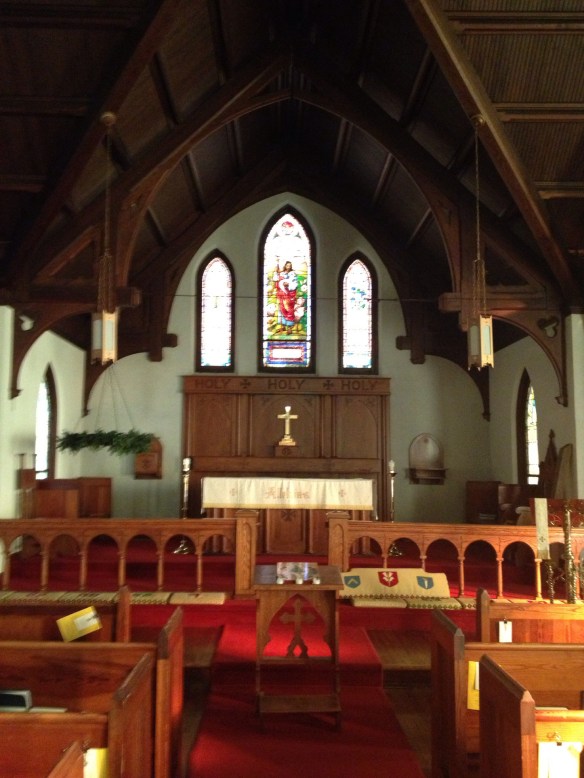 I was committed to leading one of the Daily Offices (Morning, Noonday, Evening Prayer, and Compline) every week of the academic year, which roughly lined up to our time as catechumens, preparing for Confirmation in the Episcopal Church. Further, we were to pray this set of Offices every day by ourselves, if we didn’t show up at church for it. I was overwhelmed and a little bit rebellious. I didn’t stick with it well at all over winter break that year. By the next summer, a newly minted Episcopalian for just over a year, my field education supervisor expected me to pray Morning Prayer with him every day in our parish’s chapel, and though I felt a bit rebellious here too (when I led, I used contemporary language), I think that is when I fell in love with the Daily Office. Those weeks cemented something in me; some mornings I almost cried through the prayers, I was so tired, so humiliated, so lonely. But every morning, those words were there again, and in a way, that time and place–8 a.m. in St. Agnes’ Chapel–became sacred and became home.
I returned to Durham and to St. Joe’s that autumn, to the people and place that had already been with me through plenty of change and confusion. Morning Prayer was no longer a burden, a commitment that I’d made and felt imprisoned to keep, but a joy and delight–a place and time where I kept meeting God in the words I said and heard.
A little more than a year ago, I arrived late to a service of Morning Prayer in the parish I was serving in Missouri; I jumped right into the canticle being recited, and then I just forgot to pick up a prayer book. The rest of the service had hidden itself in my memory and in my heart. My brain turned off and the words easily came out of my mouth. Just like my body knew exactly how to drive my car to the grocery store, my heart practiced and found its way to God in Morning Prayer.
Years ago, when I started eating breakfast at St. Joe’s with who ever showed up for eggs and grits, they gave me a key, for the mornings that I’d be the first one there to start the coffee. I still keep that key on my key chain to remember the place and people who re-introduced me to Jesus.
Last week, a dear friend of mine said, “Sometimes big things are the easy things to be courageous about; the little things are hard.” Why can we commit to things like marriage and jobs, but find it so difficult to commit to something like daily prayer, Scripture memorization, or keeping up with pen pals?
(postscript: this is the community now)

 A visitor comes in to the church at the 4pm service a little late–maybe only ten or fifteen minutes before the service begins; she hadn’t really committed to coming to church, but an urge had struck her an hour or so before, and she thought to herself, “if not at Christmas, then when?”, so she came.

 hope of things not seen