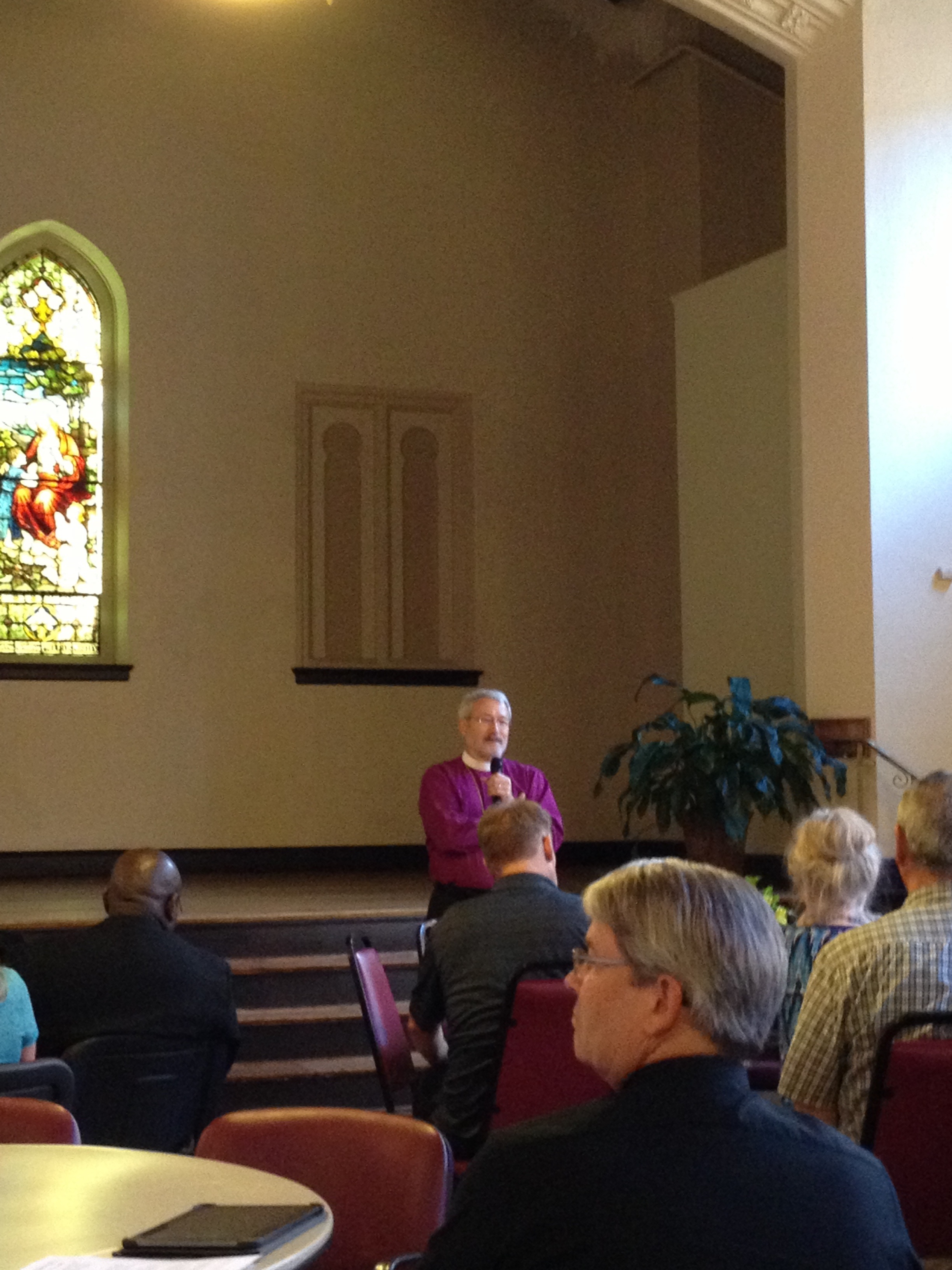
Bishop Waldo quotes Thomas Morely:
Worship is to “…draw the hearer, as it were, in chains of gold by the ears to the consideration of holy things.”
Worship as Formation at Trinity Cathedral
Reply

Bishop Waldo quotes Thomas Morely:
Worship is to “…draw the hearer, as it were, in chains of gold by the ears to the consideration of holy things.”
 Last weekend, I was in Cooperstown, New York. This is the place where I learned what it was to be a parish priest, where I fell in love with the vocation, and where I’ve been stretched and challenged within an inch of my life to do my best at that job. The places (geographically) where great pain is experienced and lived through are sites of enormous comfort. When I return to Cooperstown, or Grand Lake, or Durham, I feel like the rocks and trees and wooden siding of buildings understand me and are full of those powerful memories–they’re witnesses to the battles fought.
People are witnesses, too, of course, and they can be a comfort, but there’s something about buildings and mountains and lakes and particular bits of earth (on which one stands and remembers a vantage point) that is somehow deeper, perhaps because of their stability and unchangingness. The unsettling thing is that even cities, buildings, and bits of earth change. You remember your backyard growing up as a place of great meaning, but when you return to your childhood home decades later, it’s almost unrecognizable–the trees have grown so that the sun is not at all the same, the new owners have re-modeled the flower beds; it’s not the same place anymore, the place you knew is lost.
God promises, though, that he is the same yesterday, today and forever. In this week’s Epistle lesson, Hebrews 13:1-8, 15-16, we hear the witness of faithful people in the past who believed and trusted that, “Jesus Christ is the same yesterday and today and forever” (v. 8). This is what the church’s Gloria Patri says (“Glory to the Father, and to the Son, and to the Holy Spirit; as it was in the beginning, is now, and will be forever, amen.”).
The first part of Hebrews 13 recalls Abraham, Joseph, and the prophets by their faith-filled acts: Abrahahm “show(s) hospitality to strangers, for by doing that (he) entertained angels without knowing it” (v.2); Joseph was first sold into slavery, then was imprisoned unjustly (v. 3) but didn’t turn away from God because of his circumstances; and the prophets, fairly described as “those who are being tortured” (v. 3) exactly because they refused to turn from God–to renege on God’s promise of being unchanging himself.
“Let marriage be held in honor by all… for he has said, ‘I will never leave you or forsake you.'” (vs.4-5) The witness of Christian marriage is an effort at humans committing–in God’s strength–to be faithful to each other despite changes in themselves and their circumstances. This is the commitment that God makes to us–that he will never leave or forsake each of us, that he will be with us when we have no home like Abraham, or when we are isolated like Joseph, or when we are being persecuted like the prophets. God remains the same, even when we change and when our worlds change.
“Be present, O merciful God, and protect us through the hours of this night, so that we who are wearied by the changes and chances of this life may rest in your eternal changelessness; through Jesus Christ our Lord. Amen.”
(BCP service of Compline, pg. 133)

Psalm 37 knocked me off my feet this morning.
“do not fret yourself; it leads only to evil.” – today’s memory verse (v.9b, BCP)
I’ve been reflecting on my worry-wort habits recently, and keep resolving to find some verse to refocus my mind when it wanders toward the worry-wasteland. the resolutions have fallen flat till now–I have a verse! Therefore, today will be completely different (no, not really. today may be a little better, and tomorrow may be a little worse. we just keep trying, bringing our minds and spirits and intentions back again, and again, and again).
Entertaining a dairy-free friend a few weeks ago (and knowing that Smart Balance, though awesome, doesn’t melt into pastry very well), I took the deep plunge into gluten-free/dairy-free baking. What better than chocolate and coconut to soften the no-butter, no-flour blow?
They were so delicious, there aren’t even any photos.
(super adapted from Martha Stewart Cookies)
Chocolate Coconut Macaroons
Combine 2 1/2 cups shredded coconut (unsweetened, if possible), 1/3 cup cocoa powder, 1/4 cup sugar, and 2 egg whites (egg-white-beaters–in the carton–are great). Best to mix with hands, as it’s a sticky, strange batter given to clumping. When thoroughly combined, wash hands, line a cookie sheet with parchment, and preheat oven to 325 degrees.
Wet fingers (perhaps fill a small bowl with water to facilitate a little finger dip while shaping the macaroons) so that the batter doesn’t stick (as much…) and mold 1-tablespoon servings into balls, pyramids, or whatever inspires you. Place on cookie sheet at least 1 inch apart (you can pack them in pretty well–usually all on one sheet), and then bake for 16-18 minutes, rotating the pan halfway through.
Let cool–at least a little bit–and enjoy! Next batch, I’ll try to snap a photo before devouring them…
The trip I took was supposed to be a retreat. It was supposed to be a break from the everyday stresses of ministry. Instead, it made me oh-so-homesick…
The Double-Ivy sitting across from me at dinner waxed on about aspiring to have children–after business school was finished, of course–I couldn’t suss out whether there was any sort of partner in the picture, but quickly remembered that the real “problems” of family building these days weren’t whether there was an emotional support network or even a partnered relationship, but whether you could produce or procure the sort of child you meant to have (with enough money, of course, these are hardly obstacles either). Immediately, I was reminded of Expecting Adam, the book written by a Double-Ivy, about being married to another such creature, having done all sorts of strange things like getting married right after college, and having a child at 25, and accidentally getting pregnant with another two years later, as graduate school started for each of the spouses–and then doing the most-strange thing: not having an abortion.
I mentioned this book to my dinner companion, and she seemed intrigued. Then, I mindlessly waltzed into a mine field: “Oh, and most of the book is really about how she found out that the baby she was carrying had Down syndrome, and she still didn’t abort him.”
She was confused. “But the child would start out so far behind. Why would a mother wish such a difficult life on her child?” Behind what? I ask myself, behind in what? I knew exactly what she meant by “start out behind;” I had spent time in that world, where value is based upon one’s intellectual contribution to society, where success means climbing to the top of the academic and societal heap. Still, I voiced my query, if only in an attempt to jar the norms of my conversation partner’s world, just a little: “So far behind? What do you mean?” “Well, the child would suffer so much. It just seems unfair, if you know going in that life will be so difficult, why make someone suffer through it at all?”
My bubble is too thick; why do Downs syndrome children suffer? It has been too long since I’ve been in that world to remember why it is exactly that this brand of eugenics is okay, how this kind of sorting and killing is fundamentally different than Nazism–choosing which lives are the ones worth nurturing (for lots, lots more, see Conceiving Parenthood). Spoiler: it’s not okay, it’s not different. The slippery slope is actually a cliff, and if there are babies dying, we’ve already found ourselves over the cliff’s edge.
Expecting Adam asks, as I did: how it is, exactly, that Downs children are so much more broken that they ought not even live?–and comes out the other end still wondering. That is–how is it that a Downs person is suffering, or “far behind,” or has a “difficult” life? The answer which the author finds is that a Downs person suffers no more than any other–than any person who has the “correct” number of chromosomes, or the wrong sort of desires, or not enough food, or not enough family.
At dinner last night, my interlocutor suggested that it was the difference between the suffering and problems that you can control, and those which you can’t–you can control whether a Downs syndrome child is born to you, you cannot control how other children treat your progeny on the playground (though that is changing, too).
Affluent, Ivy-educated people can afford to say things like that; to assert that they hold this thing called “control” and can wield it over their lives (and the lives of others). Lots of people can’t afford to imagine that they are in control of their lives, or that children are possessions to choose and to plan for and to control.
Human control over our own lives is an illusion anyway; we cannot control whether we make babies with “abnormalities” or whether we are victims of an accident or disaster. The more we are able to recognize and relax (lean in?) into the un-control which marks our lives, the more we are able to instead seek and cultivate a relationship with the only, only presence which is willing and able to be with us throughout all this un-control–God.
 hope of things not seen